10.11.2025 Competition Results
Set within the historic heart of Ohrid, North Macedonia, the competition invited architects anddesigners, to reinterpret one of the city’s most emblematic landmarks. The challenge called for a cohesive architectural and landscape intervention capable of harmonizing the site’s deep historical roots with bold contemporary design. Participants were encouraged to explore a range of possibilities, from reimagining the stage and roof to sensitively restoring the seating area, all while maintaining a unified spatial language that enhances the theatre’s cultural relevance and year-round usability. The competition aimed to breathe new life into the ancient venue, transforming it into an active and inclusive public space that bridges past and present.
The awarded proposals were praised for their balance between preservation and innovation, offering thoughtful and contextually aware interpretations of the historic site. The jury highlighted projects that achieved strong conceptual clarity through minimal yet impactful interventions, allowing the ancient structure to retain its essence while adapting to modern needs. Some designs stood out for their refined material and landscape integration, creating compositions that felt naturally embedded within Ohrid’s heritage and urban fabric. Others distinguished themselves through coherent spatial organization and restrained contemporary language, enhancing both the visual and experiential quality of the theatre. Together, these works showcased a sensitive and forward-looking dialogue between culture, history and design.
Terraviva warmly congratulates all participants for their outstanding creativity and commitment, whose inspiring proposals have contributed to reimagining the timeless legacy of the Ancient Theatre of Ohrid.
Get a Tailored Review on your Submitted Entry!
Request your personalised “Project Feedback” and receive an analysis of your proposal, highlighting its strengths and identifying key aspects to refine. Download Example
Your project wasn’t selected among the finalists?
As it certainly still deserves to be seen, we’re offering you the chance to showcase your work through our Featured Publications. Discover More
1st PRIZE
OVERTURE
Ho Chi Kwan, Ching Lam Chu, Hoi Wah Wan, Lok Yin Chiu, Tsz Wai Fu [Hong Kong]
PROJECT DESCRIPTION
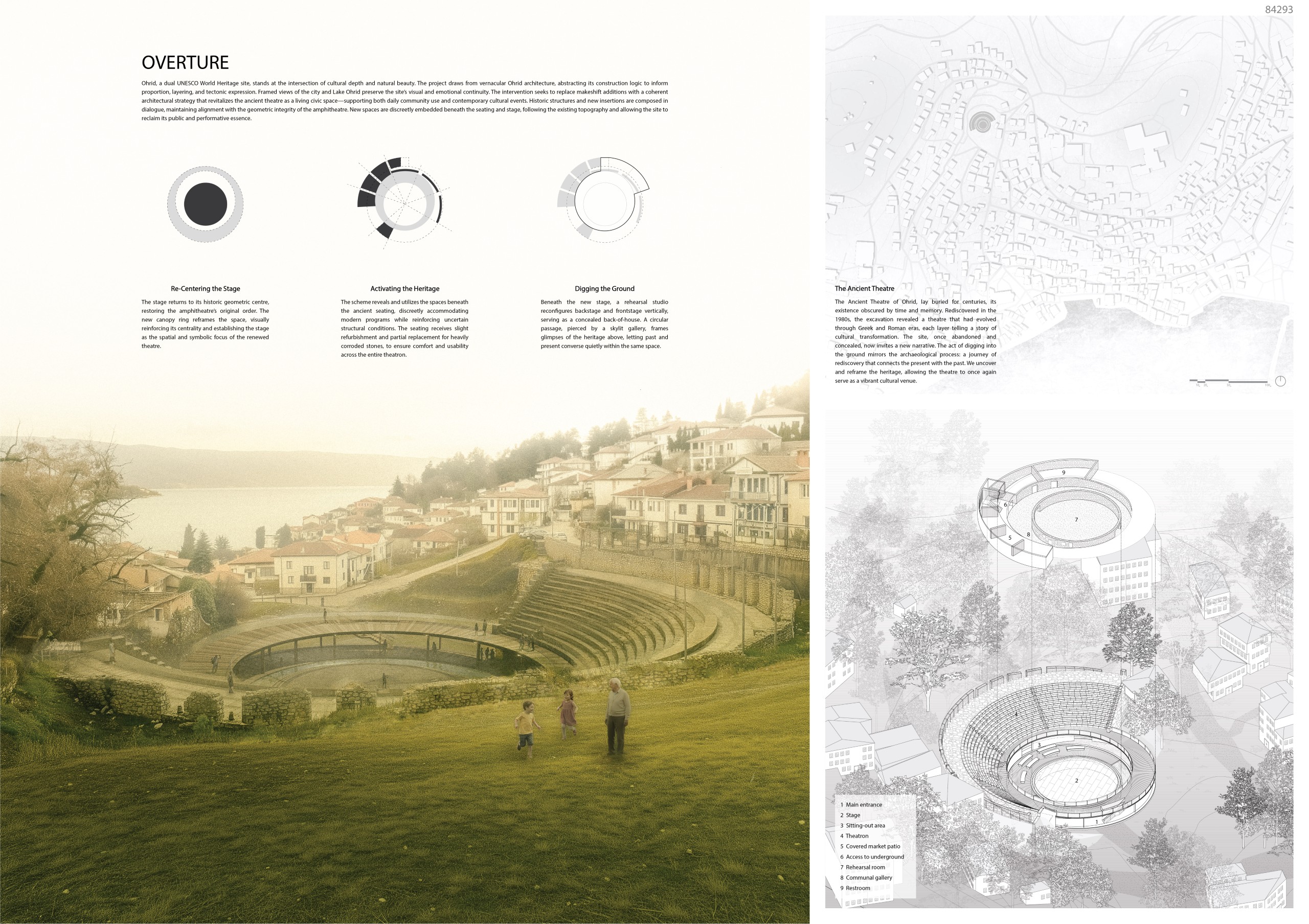
Ohrid, a dual UNESCO World Heritage site, stands at the intersection of cultural depth and natural beauty. The project draws from vernacular Ohrid architecture, abstracting its construction logic to inform proportion, layering, and tectonic expression. Framed views of the city and Lake Ohrid preserve the site’s visual and emotional continuity. The intervention seeks to replace makeshift additions with a coherent architectural strategy that revitalizes the ancient theatre as a living civic space—supporting both daily community use and contemporary cultural events. Historic structures and new insertions are composed in dialogue, maintaining alignment with the geometric integrity of the amphitheatre.
Re-Centering the Stage
The stage returns to its historic geometric centre, restoring the amphitheatre’s original order. The new canopy ring reframes the space, visually reinforcing its centrality and establishing the stage as the spatial and symbolic focus of the renewed theatre.
Activating the Heritage
The scheme reveals and utilizes the spaces beneath the ancient seating, discreetly accommodating modern programs while reinforcing uncertain structural conditions. The seating receives slight refurbishment and partial replacement for heavily corroded stones, to ensure comfort and usability across the entire theatron.
Digging the Ground
Beneath the new stage, a rehearsal studio reconfigures backstage and frontstage vertically, serving as a concealed back-of-house. A circular passage, pierced by a skylit gallery, frames glimpses of the heritage above, letting past and present converse quietly within the same space.
The Ancient Theatre
The Ancient Theatre of Ohrid, lay buried for centuries, its existence obscured by time and memory. Rediscovered in the 1980s, the excavation revealed a theatre that had evolved through Greek and Roman eras, each layer telling a story of cultural transformation. The site, once abandoned and concealed, now invites a new narrative. The act of digging into the ground mirrors the archaeological process: a journey of rediscovery that connects the present with the past.
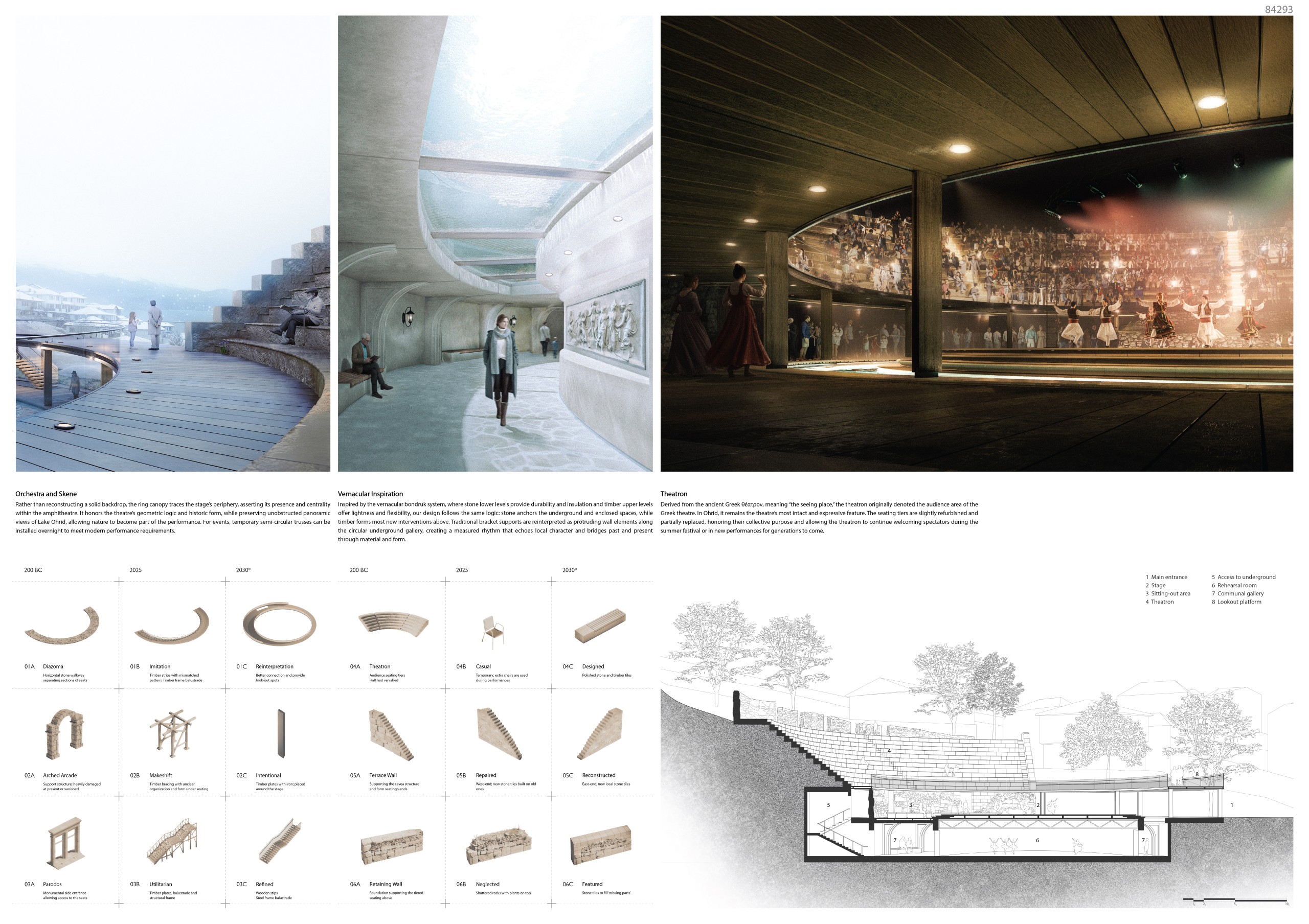
Orchestra and Skene
Rather than reconstructing a solid backdrop, the ring canopy traces the stage’s periphery, asserting its presence and centrality within the amphitheatre. It honors the theatre’s geometric logic and historic form, while preserving unobstructed panoramic views of Lake Ohrid, allowing nature to become part of the performance.
Vernacular Inspiration
Inspired by the vernacular bondruk system, where stone lower levels provide durability and insulation and timber upper levels offer lightness and flexibility, our design follows the same logic: stone anchors the underground and enclosed spaces, while timber forms most new interventions above. Traditional bracket supports are reinterpreted as protruding wall elements along the circular underground gallery, creating a measured rhythm that echoes local character and bridges past and present through material and form.
Theatron
Derived from the ancient Greek θέατρον, meaning “the seeing place,” the theatron originally denoted the audience area of the Greek theatre. In Ohrid, it remains the theatre’s most intact and expressive feature. The seating tiers are slightly refurbished and partially replaced, honoring their collective purpose and allowing the theatron to continue welcoming spectators during the summer festival or in new performances for generations to come.
JURY COMMENT
“The project successfully translates the site’s multiple values into a coherent whole that is capable of integrating with its context while maintaining its uniqueness. By framing the stage, digging the ground for new uses, and thoughtfully reusing traditional elements, it creates a new entity that may seem simple at first glance, yet embodies a deep and nuanced interpretative vision.”
Elisa Donini – Università La Sapienza
“This project achieves maximum impact through minimal intervention, demonstrating a deep respect for the existing historical build up. It maintains the essence of the original structure while reimagining the theater’s program with clarity and sensitivity, bridging heritage and contemporary use.”
Tianjian Li – Grimshaw Architects
2nd PRIZE
Lychnidos ex Machina
Lars Westhoff [Germany]
PROJECT DESCRIPTION
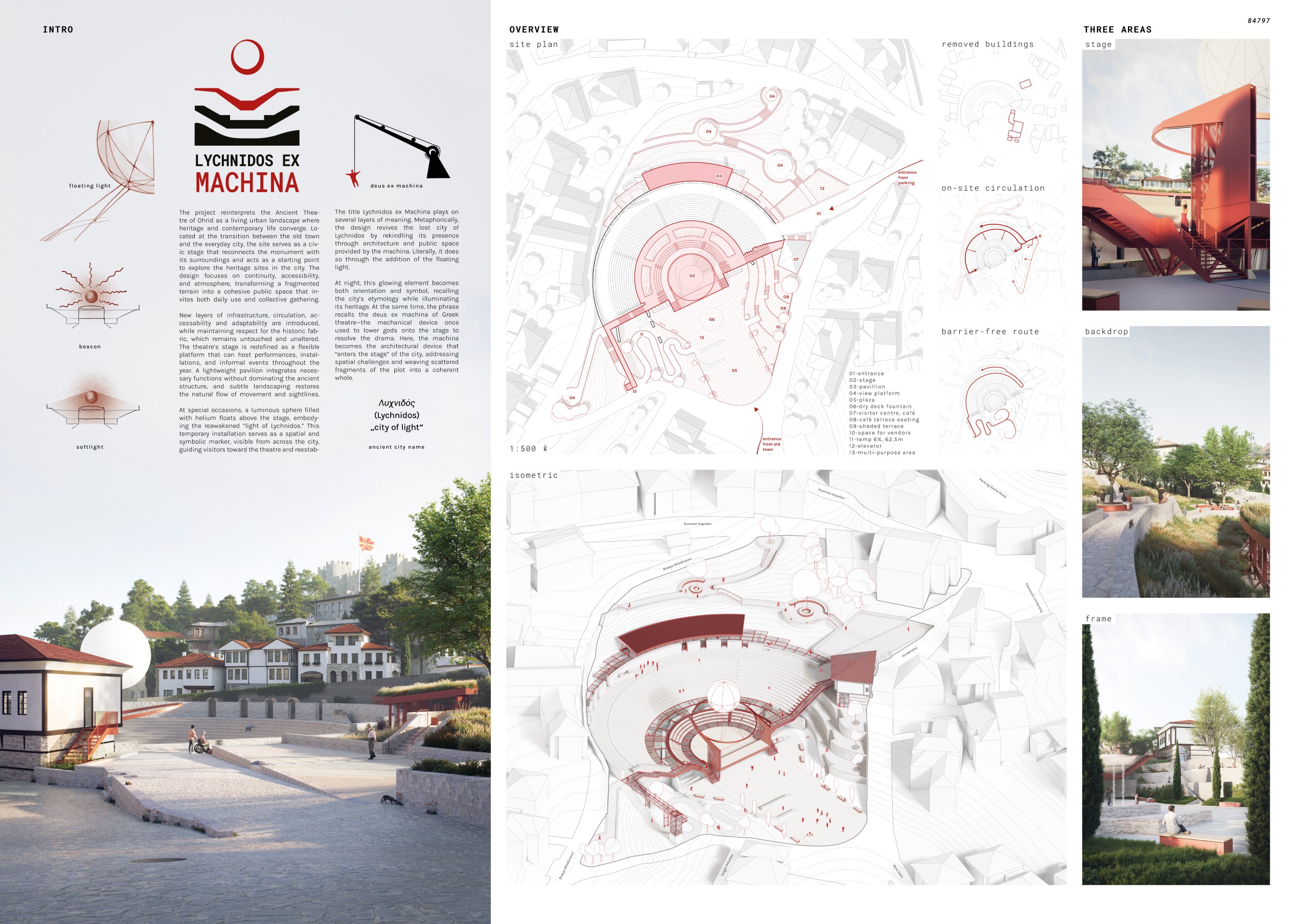
The project Lychnidos ex Machina reinterprets the Ancient Theatre of Ohrid as a living landscape where history and contemporary life converge. The proposal responds to the competition’s call for unity between architecture, landscape, and heritage by transforming the fragmented site into a coherent civic space that restores the theatre’s cultural presence while introducing new layers of public use.
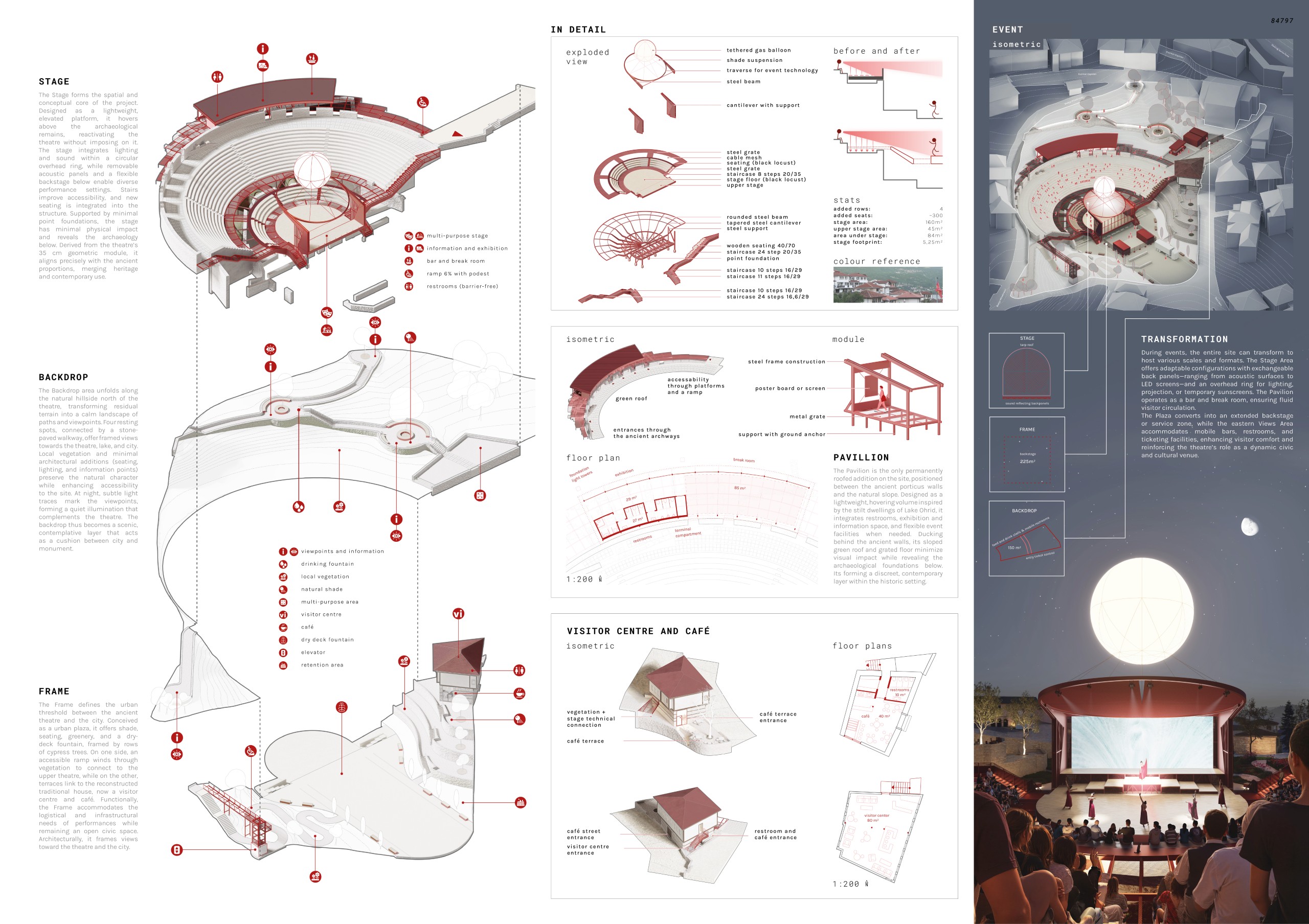
The site is organized into three interdependent zones: the Stage, the Frame, and the Backdrop. Together, they create a continuous landscape that respects archaeological remains while enhancing accessibility, legibility, and adaptability. The Stage forms the heart of the intervention. It is a lightweight, elevated platform that hovers above the ancient chorus. Its form extends outward, reconnecting performers and audience through renewed spatial continuity. The added walkways, stairs and seating is designed as transparent as possible, to allow for direct view of the ancient archaeological layers.
At the same time the stages modular system supports different configurations for concerts, performances, and civic events, offering both fixed and adaptable arrangements. A suspended ring above can hold lighting, projection, and sound systems. Mounted to it, a tethered helium sphere acts as the “light of Lychnidos”—a luminous beacon visible across the city, which can be deployed during special occasions to mark the theatre’s renewed presence.
Behind the ancient cavea, the project introduces a pavilion that introduces a flexible roofed space for exhibition and information, that transforms into a break room and bar during events. Restrooms are also located here. Embedded within the slope behind the theatre and hovering above the ancient foundations, the pavilion minimizes its visual and structural impact while revealing the archaeological foundations below.
The landscape becomes the connective tissue of the design. For coherence and circulation, new terraced paths, ramps, and steps weave between the upper and lower levels, improving accessibility while preserving archaeological integrity. The Frame is a new civic plaza that extends the theatre into the city fabric, hosting daily activities, small gatherings, and informal markets. The existing building on the site is restored and is used as visitor centre and café. Local vegetation, permeable surfaces, and integrated seating invite year-round use, reinforcing the theatre’s role as a social hinge between the old town and the everyday city.
The Backdrop area unfolds along the natural hillside north of the theatre, transforming residual terrain into a calm landscape of paths and viewpoints. Four resting spots, connected by a stone-paved walkway, offer framed views towards the theatre, lake, and city. Local vegetation and minimal architectural additions preserve quality of stay and enhanceaccessibility to the site.
Through its layered approach, Lychnidos ex Machina directly answers the competition’s objectives: the new stage and pavilion provide a renewed identity, the landscape unites the fragmented terrain, and the small interventions bring comfort and continuity. The project preserves authenticity through reversibility and lightness, while allowing the theatre to function once more as a civic stage for performance, encounter, and reflection—reviving the spirit of Lychnidos for the city of today.
JURY COMMENT
“The project presents a strong concept narrative and a clear identity between the existing theatre and the proposed interventions. Landscape, new and reused structures, texture, and the central art installation create a coherent composition that create a sense of belonging to Ohrid.”
Kyriakos Chatziparaskevas – Heatherwick Studio
3rd PRIZE
TERRA
Anıl Sidar İldan [Germany]
PROJECT DESCRIPTION
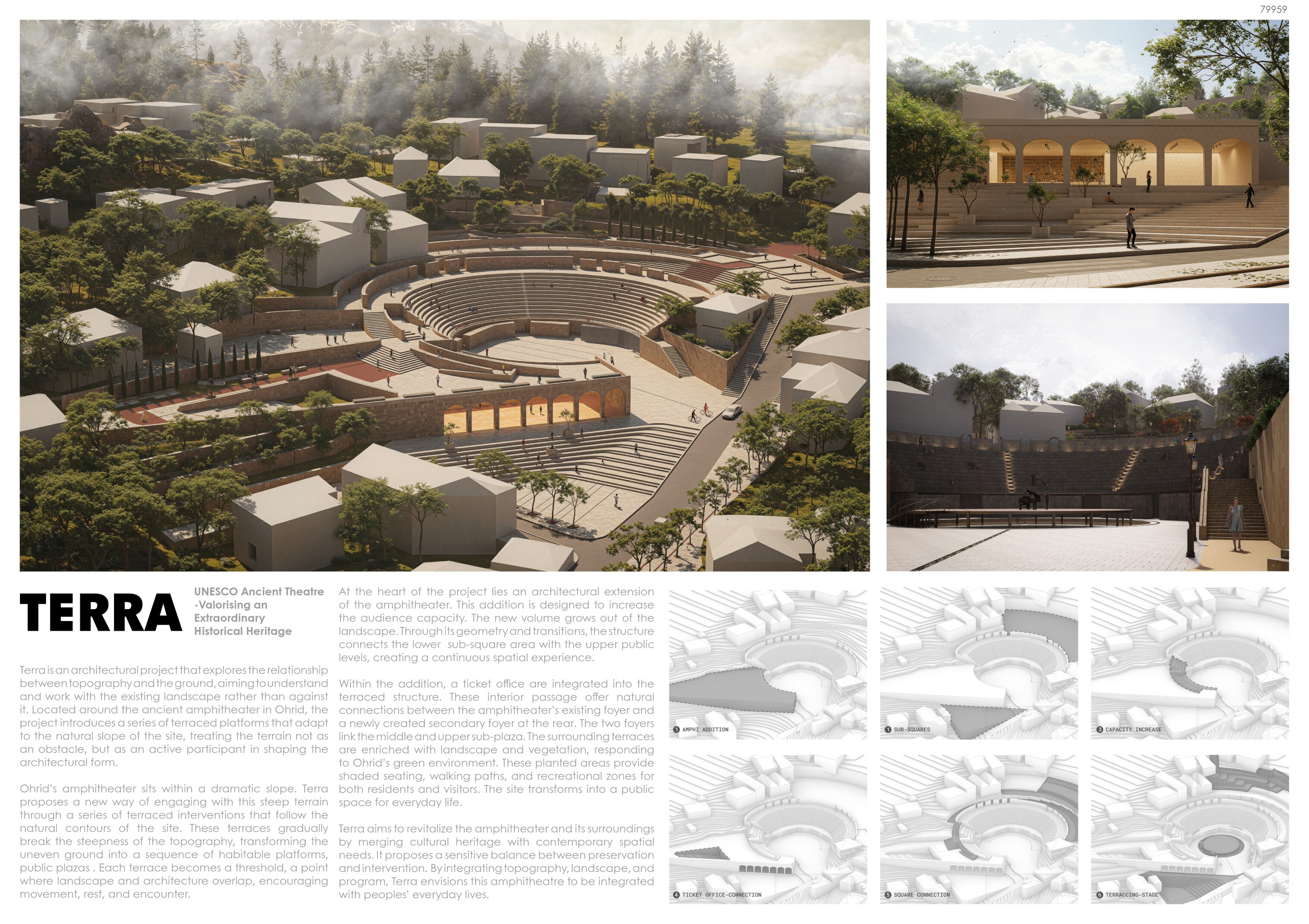
Terra is an architectural project that explores the relationship between topography and the ground, aiming to understand and work with the existing landscape rather than against it. Located around the ancient amphitheater in Ohrid, the project introduces a series of terraced platforms that adapt to the natural slope of the site, treating the terrain not as an obstacle, but as an active participant in shaping the architectural form.
Ohrid’s amphitheater sits within a dramatic slope. Terra proposes a new way of engaging with this steep terrain through a series of terraced interventions that follow the natural contours of the site. These terraces gradually break the steepness of the topography, transforming the uneven ground into a sequence of habitable platforms, public plazas . Each terrace becomes a threshold, a point where landscape and architecture overlap, encouraging movement, rest, and encounter.
At the heart of the project lies an architectural extension of the amphitheater. This addition is designed to increase the audience capacity. The new volume grows out of the landscape. Through its geometry and transitions, the structure connects the lower sub-square area with the upper public levels, creating a continuous spatial experience.
Within the addition, a ticket office are integrated into the terraced structure. These interior passageoffer natural connections between the amphitheater’s existing foyer and a newly created secondary foyer at the rear. The two foyers link the middle and upper sub-plaza. The surrounding terraces are enriched with landscape and vegetation, responding to Ohrid’s green environment. These planted areas provide shaded seating, walking paths, and recreational zones for both residents and visitors. The site transforms into a public space for everyday life.
Terra aims to revitalize the amphitheater and its surroundings by merging cultural heritage with contemporary spatial needs. It proposes a sensitive balance between preservation and intervention. By integrating topography, landscape, and program, Terra envisions this amphitheatre to be integrated with peoples’ everyday lives.
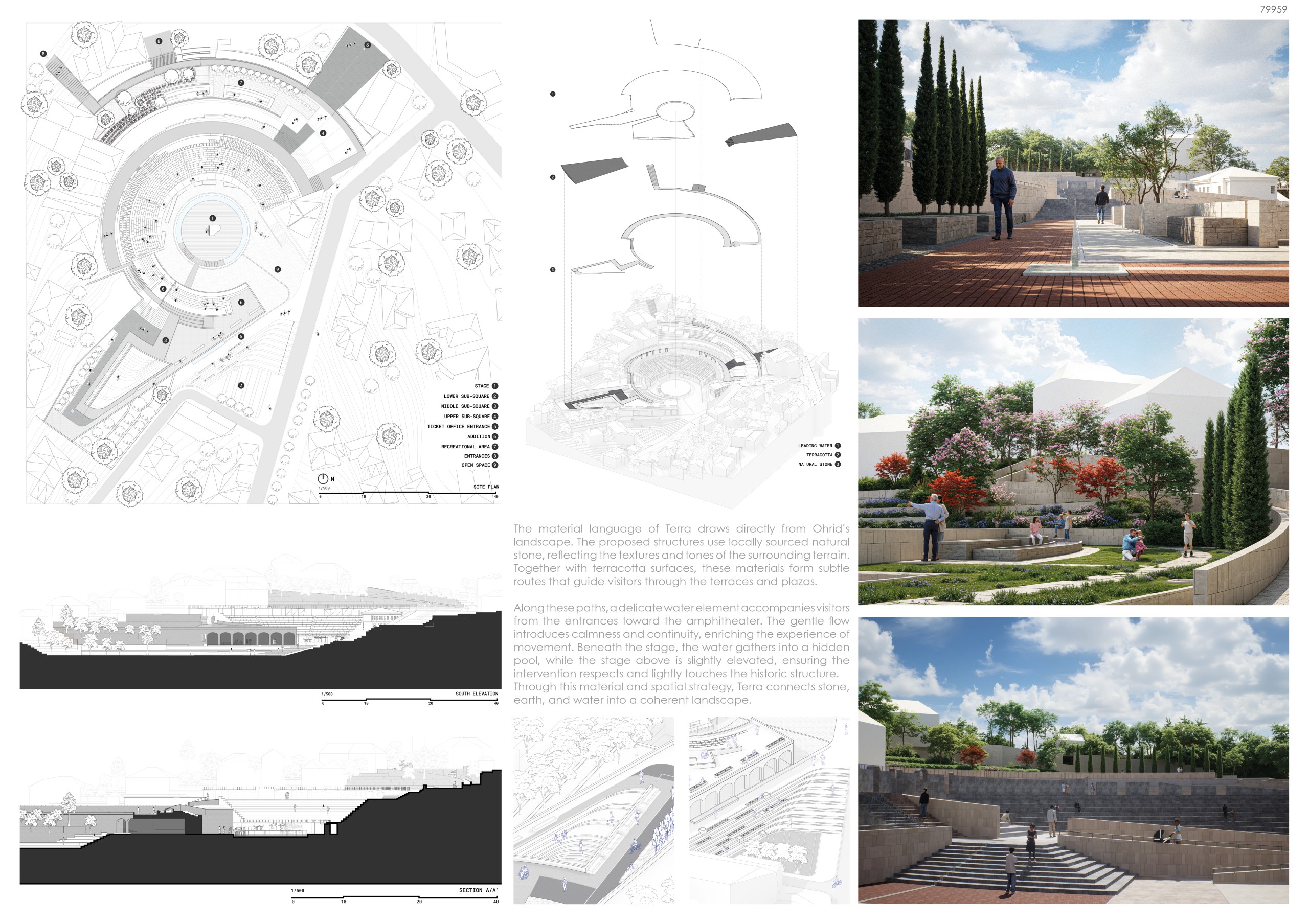
The material language of Terra draws directly from Ohrid’s landscape. The proposed structures use locally sourced natural stone, reflecting the textures and tones of the surrounding terrain. Together with terracotta surfaces, these materials form subtle routes that guide visitors through the terraces and plazas.
Along these paths, a delicate water element accompanies visitors from the entrances toward the amphitheater. The gentle flow introduces calmness and continuity, enriching the experience of movement. Beneath the stage, the water gathers into a hidden pool, while the stage above is slightly elevated, ensuring the intervention respects and lightly touches the historic structure. Through this material and spatial strategy, Terra connects stone, earth, and water into a coherent landscape.
JURY COMMENT
“In an orderly and contemporary manner, the project integrates the architectural program into the heritage site with respect and balance. It complements the urban and heritage language through a volumetric and material response that blends with the existing natural and urban landscape, bringing coherence and sobriety to the intervention.”
René Daniels – We Are Size
Golden Mentions
(ordered by registration code)
MIRAGE
Nathan Ma [Hong Kong]
PROJECT DESCRIPTION
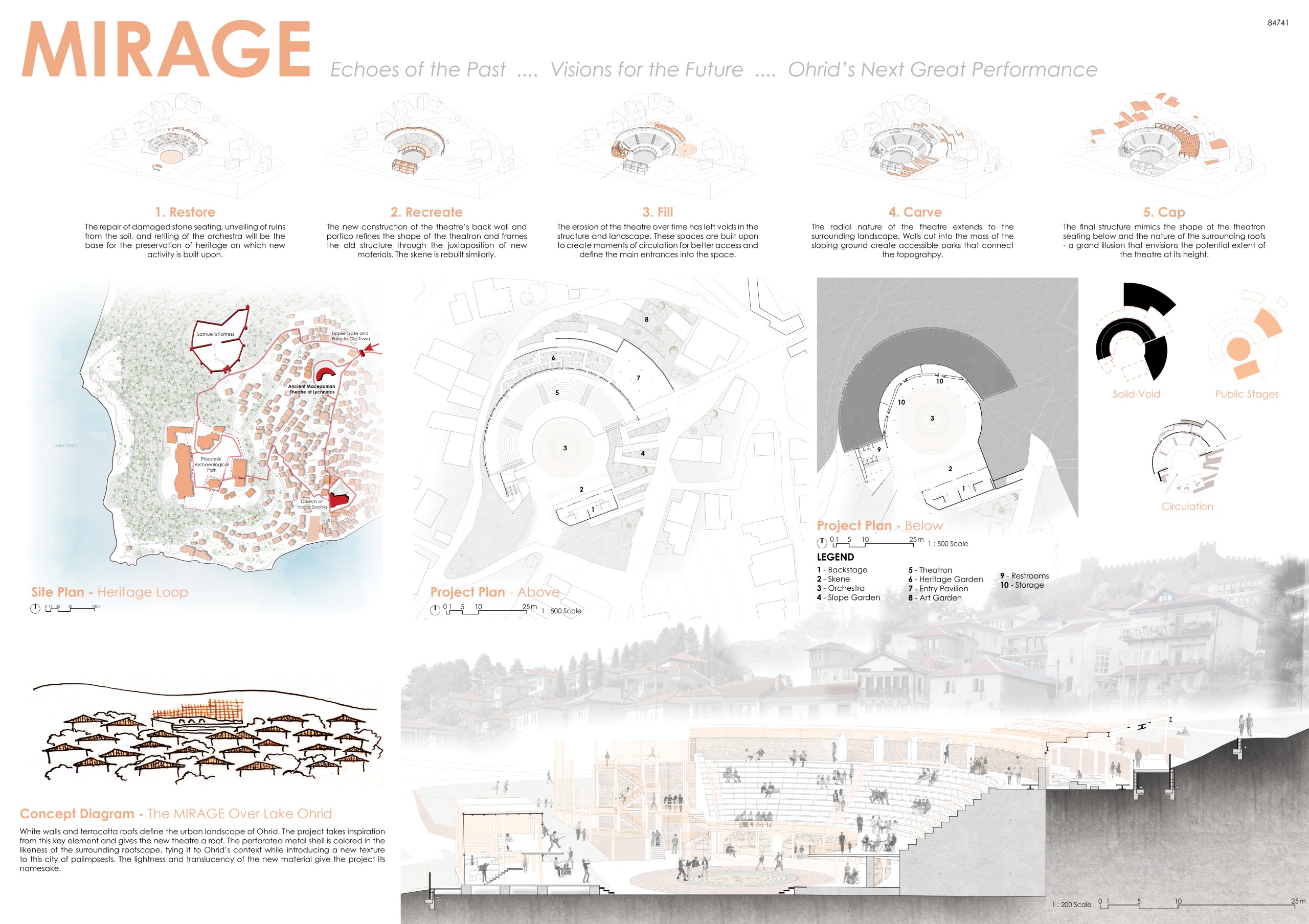
Where the ancient theatre of Ohrid stands, I see a MIRAGE – Echoes of the past, Visions of the Future, and Ohrid’s next great performance.
Echoes of the Past
The maintenance of the theatre’s remains is paramount to the expression of place and time. The seating area is to be cleaned, with damaged stones restored in the likeness of the original material texture.
The Northern area where fragments of the ancient theatre are located should be trimmed and weeded such that the former structural base is exposed, giving a hint at the theatre’s former expanse and grandeur.
Most importantly, the central orchestra will be restored through the classical method of terrasse, as is tradition in theatres like such. A ceramic tapestry woven together by local artisans and craftsmanship will mark this area as the central space, creating an image that is of Ohrid, for Ohrid.
Visions of the Future
Not all ruin can be fully restored, but the cracks formed from the test of time leave much to the imagination and beyond. Modern materials of steel beams and perforated sheet metal fill the eroded gaps, adding a new layer to this city of palimpsests.
These materials will be used to recreate the likeness of the second section of theatre believed to extend beyond the theatre’s current mass. The structure becomes a pavilion that complements the central space, earning the theatre a new entry way from the main city gate.
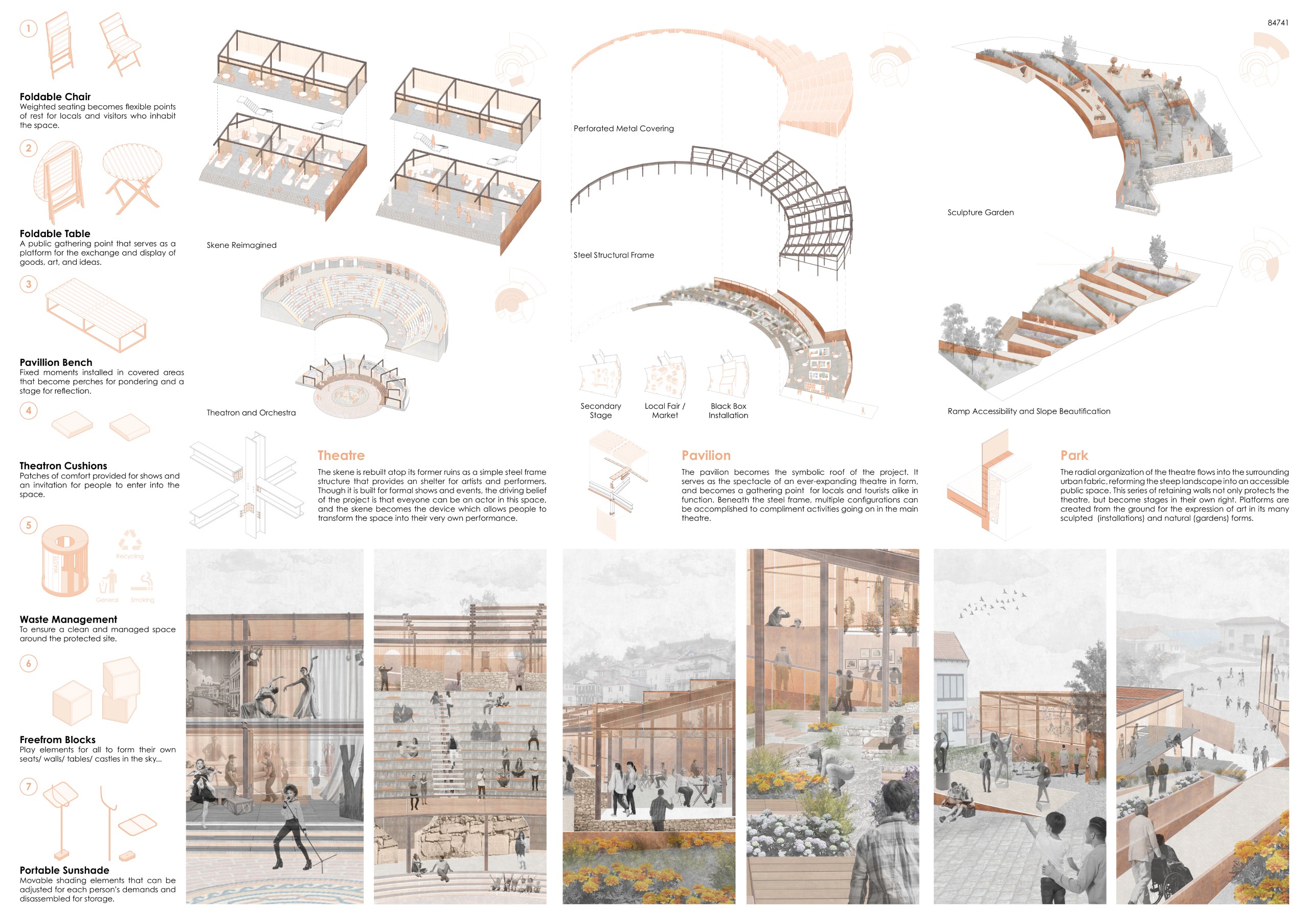
These materials will also be used to reimagine the skene, building upon the functional needs of such a stage, and providing a basic structure from which multiple types of performances can be built upon. Modern lighting, sound, and display technology will act as a supplement to the theatre’s purpose.
The translucent nature of these materials gives the MIRAGE project its namesake – a wondrous illusion over Lake Ohrid.
Ohrid’s Next Great Performance
Program and street furniture give visitors and locals the means to enjoy the various spaces. Circulation via pathways, stairs and stepped landscapes reconnect the once isolated theatre to the greater urban landscape, creating a transition between the daily lives of people and that of the MIRAGE theatre’s activities.
With this, the space around the theatre becomes art and dance, it becomes a farmer’s market, it becomes a history lesson, and a shared space of gathering and exchange for all who enter.
In its activation, the theatre comes to life once again, and the MIRAGE is complete. Because more than urban spaces, more than ancient stone, what truly makes a project is people – the greatest actors in this beautiful city of terracotta roofs and vibrant histories.
JURY COMMENT
“The project offers an improved functional solution for the theatre, achieving multifunctionality through a transformable design capable of supporting diverse events.”
Simona Chingoska – Arhrid
Dualities
Lucy Dragancheva, Mariia Apostolova, Dimitriy Lotash, Georgii Chernyshov [Bulgaria – Russia – Kazakhstan]
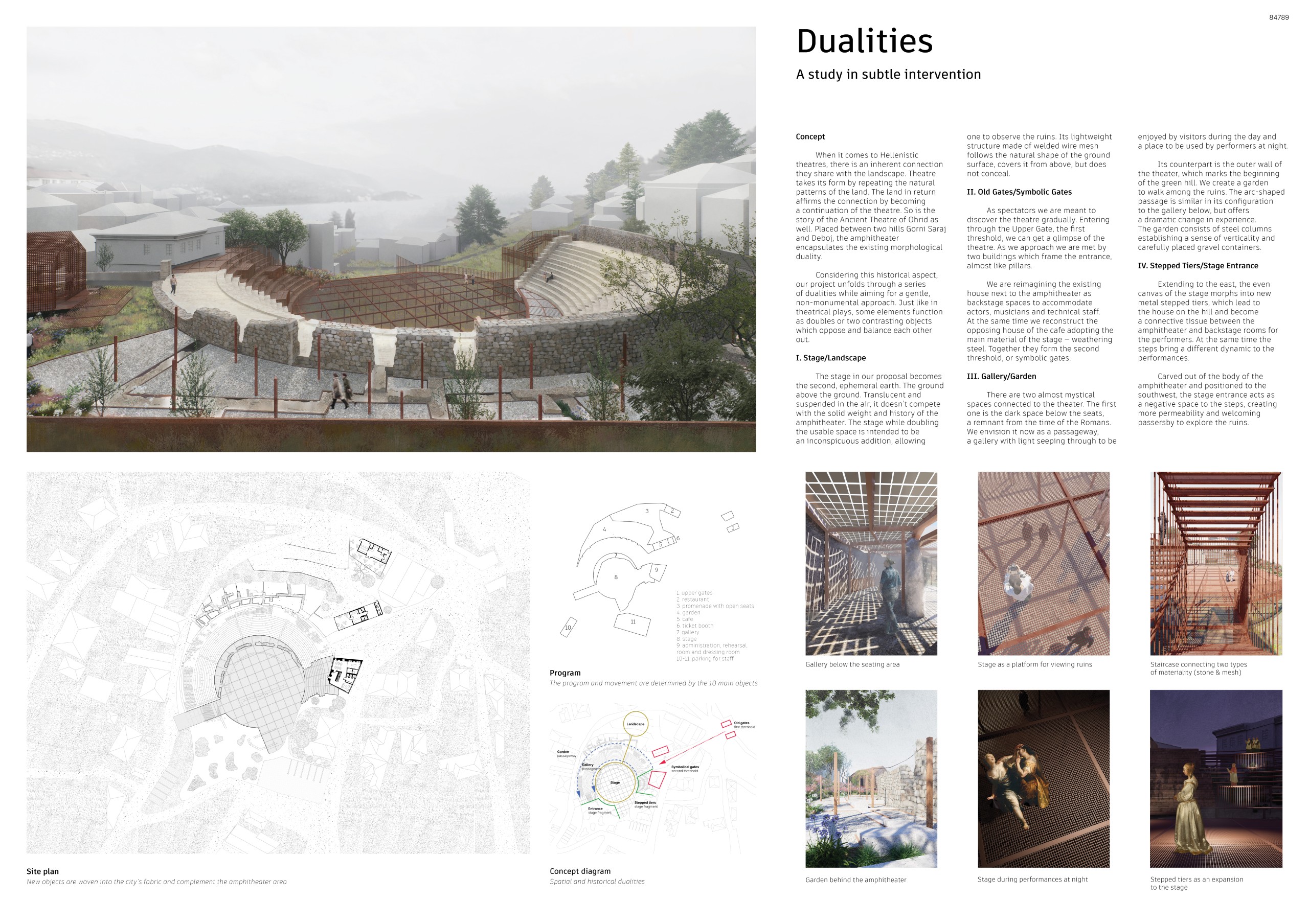
PROJECT DESCRIPTION
When it comes to Hellenistic theatres, there is an inherent connection they share with the landscape. Theatre takes its form by repeating the natural patterns of the land. The land in return affirms the connection by becoming a continuation of the theatre. So is the story of the Ancient Theatre of Ohrid as well. Placed between two hills Gorni Saraj and Deboj, the amphitheater encapsulates the existing morphological duality.
Considering this historical aspect, our project unfolds through a series of dualities while aiming for a gentle, non-monumental approach. Just like in theatrical plays, some elements function as doubles or two contrasting objects which oppose and balance each other out.
I. Stage/Landscape
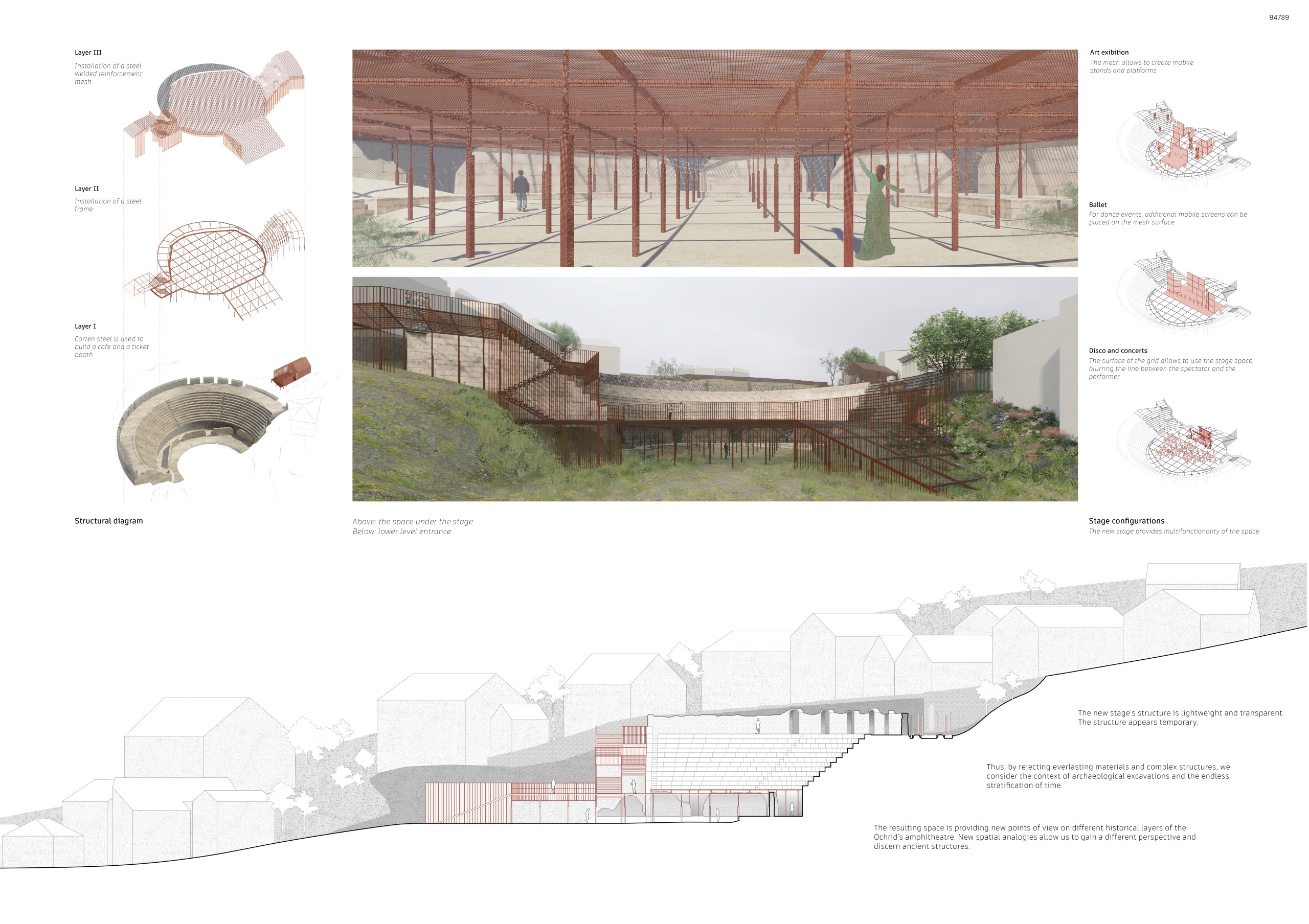
The stage in our proposal becomes the second, ephemeral earth. The ground above the ground. Translucent and suspended in the air, it doesn’t compete with the solid weight and history of the amphitheater. The stage while doubling the usable space is intended to be an inconspicuous addition, allowing one to observe the ruins. Its lightweight structure made of welded wire mesh follows the natural shape of the ground surface, covers it from above, but does not conceal.
II. Old Gates/Symbolic Gates
As spectators we are meant to discover the theatre gradually. Entering through the Upper Gate, the first threshold, we can get a glimpse of the theatre. As we approach we are met by two buildings which frame the entrance, almost like pillars. We are reimagining the existing house next to the amphitheater as backstage spaces to accommodate actors, musicians and technical staff. At the same time we reconstruct the opposing house of the cafe adopting the main material of the stage — weathering steel. Together they form the second threshold, or symbolic gates.
III. Gallery/Garden
There are two almost mystical spaces connected to the theater. The first one is the dark space below the seats, a remnant from the time of the Romans. We envision it now as a passageway, a gallery with light seeping through to be enjoyed by visitors during the day and a place to be used by performers at night.
Its counterpart is the outer wall of the theater, which marks the beginning of the green hill. We create a garden to walk among the ruins. The arc-shaped passage is similar in its configuration to the gallery below, but offers a dramatic change in experience. The garden consists of steel columns establishing a sense of verticality and carefully placed gravel containers.
IV. Stepped tiers/Stage entrance
Extending to the east, the even canvas of the stage morphs into new metal stepped tiers, which lead to the house on the hill and become a connective tissue between the amphitheater and backstage rooms for the performers. At the same time the steps bring a different dynamic to the performances.
Carved out of the body of the amphitheater and positioned to the southwest, the stage entrance acts as a negative space to the steps, сreating more permeability and welcoming passersby to explore the ruins.
JURY COMMENT
“This project distinguishes itself through an exceptional conceptual vision — the idea of the “second, ephemeral earth” stage introduces a poetic yet precise redefinition of performance and heritage. Its lightweight, translucent structure hovers above the ruins, enhancing rather than obscuring the archaeological remains. The result is an elegant and intellectually mature synthesis that transforms the theatre into a living dialogue between time, memory, and architecture.”
Merve Güleryüz Çohadar – Balvin Architects
Path of Lychnidos
Andrew Mattessich, Alexa Patel, Luis Cardona, Austin Scott, Zack Cundey [United States]
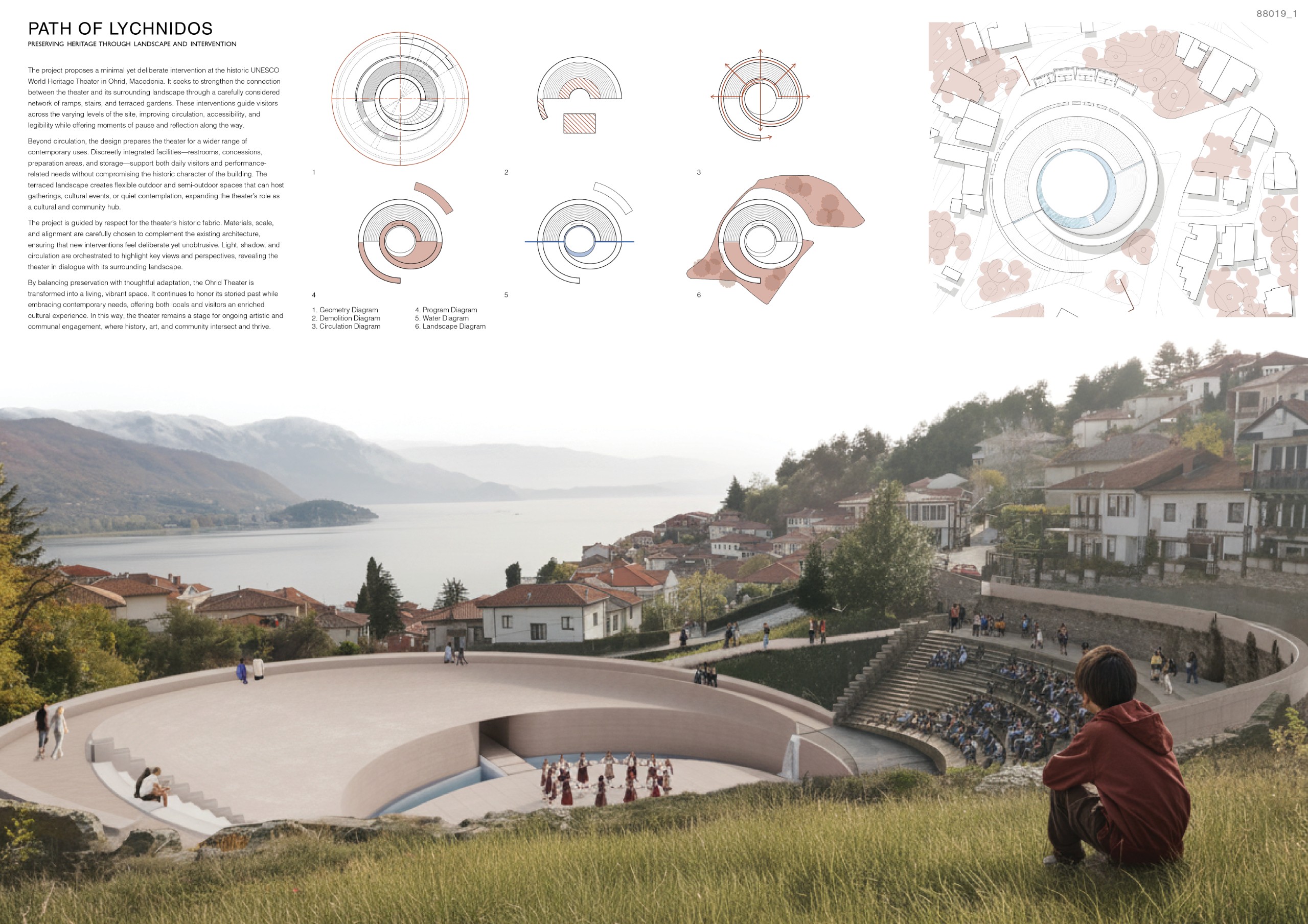
PROJECT DESCRIPTION
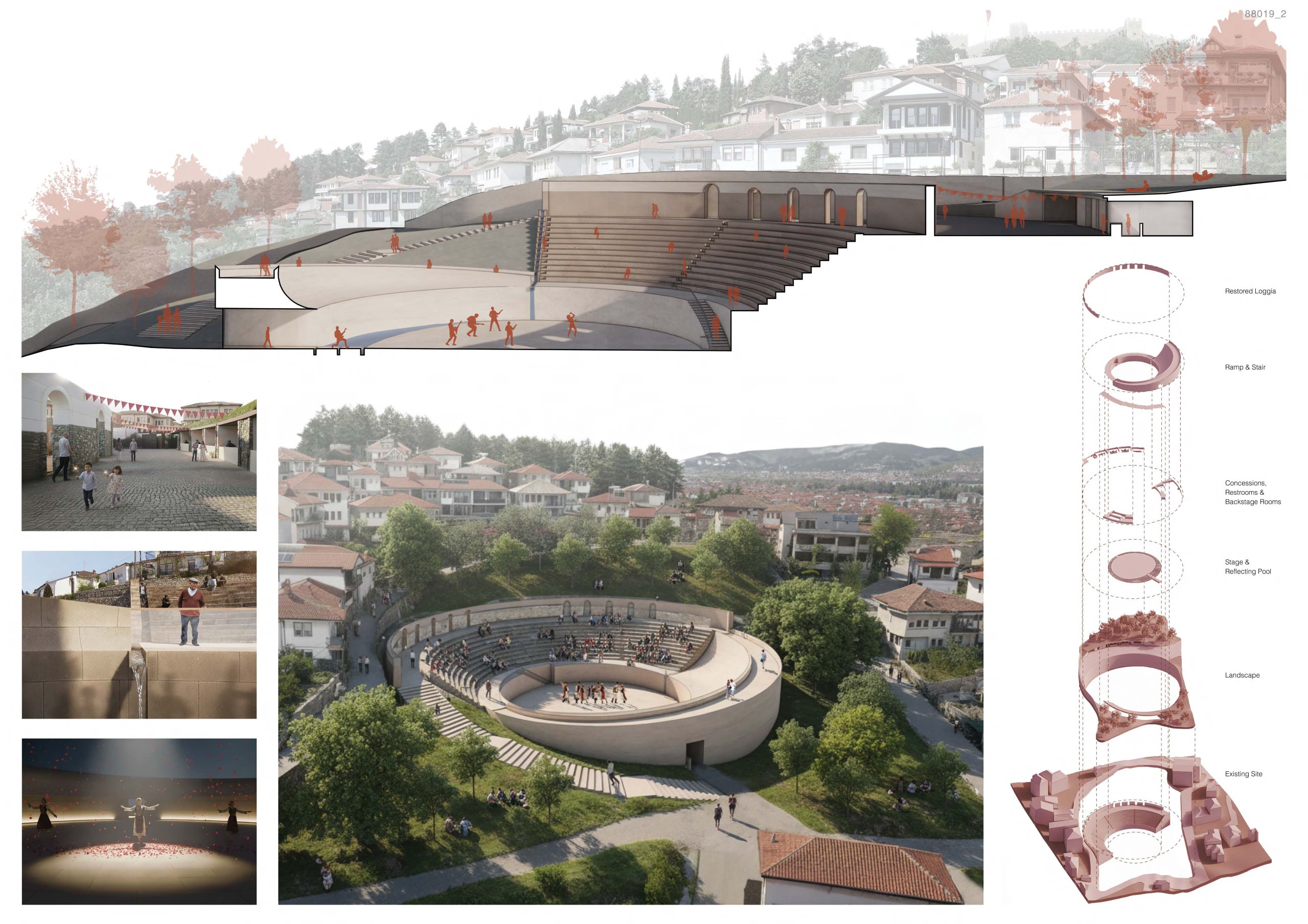
The project proposes a minimal yet deliberate intervention at the historic UNESCO World Heritage Theater in Ohrid, Macedonia. It seeks to strengthen the connection between the theater and its surrounding landscape through a carefully considered network of ramps, stairs, and terraced gardens. These interventions guide visitors across the varying levels of the site, improving circulation, accessibility, and legibility while offering moments of pause and reflection along the way.
Beyond circulation, the design prepares the theater for a wider range of contemporary uses. Discreetly integrated facilities such as restrooms, concessions, storage, and backstage rooms support both daily visitors and performance related needs without compromising the historic character of the building. The terraced landscape creates flexible outdoor and semi-outdoor spaces that can host gatherings, cultural events, or quiet contemplation, expanding the theater’s role as a cultural and community hub.
The project is guided by respect for the theater’s historic fabric. Materials, scale, and alignment are carefully chosen to complement the existing architecture, ensuring that new interventions feel deliberate yet unobtrusive. Light, shadow, and circulation are orchestrated to highlight key views and perspectives, revealing the theater in dialogue with its surrounding landscape.
By balancing preservation with thoughtful adaptation, the Ohrid Theater is transformed into a living, vibrant space. It continues to honor its storied past while embracing contemporary needs, offering both locals and visitors an enriched cultural experience. In this way, the theater remains a stage for ongoing artistic and communal engagement, where history, art, and community intersect and thrive.
JURY COMMENT
“Minimal, subtle and visually striking addition to the theatre with sensitive use of materials and textures. The project emphasizes the breathtaking views of the lake.”
Simona Chingoska – Arhrid
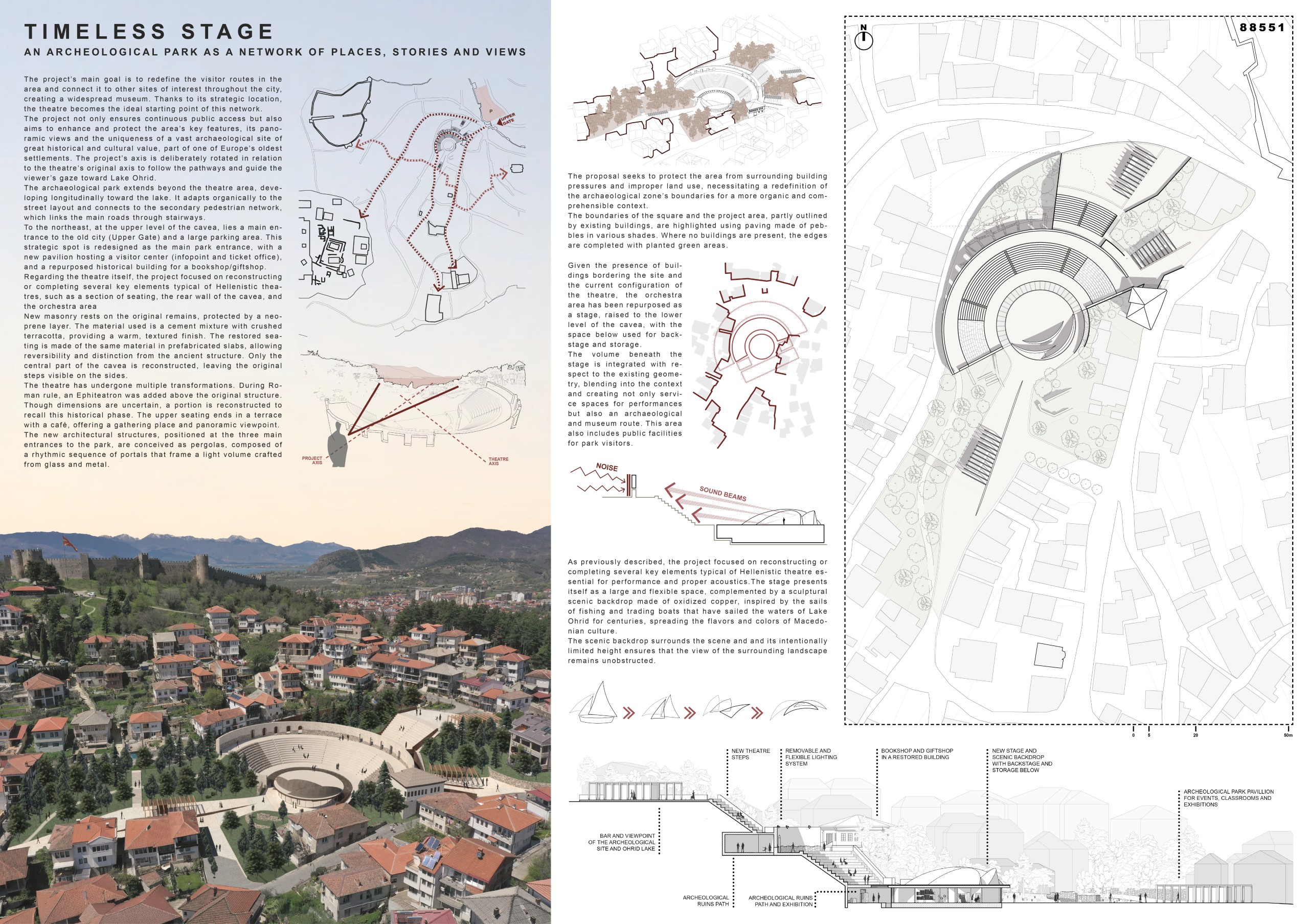
TIMELESS STAGE – An archeological park as a network of places, stories and views
Bruna Galbusera, Chiara Chendi, Laura Bruno [Italy]
PROJECT DESCRIPTION
The project’s main goal is to redefine the visitor routes in the area and connect it to other sites of interest throughout the city, creating a widespread museum. Thanks to its strategic location, the theatre becomes the ideal starting point.
The project not only ensures continuous public access but also aims to enhance and protect the area’s key features, its panoramic views and the uniqueness of a vast archaeological site of great historical and cultural value, part of one of Europe’s oldest settlements. It also seeks to shield the area from urban pressure and misuse, requiring a clearer definition of the archaeological boundaries for a more coherent layout.
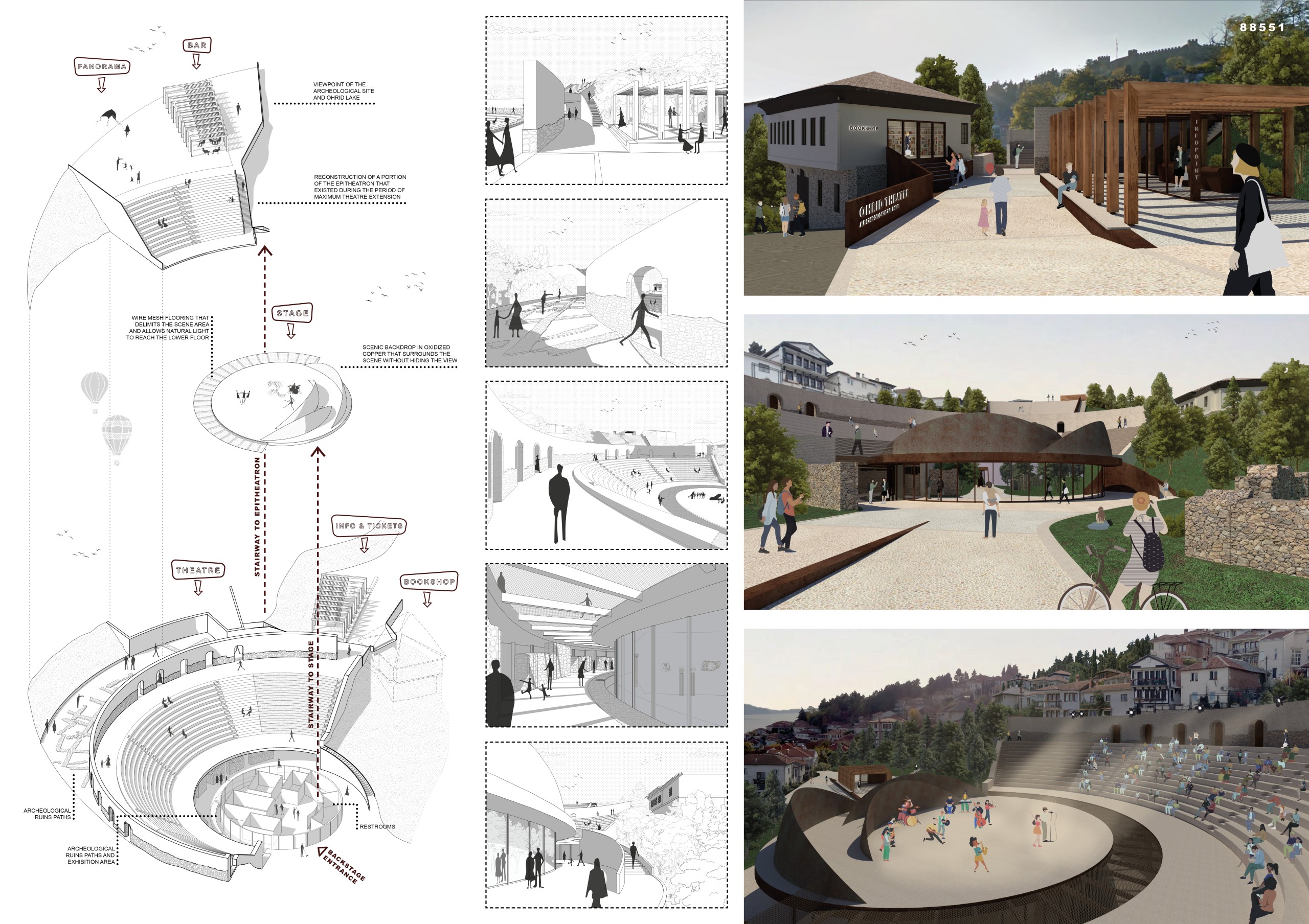
To the northeast, at the upper level of the cavea, lies a main entrance to the old city (Upper Gate) and a large parking area. This strategic spot is redesigned as the main park entrance, with a new pavilion hosting a visitor center (infopoint and ticket office), and a repurposed historical building for a bookshop/giftshop.
The theatre intervention focuses on reconstructing key elements of Hellenistic theatres, part of the seating, the rear wall of the cavea, and the orchestra, all essential for performance use and proper acoustics.
New masonry rests on the original remains, protected by a neoprene layer. The material used is a cement mixture with crushed terracotta, providing a warm, textured finish. The restored seating is made of the same material in prefabricated slabs, allowing reversibility and distinction from the ancient structure. Only the central part of the cavea is reconstructed, leaving the original steps visible on the sides.
Due to the surrounding buildings and the current shape of the theatre, the orchestra becomes a raised stage, using the space beneath for backstage and storage.
The new stage is spacious and versatile, with a scenic backdrop made of oxidized copper, inspired by the sails of traditional boats on Lake Ohrid. As part of an archaeological site, the stage is intentionally “unfinished,” allowing adaptable setups for various performances.
The volume under the stage integrates with the existing geometry and houses not only service areas but also a museum path. On one side are the theatre’s substructures, and on the other, display cases for artifacts with no fixed placement or requiring protection.
This area also includes public restrooms for visitors and spectators.
The theatre has undergone multiple transformations. During Roman rule, an Ephiteatron was added above the original structure. Though dimensions are uncertain, a portion is reconstructed to recall this historical phase. The upper seating ends in a terrace with a café, offering a gathering place and panoramic viewpoint.
The project axis is intentionally rotated to follow pedestrian paths and direct the view toward Lake Ohrid.
The archaeological park extends beyond the theatre, following the street layout and connecting with secondary pedestrian paths. A new square, functioning as the theatre foyer, hosts a multifunctional pavilion for exhibitions, events, or educational use.
Its edges, partly delineated by existing buildings, are defined with pebble paving in varying shades and tree-lined green areas.
JURY COMMENT
“The proposal’s intention to integrate with the historical context results in minimal interventions, providing adequate program in a single spatial extension and connecting to all the main nodes around the site. The sensitive approach showcases cultural sensitivity by the integration and accentuation of the visible archaeological findings and retaining the view towards the landscape/lake. The duality in material choices serves both to emphasize the intervention’s modernity and to heighten the dialogue between old and new, fostering a dynamic identity for the renewed theatre environment.”
Tea Damjanovska – Ss. Cyril & Methodius University
Hollow
Avisa Yazdani, HamedKamalzadeh, Mohammad Razavizadeh, Omid Golshan [United Kingdom – Iran]
PROJECT DESCRIPTION
A Multi-Mise–en–Scène Theatre
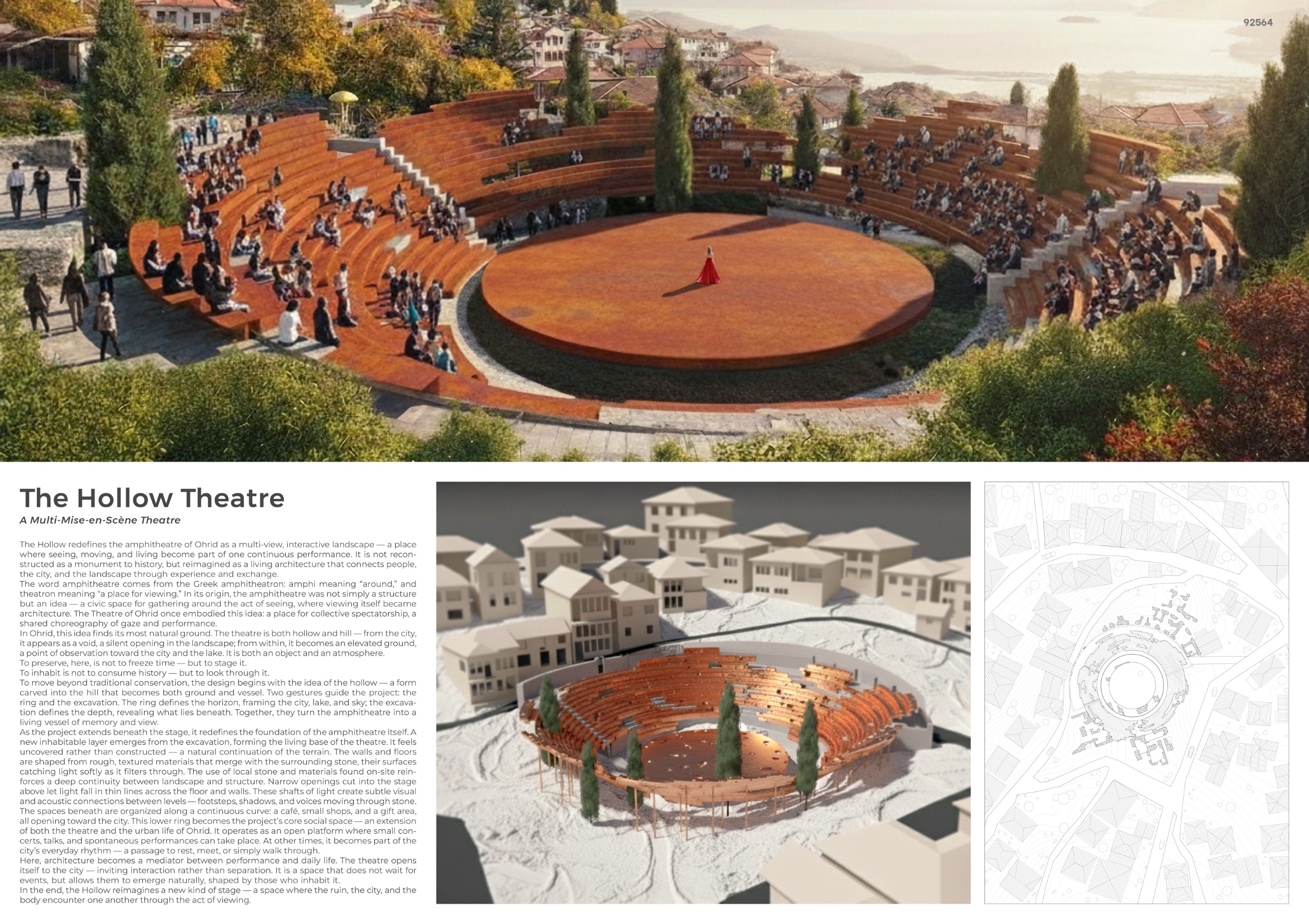
The Hollow redefines the amphitheatre of Ohrid as a multi-view, interactive landscape — a place where seeing, moving, and living become part of one continuous performance. It is not reconstructed as a monument to history, but reimagined as a living architecture that connects people, the city, and the landscape through experience and exchange.
The word amphitheatre comes from the Greek amphitheatron: amphi meaning “around,” and theatron meaning “a place for viewing.” In its origin, the amphitheatre was not just a structure but an idea — a civic space for gathering around the act of seeing, where viewing itself became architecture. The Theatre of Ohrid once embodied this: a place for collective spectatorship, a shared choreography of gaze and performance.
In Ohrid, this idea finds its most natural ground. The theatre is both hollow and hill — from the city, it appears as a void, a quiet opening in the landscape; from within, it becomes an elevated point of observation toward the city and lake. It is both an object and an atmosphere — a place layered with time, memory, and movement.
To preserve, here, is not to freeze time — but to stage it.
To inhabit is not to consume history — but to look through it.
To move beyond traditional conservation, the design begins with the idea of the hollow — a form carved into the hill that becomes both ground and vessel. Two gestures guide the project: the ring and the excavation. The ring defines the horizon, framing the city, lake, and sky; the excavation defines the depth, revealing what lies beneath. Together, they turn the amphitheatre into a living vessel of memory and view.
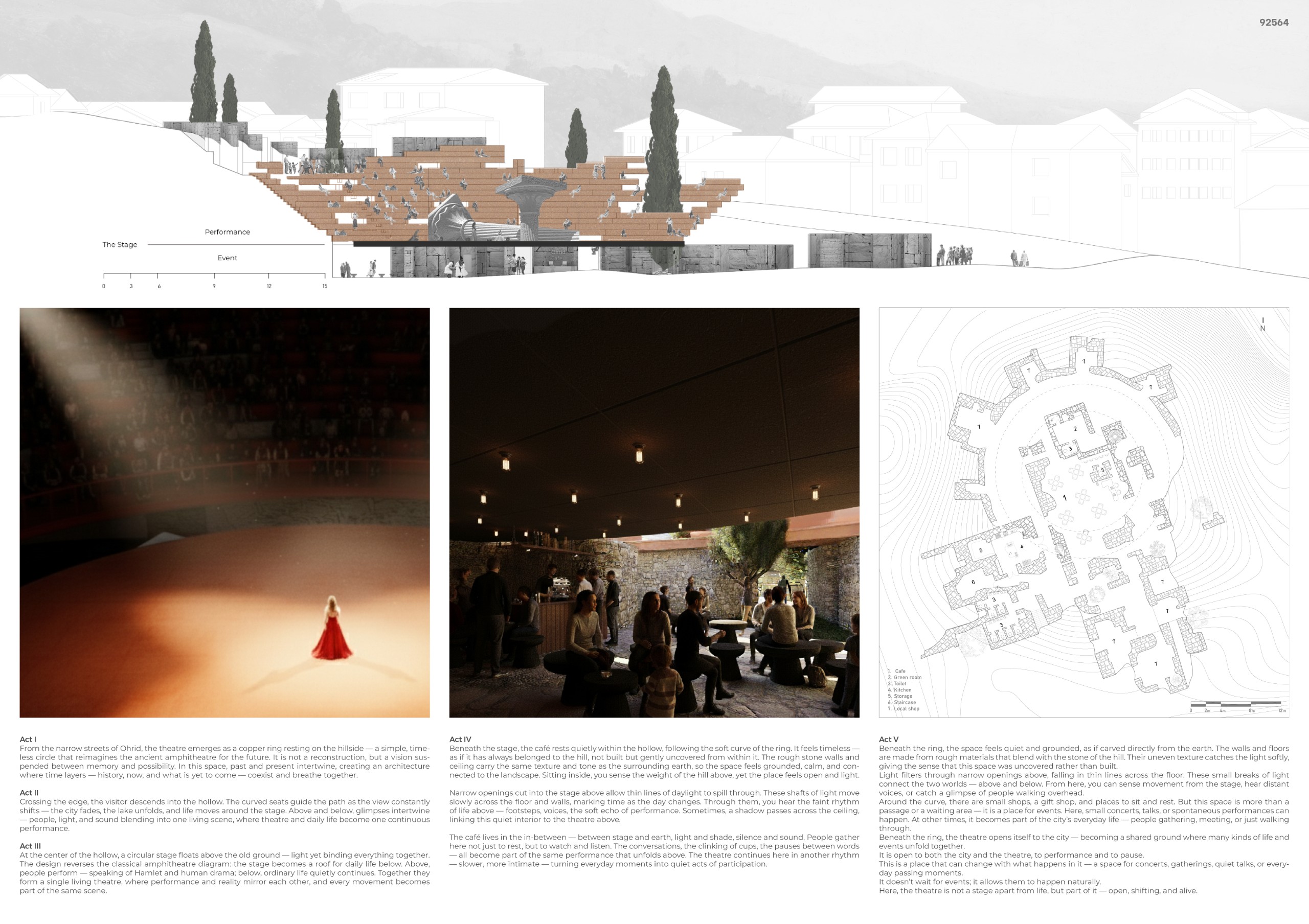
As the project extends beneath the stage, it redefines the foundation of the amphitheatre. A new inhabitable layer emerges from the excavation, forming the living base of the theatre. It feels uncovered rather than constructed — a natural continuation of the terrain. The rough stone walls and floors merge with the hill, their uneven textures catching light softly as it filters through narrow openings cut into the stage above. These shafts of light create subtle visual and acoustic connections between levels — footsteps, shadows, and voices moving through stone.
The spaces beneath are organized along a continuous curve: a café, small shops, and a gift area, all opening toward the city. This lower ring becomes the project’s core social space — an extension of both the theatre and the urban life of Ohrid. It operates as an open platform where small concerts, talks, and spontaneous performances can take place. At other times, it becomes part of the city’s everyday rhythm — a passage to rest, meet, or simply walk through.
Here, architecture becomes a mediator between performance and daily life. The theatre opens itself to the city — inviting interaction rather than separation. It is a space that does not wait for events, but allows them to emerge naturally, shaped by those who inhabit it.
In the end, the Hollow reimagines a new kind of stage — a space where the ruin, the city, and the body encounter one another through the act of viewing.
JURY COMMENT
“Here, the massive stone structure of the old theatre is completed and refined by a thin, light, and elegant intervention that transforms the original semi-circular plan into a full circle. The theatre remains a void within the city, allowing uninterrupted views that embrace both the lake and the urban landscape.”
Elena Cantoni – Studio Schwitalla
Honorable Mentions
(ordered by registration code)
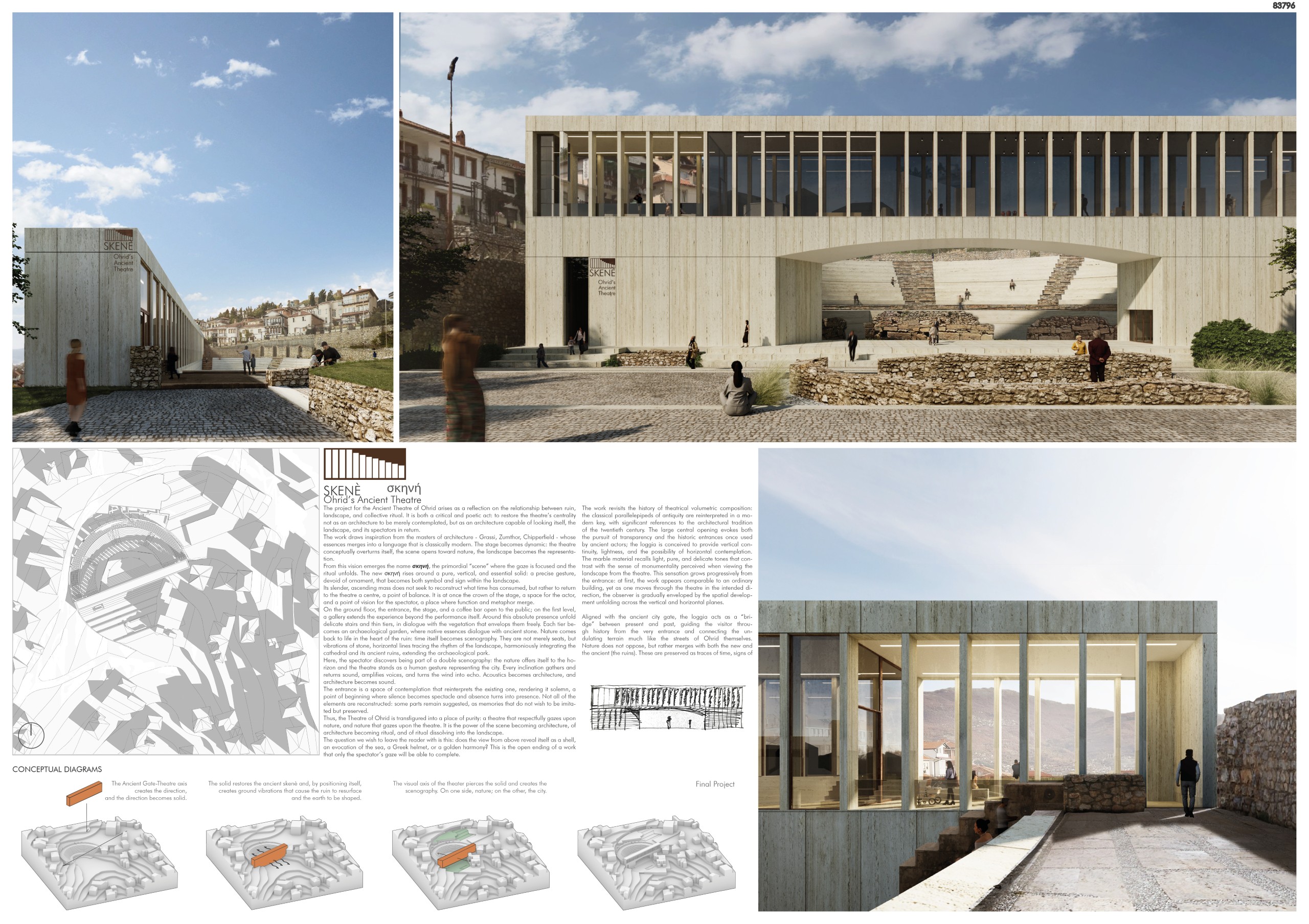
Skenè Ohrid’s Ancient Theatre
Gianluca Dell’Abate, Gabriele Potenza [Italy]
PROJECT DESCRIPTION
The project for the Ancient Theatre of Ohrid arises as a reflection on the relationship between ruin, landscape, and collective ritual. It is both a critical and poetic act: to restore the theatre’s centrality —not as an architecture to be merely contemplated, but as an architecture capable of looking itself, the landscape, and its spectators in return.
The work draws inspiration from the masters of architecture — Grassi, Zumthor, Chipperfield — whose essences merges into a language that is classically modern. The stage becomes dynamic: the theatre conceptually overturns itself, the scene opens toward nature, the landscape becomes the representation.
From this vision emerges the name σκηνή, the primordial “scene” where the gaze is focused and the ritual unfolds. The new σκηνή rises around a pure, vertical, and essential solid: a precise gesture, devoid of ornament, that becomes both symbol and sign within the landscape.
Its slender, ascending mass does not seek to reconstruct what time has consumed, but rather to return to the theatre a centre, a point of balance. It is at once the crown of the stage, a space for the actor, and a point of vision for the spectator — a place where function and metaphor merge.
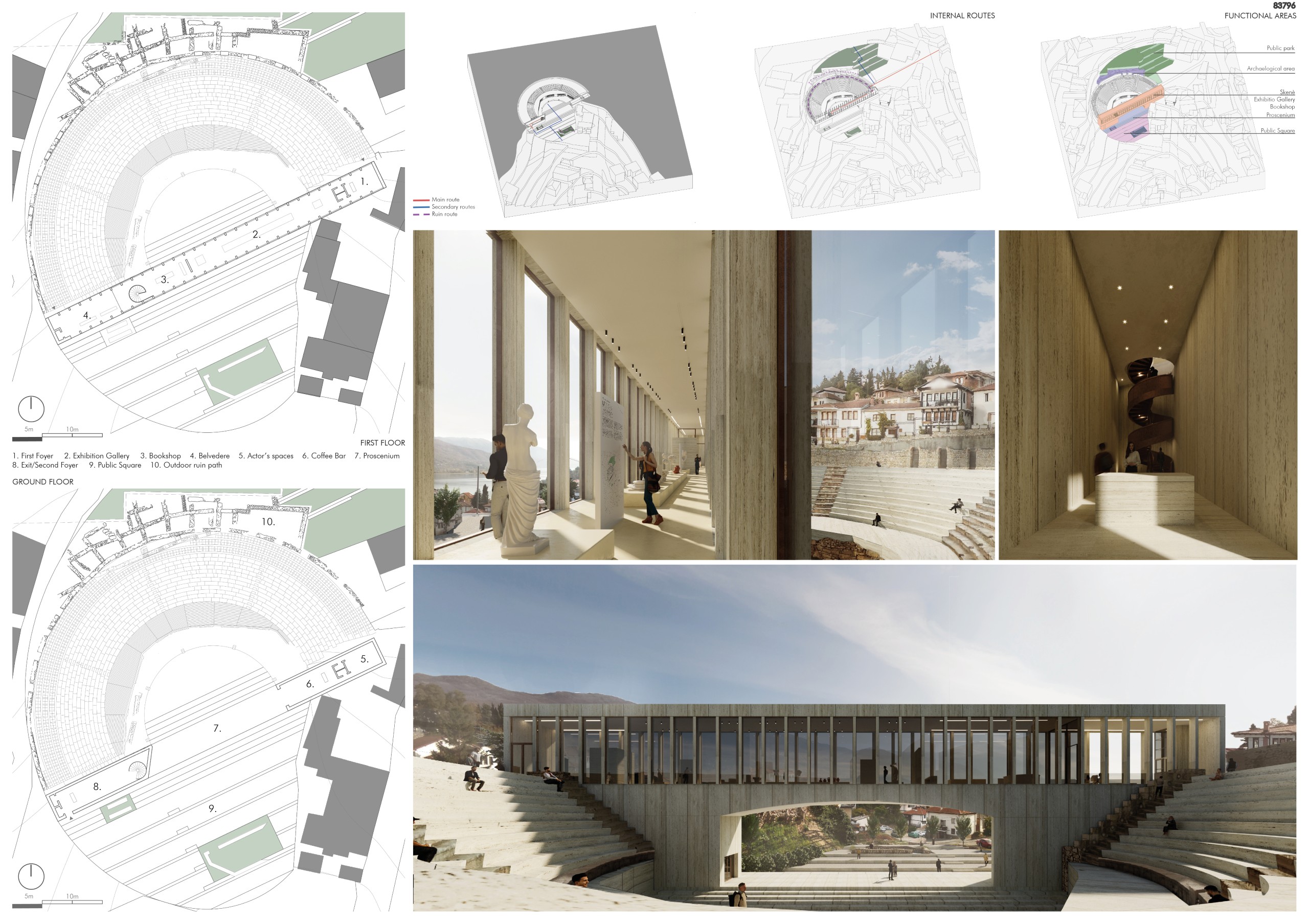
On the ground floor, the entrance, the stage, and a coffee bar open to the public; on the first level, a gallery extends the experience beyond the performance itself. Around this absolute presence unfold delicate stairs and thin tiers, in dialogue with the vegetation that envelops them freely. Each tier becomes an archaeological garden, where native essences dialogue with ancient stone. Nature comes back to life in the heart of the ruin: time itself becomes scenography. They are not merely seats, but vibrations of stone — horizontal lines tracing the rhythm of the landscape, harmoniously integrating the cathedral and its ancient ruins, extending the archaeological park.
Here, the spectator discovers being part of a double scenography: the nature offers itself to the horizon and the theatre stands as a human gesture representing the city. Every inclination gathers and returns sound, amplifies voices, and turns the wind into echo. Acoustics becomes architecture, and architecture becomes sound.
The entrance is a space of contemplation that reinterprets the existing one, rendering it solemn — a point of beginning where silence becomes spectacle and absence turns into presence. Not all of the elements are reconstructed: some parts remain suggested, as memories that do not wish to be imitated but preserved.
Thus, the Theatre of Ohrid is transfigured into a place of purity: a theatre that respectfully gazes upon nature, and nature that gazes upon the theatre. It is the power of the scene becoming architecture, of architecture becoming ritual, and of ritual dissolving into the landscape.
The question we wish to leave the reader with is this: does the view from above reveal itself as a shell, an evocation of the sea, a Greek helmet, or a golden harmony? This is the open ending of a work that only the spectator’s gaze will be able to complete.
Dualities in dialogue
Agostina Lelia Babaglio, Leonardo Hernán Araoz, Juana Prieto, Victoria Brea, Paula Alejandra Klima , Valeria Pagani , NoraPonce, Wanda Dalmau [Argentina]
PROJECT DESCRIPTION
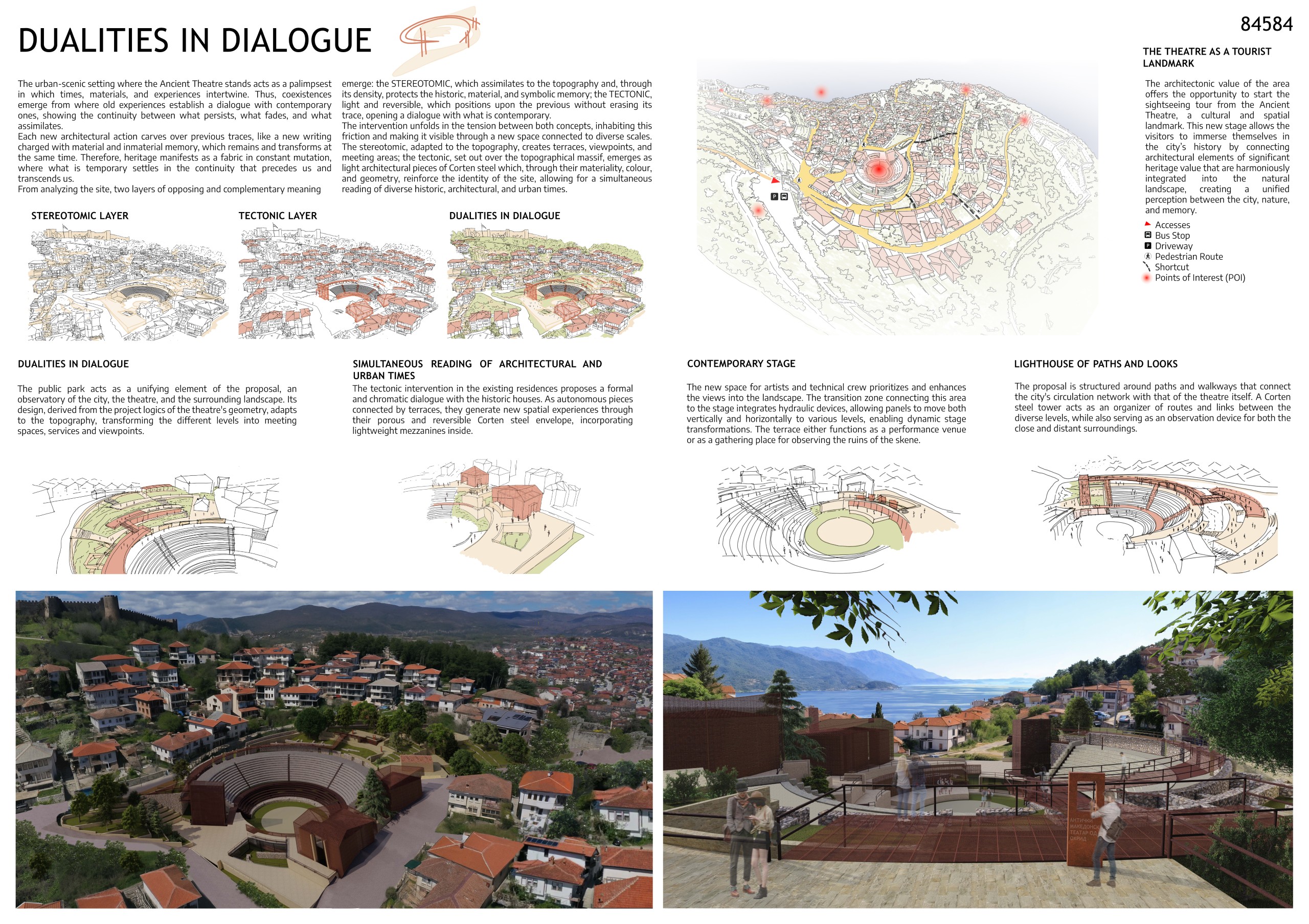
The urban-scenic setting where the Ancient Theatre stands acts as a palimpsest in which times, materials, and experiences intertwine. Thus, coexistences emerge from where old experiences establish a dialogue with contemporary ones, showing the continuity between what persists, what fades, and what assimilates.
Each new architectural action carves over previous traces, like a new writing charged with material and in material memory, which remains and transforms at the same time. Therefore, heritage manifests as a fabric in constant mutation, where what is temporary settles in the continuity that precedes us and transcends us.
From analyzing the site, two layers of opposing and complementary meaning emerge: the STEREOTOMIC, which assimilates ot the topography and, through its density, protects the historic, material, and symbolic memory; and the TECTONIC, light and reversible, which positions upon the previous without erasing its trace, opening a dialogue with what is contemporary.
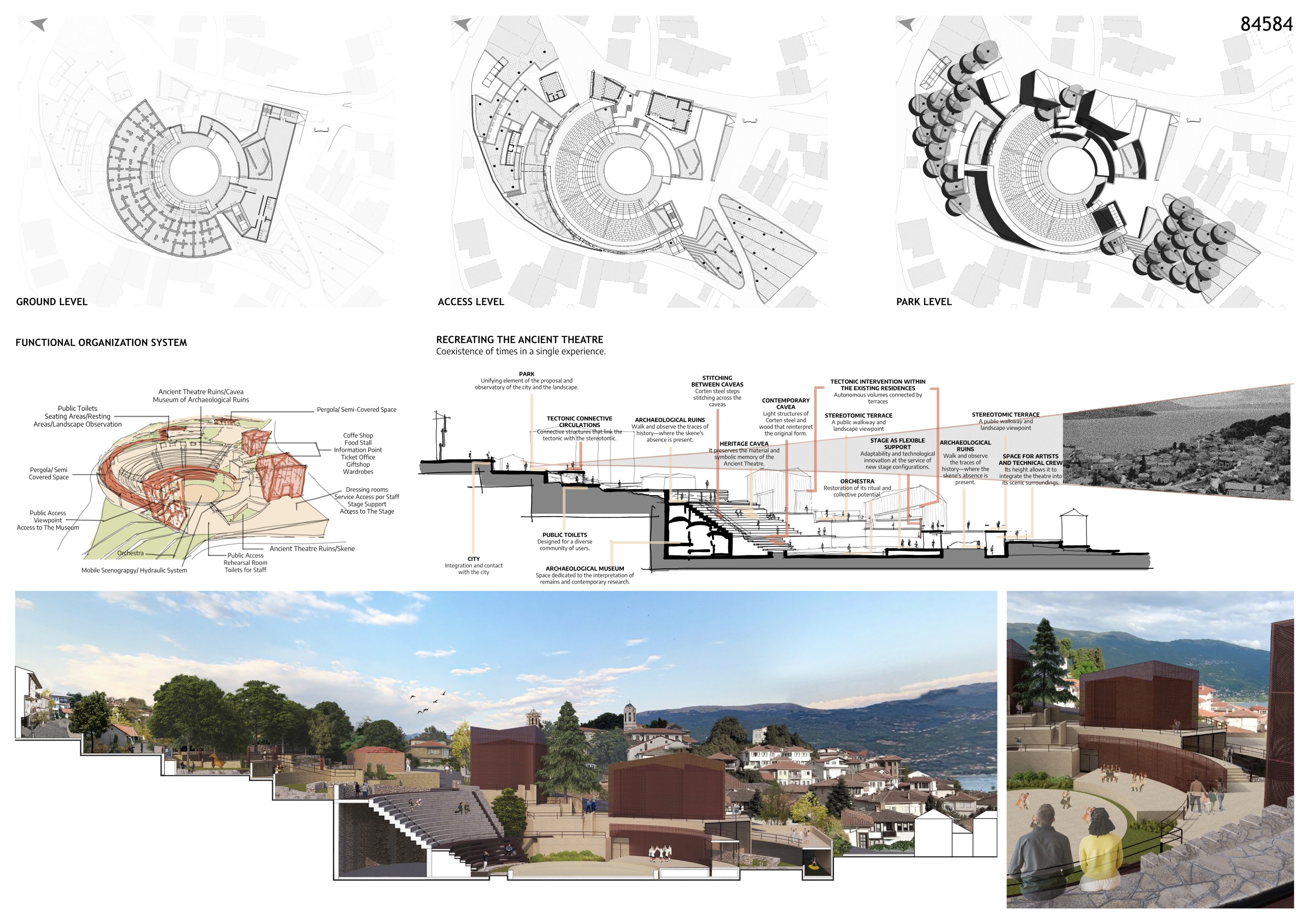
The intervention unfolds ni the tension between both concepts, inhabiting this friction and making it visible through a new space connected to diverse scales. The stereotomic, adapted to the topography, creates terraces, viewpoints, and meeting areas; the tectonic, set out over the topographical massif, emerges as light architectural pieces of Corten steel which, through their materiality, colour, and geometry, reinforce the identity of the site, allowing for a simultaneous reading of diverse historic, architectural, and urban times. The geometry of the Ancient Theatre’s cavea arranges the design of the intervention, defining paths and links with the surroundings. A series of paths, on the stereotomic support and through elevated tectonic lines, symbolize the dialogue between permanence and contemporaneity, allowing one to walk on traces of history and, at the same time, be surrounded by the brevity of the present.
In addition, the intervention recreates the Ancient Theatre’s typology, preserving the visual and symbolic relationship with the natural landscape of the lake and its surroundings. The proposal combines scenic flexibility and technological innovation in the design of the new stage; the orchestra is rebuilt, the inferior cavea restored, and the movement systems optimized. Geometry, materials, and textures summon as much memory as to contemporaneity, offering the spectator a renewed experience.
Then a new landscape of inhabited memories emerges, where the user, as an active agent, perceives the duality between permanence and transformation, which holds the tension between the legacy of the past and contemporary intervention. That preserves the identity of the place while establishing new relationships and a renewed spatial and symbolic reading of the city of Ohrid’s landscape, strengthening the collective sense of the theatre as an ancestral and contemporary meeting place.
Rebreathe
Wenlei Ma, Pu Cheng, Jingshuang Zhao, Shanshan Liu, Yuan Peng [China]
PROJECT DESCRIPTION
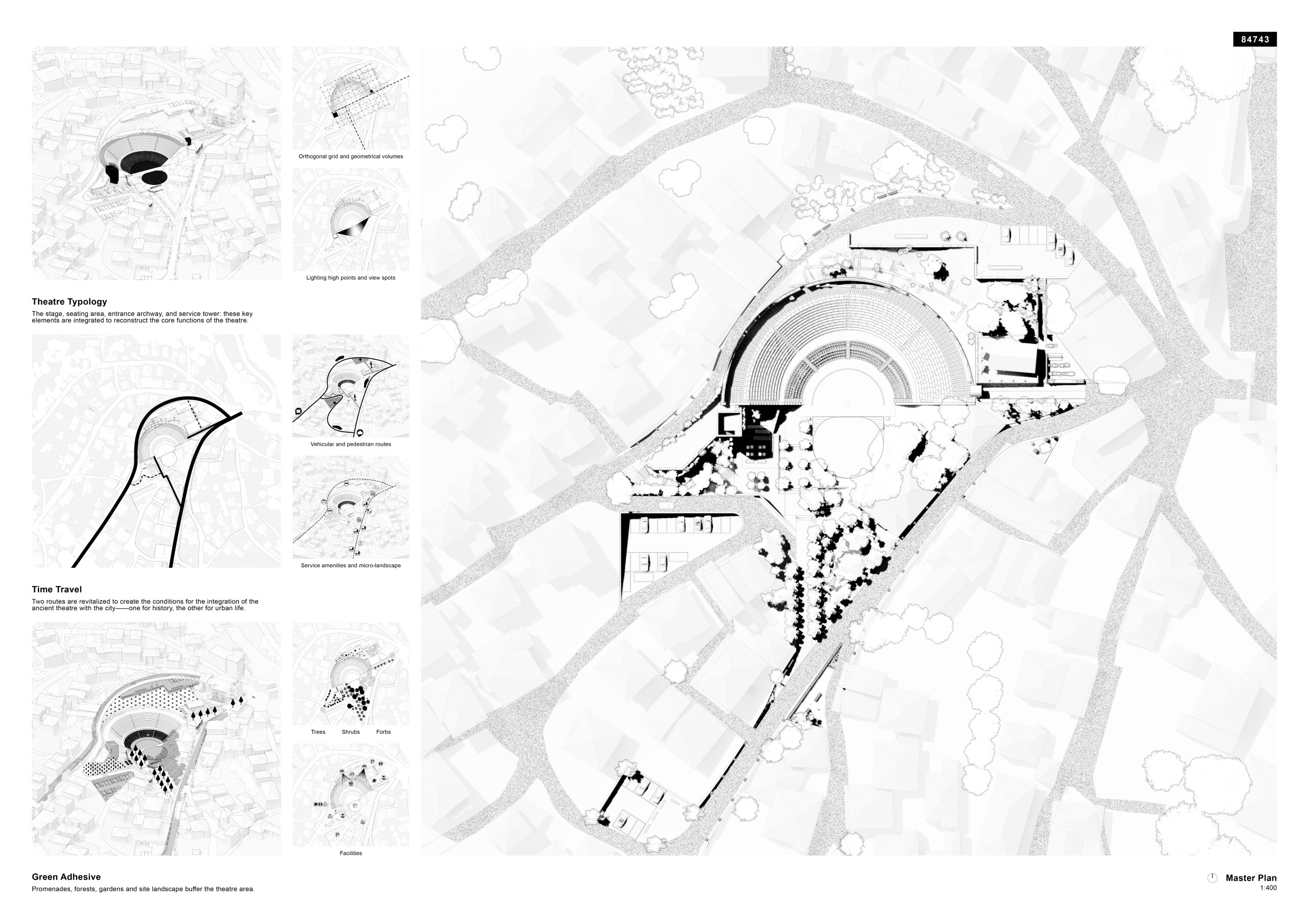
Our design begins by revitalizing two routes that run parallel both in space and time, creating the conditions for the integration of the ancient theatre with the city.
The Lindenska Street stretches from the upper gate all the way to the Cathedral of Saint Sophia, serving as a “journey through time” for visitors. The main entrance of the theatre will be positioned at the starting point of the road, with a refined design and setup. At the other end of the road, landscape extends downward from the theatreto reach the road, transforming the access into a temporal journey filled with ritualistic atmosphere. “A mist-like grove” with a cut-through promenade separates the theatre from residential area with dense vegetation. It is here that the theatre is reborn, and drama continues to be performed.
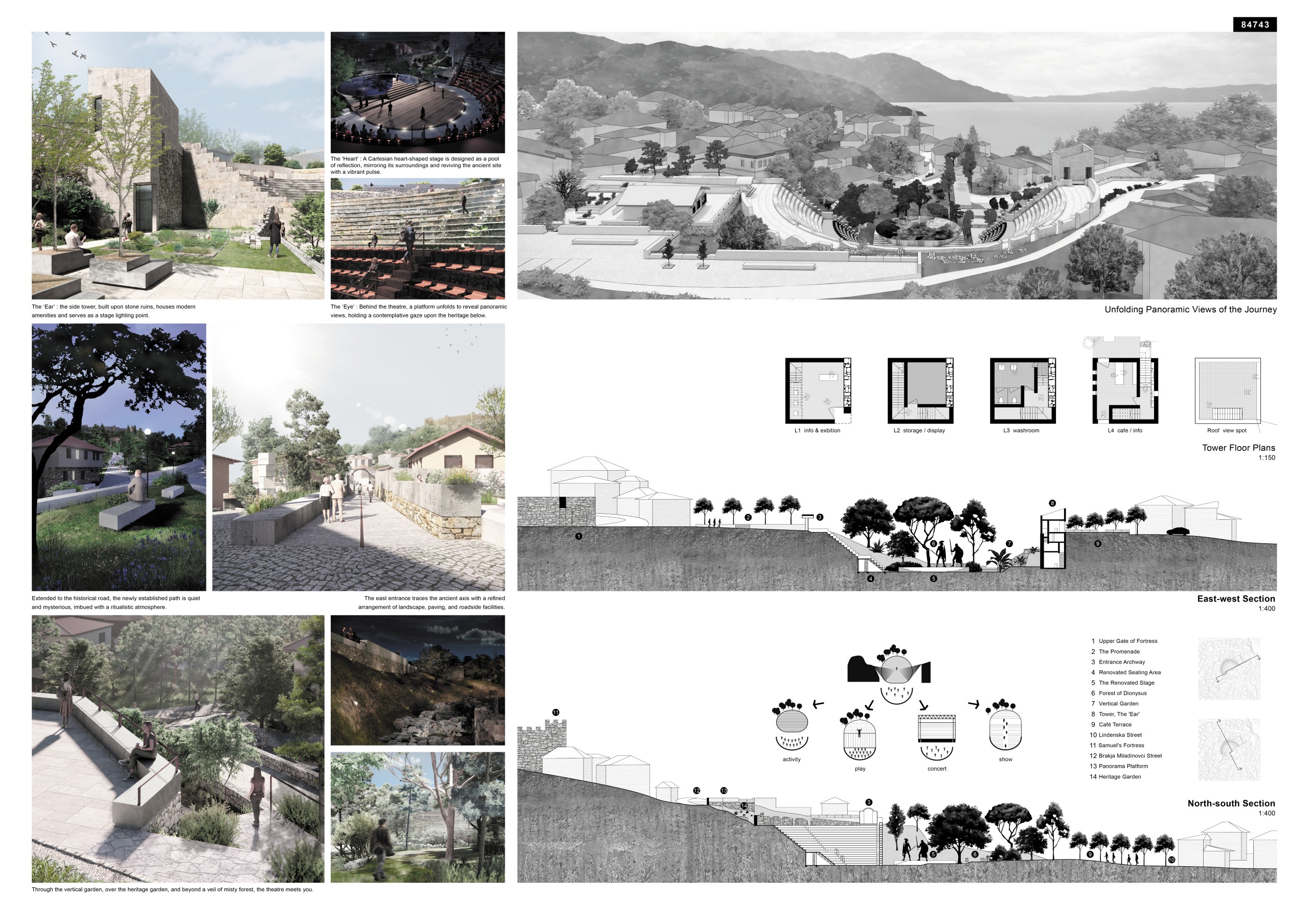
The Brakja Miladinovci Street, located behind the theatre, is adjacent to the residential area. Although narrow, it is sufficiently wide to accommodate vehicle passage, ensuring daily convenience. A platform unfolds along this road, offering spectacular panorama views. The ruin site places the platform at a distance from theatre area. With no direct connection, the theatre, the ruins and the lake are thoughtfully preserved, maintaining a careful perspective on heritage. Beyond a “veil of mist” (the forest) and a far-watching “Eye” (platform), we redefine the way ancient heritage and modern life coexist and interact.
Our reinterpretation of the theatre follows ancient Greek typology and classical geometry while incorporating modern qualities.
1. Various functions including info desk, café, washrooms, stage lighting are integrated into a square tower, an organ that meets essential modern needs. For its spiral interior circulation, modest appearance and strategic location, we refer to it as a”Ear”.
2. The stage is designed as a pool of water, outlined by a Cartesian heart-shaped curve to reflect everything around it, giving the ancient site with a vibrant heart that carries primordial memories. The stage can be adjusted as needed, providing flexibility to accommodate various sceneries requirements, such as “forest” and “sea” in the performance.
3. In terms of material strategy, the square tower will be built on part of the remains. Pre-cut stone panels establish a dialogue with the old, telling how we use this timeless material today, also referencing the mosaic crafts of the city. All wood is replanted into surrounding landscape and forests. The forest grows as echo and a reborn form of them. Durable, aged steel is used to rebuild seats, handrails and decking. Its dark tone and lightweight quality contrast with the shallow rocky appearance of the rest, rendering the seating area with a touch of modern qualities through its thinness, texture and color. Distinguished from theatre area, practical and widely-used concrete is employed for surrounding urban facilities.
Distill Moments
Seongjin Park, Myeonghun Bae [South Korea]
PROJECT DESCRIPTION
A Theatre Stilled in Time, a Distillery at its Heart
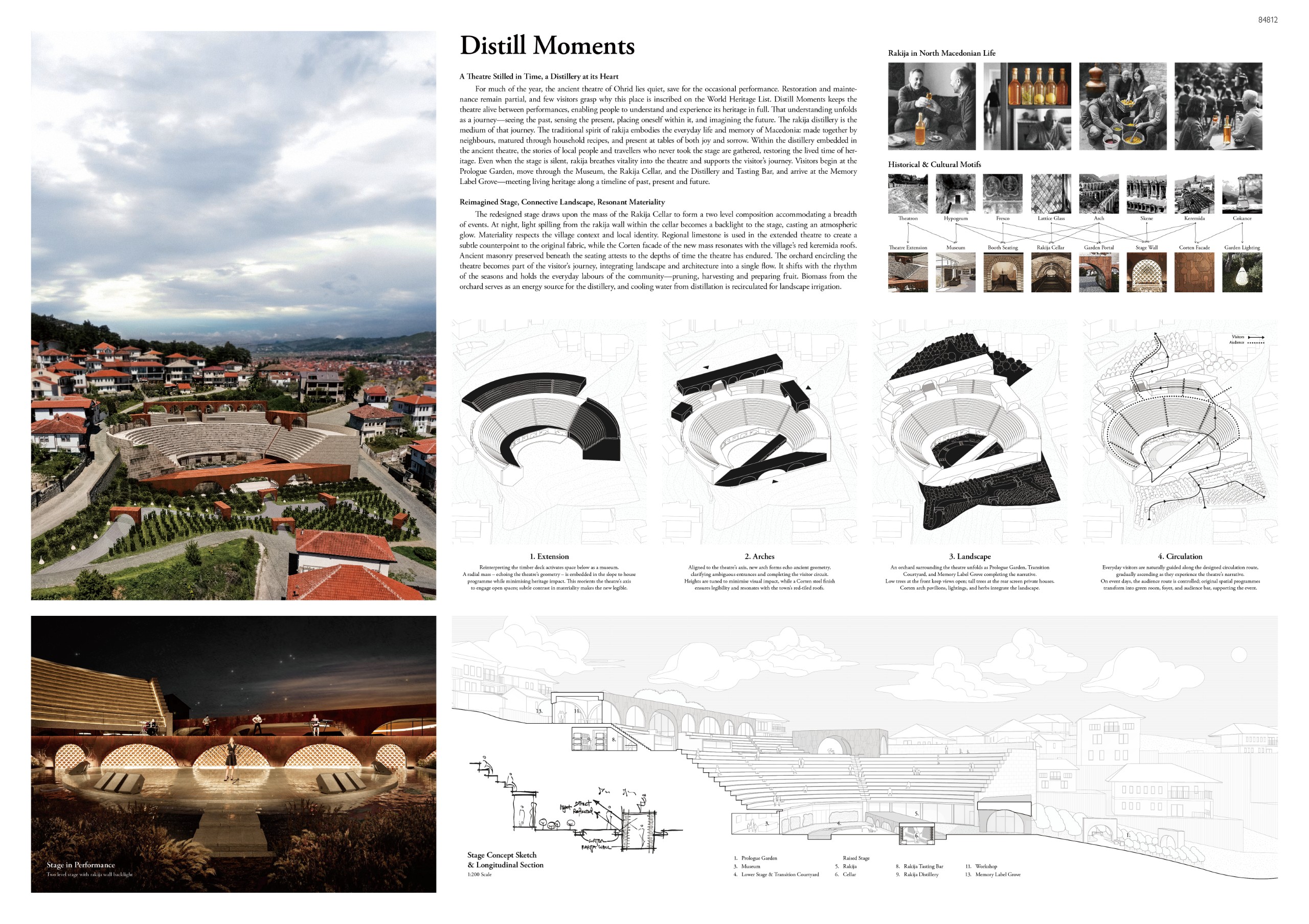
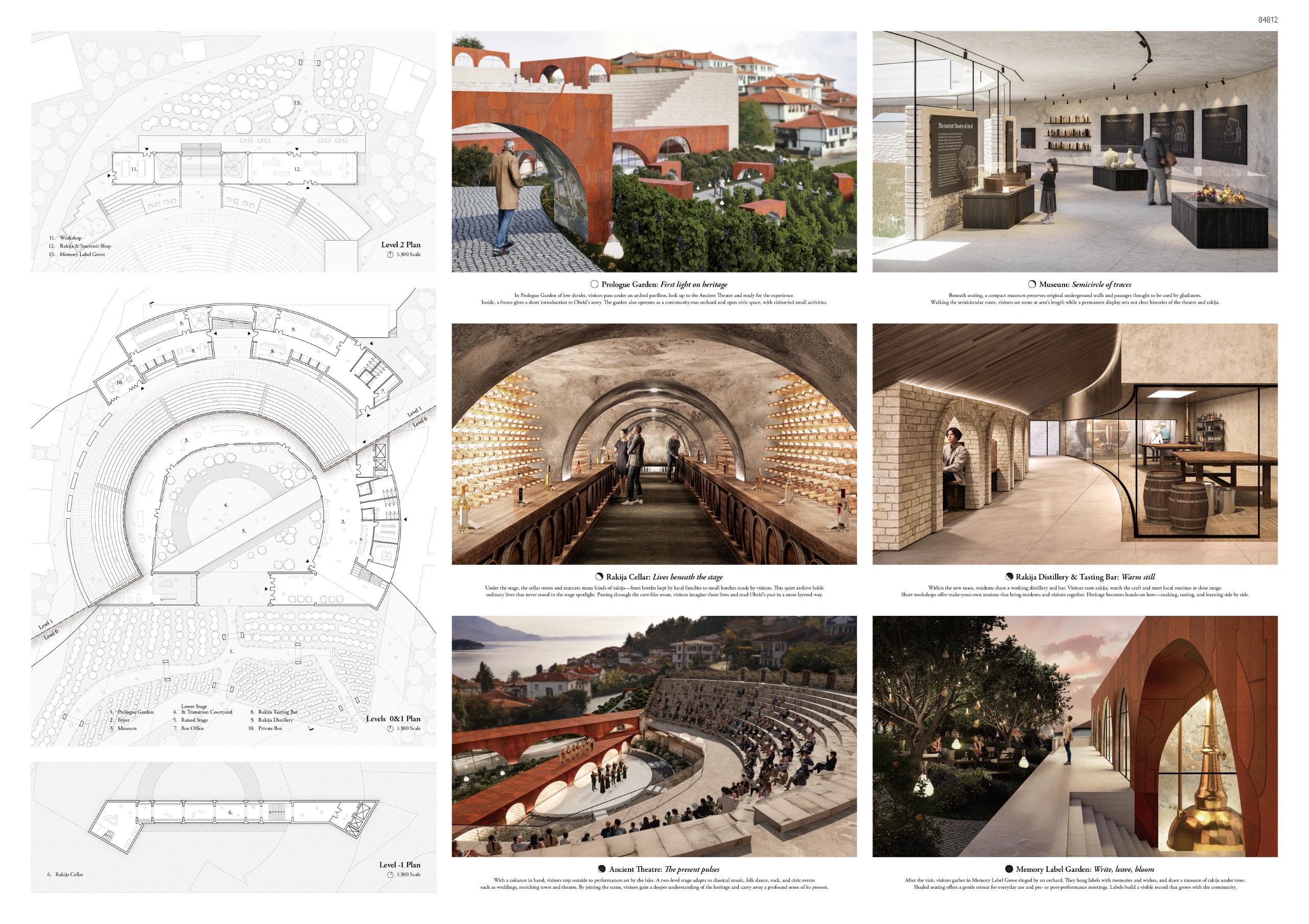
For much of the year, the ancient theatre of Ohrid lies quiet, save for the occasional performance. Restoration and maintenance remain partial, and few visitors grasp why this place is inscribed on the World Heritage List. Distill Moments keeps the theatre alive between performances, enabling people to understand and experience its heritage in ful. That understanding unfolds as a journey-seeing the past, sensing the present, placing oneself within it, and imagining the future. The rakija distillery is the medium of that journey. The traditional spirit of rakija embodies the everyday life and memory of Macedonia: made together by neighbours, matured through household recipes, and present at tables of both joy and sorrow. Within the distillery embedded in the ancient theatre, the stories of local people and travellers who never took the stage are gathered, restoring the lived time of heritage. Even when the stage is silent, rakija breathes vitality into the theatre and supports the visitor’s journey. Visitors begin at the Prologue Garden, move through the Museum, the Rakija Cellar, and the Distillery and Tasting Bar, and arrive at the Memory Label Grovemeeting living heritage along a timeline of past, present and future.
Reimagined Stage, Connective Landscape, Resonant Materiality
The redesigned stage draws upon the mass of the Rakija Cellar to form a two level composition accommodating a breadth of events. At night, light spilling from the rakija wall within the cellar becomes a backlight to the stage, casting an atmospheric glow. Materiality respects the village context and local identity. Regional limestone is used in the extended theatre to create a subtle counterpoint to the original fabric, while the Corten facade of the new mass resonates with the village’s red kermida roofs. Ancient masonry preserved beneath the seating attests to the depths of time the theatre has endured. The orchard encircling the theatre becomes part of the visitor’s journey, integrating landscape and architecture into a single flow. It shifts with the rhythm of the seasons and holds the everyday labours of the community- pruning, harvesting and preparing fruit. Biomass from the orchard serves as an energy source for the distillery, and cooling water from distillation is recirculated for landscape irrigation.
Echoes in Ohrid: Reframed Theatre
Silvia Rueda Guerrero, Nicolas Velasco Gomez [Colombia]


PROJECT DESCRIPTION
Ohrid’s Ancient Theatre stands as a layered testament to centuries of cultural continuity, a space where stone, landscape, and memory intertwine. Our proposal seeks to add a new layer to this palimpsest, breathing new life into the monument while preserving its timeless dialogue with the city and the lake below.
Conceived as an architectural and landscape intervention, the project redefines the theatre’s relationship with its surroundings. A new terraced extension unfolds from the street surrounding the theatre, echoing the geometry of the ancient tiers while softening the boundary between built form and topography. This gesture establishes a seamless transition between the monument and the urban fabric that encircles it, reconnecting the site with the rhythm of the city and the paths that lead to Samuel’s Fortress above.
A new sequence of pavilions compliment the theatre’s current use, a daily tourism visitation site, and allows it to regain a past use, a living stage for performance, now contemporary. These pavilions discreetly accommodate the functional needs of a modern theatre — gift shops, rehearsal, ticketing, restrooms and areas for food and beverage — without disturbing the integrity of the archaeological setting. Through their restrained materiality and scale, they act as a mediating layer between the ancient stone and the life of the present.
Anchoring the intervention, a series of slender columns rise above the stage, framing the horizon of Lake Ohrid. The columns also serve as the structure for any feature the artistic performances may need. This canopy — both delicate and expressive — transforms the stage into a device for viewing and performing, enframing the landscape as part of the spectacle. It recalls the ephemeral nature of ancient scenographies while offering shade and spatial definition for contemporary events.
The landscape strategy reinforces this dialogue between permanence and change. Native vegetation, low stone terraces, and shaded walkways recompose the fragmented terrain, guiding visitors through a sequence of views and encounters. The project thus becomes a continuous promenade — from the intimate scale of performance to the vastness of the natural backdrop.
More than a mere restoration, the proposal envisions the theatre as a living cultural topography — one that resonates with the rhythms of the past while embracing the possibilities of the present. In merging architecture, landscape, and memory, the project aspires to reaffirm the theatre’s role as the beating heart of Ohrid’s heritage, where history and contemporary life coexist in a single spatial continuum.
Echoes of the City
Simón Henao Uribe, Maria Gómez Velasquez, Julian Torres Fonceca, Marta Gil Angel, Valentina Ramirez Gonzalez, Cristian Sanchéz García, Diana Osorio Zuluaga, Sara Cardona Varela, Sebastian Diaz Arbelaez, Ricardo Garcia Cadavid, Alejandro Uribe Gomez [Colombia]


PROJECT DESCRIPTION
The Theater as a Frame for Nature, Architecture, and Everyday Life — Adapting to the Spirit of the City
The theater becomes a frame for the natural and architectural landscape, and for the rhythms of everyday life — a space that adapts to the spirit and essence of the city.
We propose an innovative reinterpretation and recovery of Ohrid’s history through its ancient Theater and the landmarks that shape its collective memory. These sites are reconnected through the urban fabric, allowing the theater and its historical nodes to merge with the city’s magic and narrative. The project envisions an architecture that listens — sensitive to place and to people — weaving bonds between space, form, and the living pulse of its users.
The design integrates three main components:
Theater–Stage: The central space that preserves the spirit of the city and its natural surroundings.
Landscape Devices: Elaborated paths accompanied by beacons and viewpoints — small architectural gestures that highlight the landscape.
Plaza–Platform: A timeless connection and reactivation of the city’s history and its contemporary dynamics.
We intend to restore and rehabilitate the original architecture, amplifying its symbolic value and complementing it with new spaces and materials, ensuring its lasting functionality. The Theater reemerges as one of the city’s key icons — strategically located near the ancient walls and historic spaces, in dialogue with the topography and natural context. It becomes a cornerstone in a network connecting urban and natural realms. Along these paths, the beacons–viewpoints serve as educational, recreational, and service spaces, celebrating Ohrid’s heritage and transforming it into a renewed urban landmark.
The theater extends into the public realm as a focal point and powerful urban symbol. The new ground-level relief unfolds as a generous public space inviting multiple forms of gathering and interaction. Acting as the building’s main access, it hosts small urban stages and open-air programs. A system of inclined and folded planes creates fluid circulation, linking these layers to the historical layout.
The city is revitalized through this cultural and social space — a flexible arena for encounter, recreation, and expression. It operates as an interstice between the original theater and the contemporary city. The complementary volumes complete the theater’s semicircular form, generating an active perimeter with a contemporary presence. The ground floor opens to the park with cafés and shops, while inside, a gallery corridor connects exhibition spaces, a rehearsal and conference theater, and supporting services. The upper level houses multipurpose classrooms.
Both semicircles are linked by glass “bridges” that appear to float between past and present — allowing views of the archaeological remains while illuminating the heart of the new building. By completing the original form of the theater into a perfect circle, the project reinstates the stage as its central piece, enhancing spatial hierarchy and acoustics, enabling a wide variety of performances.
The Theater stands as a circle of both remembrance and future — a space that revives the history of Ohrid while amplifying its cultural and touristic life, intertwining city, landscape, and community in one continuous act.
ARCH, LOOP, FLOW
Yangli Hu, Yiyang Feng [United States]


PROJECT DESCRIPTION
In this adaptive reuse of a historic theater located on Ilindenska Street in Ohrid, North Macedonia, the design begins not with an act of replacement, but with an act of listening to the building’s memory. The elegant arches that trace the perimeter of the original semicircular plan are more than structural remains—they are silent witnesses of past performances, spatial hierarchies, and the rituals of watching and being watched. By carefully revealing and restoring these arches, we bring their presence back into the collective experience of the theater, allowing history to speak through the architecture once again.
Traditionally, the stage has always occupied the center—a fixed point of power and focus. The audience sits in quiet rows, facing forward, receiving. But this project begins by questioning that convention: Must the stage always be the center? Must performance always happen in one direction?
Rather than preserving the semicircle as a fixed edge, the design extends it into a complete ring, creating a fluid, inclusive spatial form. A continuous steel curve emerges from the outer edge of this circle and flows gracefully inward toward the central circle, like a sheet of paper folding softly into space. This gesture is both structural and poetic—a contemporary layer that stitches the old and the new together, holding tension and harmony in a single movement.
Behind the original stage, five arched openings are carved out, connecting the performance space to its surrounding circulation. This spatial intervention blurs the line between front and back, between the visible and the hidden. The once rigid boundary between performer and spectator is loosened, allowing movement, permeability, and shared experience.
Within this reimagined theater, performance is no longer bound to a single focal point. Actors can move along the perimeter, approach the audience from behind, or perform within the circular void at the center. The audience, no longer positioned as passive receivers, becomes part of the spatial choreography—encountering the performance from multiple angles, experiencing fragments, closeness, and unexpected moments.
This transformation is more than formal; it is a rethinking of power, direction, and authorship within performance. The circle does not dictate; it opens possibilities. The theater becomes a porous landscape where stories can unfold simultaneously and differently for each viewer.
Here, the historic arches stand as a soft frame, holding memory. The steel curve acts as a new temporal layer, bending the present into dialogue with the past. And the stage—once a singular point of focus—dissolves into a living, circular field of performance.
In this theater, architecture is not merely the background for performance. It becomes performance itself—a space where history and contemporary imagination, performer and audience, direction and openness, all weave into a continuous, unfolding narrative.
Interwoven Grounds
Meryem KübraUluç Tolba, Mariam Sadek [Turkiye]


PROJECT DESCRIPTION
The project envisions the Ohrid Ancient Theatre as a vibrant cultural landscape where history, topography, and contemporary urban life intertwine. It transforms a long-neglected monument into an inclusive public space that extends beyond performances to become an everyday civic realm. Designed for both locals and visitors, the theatre evolves into a living structure that breathes with the rhythms of the city, reconnecting heritage with the vitality of daily life.
Responding to contemporary needs, the proposal treats the site as a comprehensive masterplan rather than a single intervention. The theatre becomes the heart of a continuous public park, a setting for cultural events, daily gatherings, and creative work. The revitalized complex includes rehearsal rooms beneath the historic steps, co-working spaces for emerging start-ups, and gourmet venues that extend the experience of Ilindenska Street. Together, these programs form an interconnected ecosystem of cultural and social activity, strengthening the theatre’s identity as both a local landmark and a global destination.
The design is guided by a layered spatial morphology merging topography, architecture, and public life. The new building along Ilindenska Street follows an organic, sinuous form much like the branching structure of human veins to extend its contact surface and maximize public exposure. This curving morphology multiplies points of encounter, allowing visitors to experience the historical street as a continuous unfolding of cafés, workshops, and exhibitions. The stage rises into a walkable roof, the landscape flows as connective tissue, and the ensemble becomes a living organism where heritage and contemporary life intertwine.
At the architectural core stands the reimagined stage, no longer an exclusive platform for performance but a publicly accessible ground where the “everyday performance of life” unfolds. The back of the stage forms a gently sloped roof that visitors can walk on, opening new views of the lake and the city while linking upper and lower levels. This permeability transforms the theatre into an open urban terrain, part architecture, part landscape.
At the site’s threshold stands the Time Capsule, a newly built corten steel structure acting as both an information point and a symbolic gateway into Ohrid’s temporal layers. Positioned between the Upper Gate and the theatre, it marks the moment where different eras converge: to the left a restored Ottoman house, ahead the antique theatre, and to the right the faint ruins of a church. The Time Capsule invites visitors to pause, orient, and transition a spatial device translating history into present experience.
A continuous pedestrian walkway connects the Time Capsule to the theatre and extends toward Ilindenska Street through terraced paths embedded in the topography. Rather than dispersing small pavilions, all micro-architectural functions are unified beneath a single canopy, creating elegant, non-invasive transitions between indoor, outdoor, and semi-covered spaces.
Materiality establishes a dialogue between permanence and transparency: corten steel expresses the patina of time, stone conveys endurance, and glass embodies openness. Together, they root the intervention in Ohrid’s heritage while giving it a distinctly contemporary voice.
Ultimately, the project transforms the Ancient Theatre and its surroundings into a cohesive cultural landscape and an urban organism where movement, memory, and modernity coexist in harmony.
TO•POS
Thomas Feraud, Arnaud Gillet [France]


PROJECT DESCRIPTION
Ohrid is a city marked by multiple influences : Greek, Ottoman, and Byzantine. Each era has left a footprint, shaping a complex identity where history, nature and culture met.
The project aims to give a new function into the ancient theatre, while respecting the spirit the place.
The theatre has to become a place of convergence between the city, the landscape, and the performing arts, functioning all day:
– the morning : the upper terrace overlooking the theatre and the city hosts a market and a café bar.
– during the day the museum opens its doors to showcase the site’s archaeological discoveries and remains.
– at noon and the evening the restaurant welcomes tourists and locals, up to 50 seats.
– at night the theatre welcome performances, concerts and festivals, with an capacity increased up to 2400 spectators seated (1000 originaly).
This mix of uses activates the site all day long. The natural background of the scene enhance the relationship between art and nature revives the very essence of the Greek theatre : a space for vision and émotions. The stage becomes versatile and adaptable, suitable for all kinds of performances. Mobile stage installations and a technical access allow for vehicle entry during setup. The project also includes the regulation of informalparking, through the discreet integration of parking spaces along a vegetation screen, in harmony with the surrounding landscape. To avoid a harsh confrontation between the theatre’s seating tiers and the public space, the form of the tiers extends naturally into the landscape through vine plantations. This continuity creates a gentle topography, a natural gradient between architecture and nature.
The site is structured around three interconnected levels, linked by redesigned circulations and punctuated by micro-architectures:
– On top : Creation of a public square hosting a market, a «guinguette», and covered area.
– The intermediate area : Beneath the seating tiers, spaces are reactivated to accommodate:
▪ A restaurant, built with local stone and reused materials.
▪ A museum, directly connected to the Karagjulevci Tomb, displaying artifacts linked to the site, and from the city.
Together, they form a palimpsest-like ensemble, suspended between ages or periods.The reuse of old stones in the furniture of the restaurant and museum reinforces the idea of a sustainable project, rooted in time and materiality. The ancient stone walls and brick arches on top of the old theatre are preserved, creating a new covered street and a filter between the performance space and the new programs.
The contemporary architectural language does not compete with the antique beauty of the site; rather, seeking to reveal it.
– On the ground floor : A small building is dedicated to the artists and technical functions:
▪ Dressing rooms, backstage areas, and service circulations.
▪ Handling areas and an integrated parking zone.
In addition to this buildings, small information points are created on each side of the theater.
The new buildings draw inspiration from the language of the ancient seating tiers:
The micro-architectures reinterpret the materiality and geometry of the gradins at a more intimate and delicatescale.
The whole composes a pixelated topography, an architecture of raw material, respectful of the context.
The monolithic volumes capture light and dialogue with the tiled roofs of Ohrid.
OHARID THEATRE
Mohamed Mahmoud, Ahmed Elgindy [Egypt]


PROJECT DESCRIPTION
This project reimagines Ohrid’s ancient theatre as a contemporary cultural landmark — a living monument where history, landscape, and community converge. Once a forgotten relic embedded within the urban fabric, the theatre is reborn as an inclusive public arena that bridges the dialogue between past and present. By honoring the site’s timeless circular geometry and reinterpreting it through modern interventions, the design transforms the theatre into a unifying civic symbol that breathes new life into the historic core of the city.
At the heart of the transformation lies the circular form — a powerful symbol of unity and continuity. Acting as the focal point of the intervention, it reinforces the theatre’s identity as both a performance venue and a city square, hosting cultural events, public gatherings, and daily activities. A continuous ramp weaves through the site, seamlessly linking access points and terraces while maintaining the visual prominence of the stage. This fluid movement reconnects the monument to its natural and urban surroundings, inviting residents and visitors alike to experience a gradual journey of discovery through layers of light, shade, and landscape.
A new observation tower rises gently from the site’s edge, offering panoramic views of Ohridand its shimmering lake. This vertical extension complements the theatre’s horizontality, symbolizing the dialogue between earth and sky, heritage and modernity. The tower’s slender profile serves as both a viewing platform and a sculptural beacon, reaffirming the theatre’s status as a landmark visible from across the city.
The surrounding landscape has been carefully resolved to enhance accessibility, comfort, and ecological balance. Shaded walkways, planted slopes, and water channels create a microclimate that invites year-round use while softening the monument’s stone geometry. Beneath the seating and ramps, functional spaces — including small galleries, rest areas, and service zones — are discreetly integrated, ensuring contemporary usability without compromising the theatre’s authenticity.
Locally sourced materials and warm, earthy tones harmonize the intervention with its historic and residential context. The continuity of color and texture allows the architecture to feel both new and familiar, transforming the theatre from a remote archaeological site into a vibrant urban space.
Ultimately, UN Theatre envisions Ohrid’s ancient theatre as more than a preserved ruin — it becomes a dynamic landmark of the city. It is a place where culture and landscape intertwine, where observation and performance coexist, and where memory meets movement. By blending preservation with innovation, the project reaffirms the theatre’s role as a timeless gathering ground and a symbol of Ohrid’s evolving cultural identity.
Finalists
(ordered by registration code)
Tides of Memory
Hanqing Yao, Merrick Castillo [United States]


Renewing the Ancient Macedonian Theater of Ohrid
Haochen Geng, Stefan Imbronjev, Yueyi Li [China – United States]


Thea: The Cultural Spine
Anil Yavuz, Ata Yuksel [United Kingdom]


Ohrid Nexus
Dingdong Tang, Yangqi Yang, Zehui Li, Haisheng Xu [China]


Ohrid Nexus
Dingdong Tang, Yangqi Yang, Zehui Li, Haisheng Xu [China]


Time Corridor
Jiacheng Xu [China]


CONTINUUM OF MOVEMENT
Nazanin Salimi, Ava Ranjbar, Parmis Olyaeenezhad [Iran]


4th Act
Xavier Fulchiron, Emeline Battisti [France]


On The Mountain
Jina Kim [South Korea]


Under the stage – Restoration of the ancient theatre in Ohrid – North Macedonia
Anthony Bourne, Charlotte Benoit, Chloé Manquest [France]


Re-rooting the Ohrid theater
Robin Chanussot, Emile Jeannoutot, Dorian Fourmont [France]


The Aperture: Between City and Stage
Mingrui Jiang, Xingyu Zhang [China]


Continuum
Natasha Nikolovska, Nikita Vrckoska, Angela Stanoevska [North Macedonia]


Ohrid Promenade
Satoshi Chida, Kouichi Tanikawa, Miyuki Shiraishi, Yoji Ushido, Takahiro Inuyama, Shiori Sakuraba, Mitsuo Yamagata, Madoka Keshi, Hamiru Ohtsuka, Yusaku Ohta, Makoto Koike, Nana Muneta, Tomohiro Takata, Ippei Yamashita, Masako Souma [Japan]


On a Tangent
Sophia Curbelo, Julian Chorney, Edwin Flores, Joshua In [United States – China]


Beyond the Theatre
Tianqi Liu, Dan Wu, Ping Lu, Hongxuan Qu, Taifeng Ding [China]


The Crowned Ring upon the Summit
JianmianZhang [China]


MIRALITH
Youssef Lahkim, Hasna Lahlou, Ghita Benhayoun, Meriem El Azaizi [Morocco]


LAYERS of […]
Tamara Gorgonoska, Anastasija Ekaterina Gorgonoska, Aleksandra Jojic, Katharina Lore Meyer [Germany]


Ohrid Ancient Theater – Integrating into the hills
Sizhuo Gao [China]


The Echo of the Lake
Helene Timsit, Alicia De Nobrega, Josephine Bernard, Faustine Mousse, Giancarlo Albarello, Carmen Chisvert [France – Venezuela – Colombia]


RIPPLE EFFECT
Matteo Tomasi, Sara Marinelli, Niccolò Crociani, Eleonora Guanella [Italy]


The Stage: performing the city
Jana Mulickoska, Matea Jegeni, Nadja Mijatovic [North Macedonia]


Living Symmetry
Roy Khatchadourian, Alex Williams [United Kingdom]


ACT OF TIME
Mani Makhija [India]


Duelle
Xiaojin Jian [China]


Scena+
Efe Yildirim, Kubra Yalcinkaya, Ilayda Ilaslan, Aykut Nesne, Aysu Arslan, Doga Turkmen [Turkey]


Geo- Spolia
Amirkhan Gabdullin, Liza Lisova, Felipe Bermúdez [Russia – Colombia]


Village Pulse
Jihoon Youm [South Korea]


The Theatre of Echoes
Francesco Paolo Manzari [France]


Breathe Ohrid
Luca Mazzieri [Austria]


Featured Projects
(ordered by request date)
While not all projects make it to the final stage, we believe many still deserve to be featured! That’s why we decided to create this special section to promote the most innovative designs and emerging talents from our global community.
Submit the request to publish your project on our website and Instagram accounts
Team Name(s) [Country]

PROJECT DESCRIPTION

