19.01.2026 Competition Results
Set within a Californian region deeply affected by the wildfires of early 2025, the competition addressed the urgent need for a new spiritual and communal landmark. In a context where several religious buildings were lost, participants were invited to envision a contemporary Christian church for the community of Altadena, one that is open, inclusive and deeply rooted in its landscape. The challenge called for a place of worship able to host 400 people, rethinking sacred architecture as a sensory and symbolic experience where liturgy, social life and everyday use converge. More than a religious building, the competition sought a meaningful architectural response capable of supporting collective healing, memory and renewal.
The awarded proposals were recognized for their depth of thought, emotional resonance and architectural clarity. The jury highlighted projects that offered comprehensive and well-resolved interpretations of the brief, integrating worship spaces with communal functions and exterior environments to form cohesive micro-urban ensembles. Some proposals stood out for their material consistency and warmth, using restrained palettes to create unity while responding effectively to local climatic conditions. Others explored absence, void and silence as powerful architectural tools, translating loss and memory into spatial sequences shaped by light, mass and enclosure. Across the awarded works, a strong narrative coherence emerged where symbolism, form, and procession worked together to create sacred spaces of dignity, reflection and quiet strength.
Terraviva warmly congratulates all participants for their thoughtful contributions and commitment, whose projects offered profound and inspiring visions for reimagining sacred architecture in a time of recovery and resilience.
Get a Tailored Review on your Submitted Entry!
Request your “Project Feedback” and receive an analysis of your proposal, highlighting its strengths and identifying key aspects to refine. Download Example
Your project wasn’t selected among the finalists?
As it certainly still deserves to be seen, we’re offering you the chance to showcase your work through our Featured Publications. Discover More
1st PRIZE
Axis vitae
Justine Beaurain, Charles Cartier-Bresson [France]
PROJECT DESCRIPTION
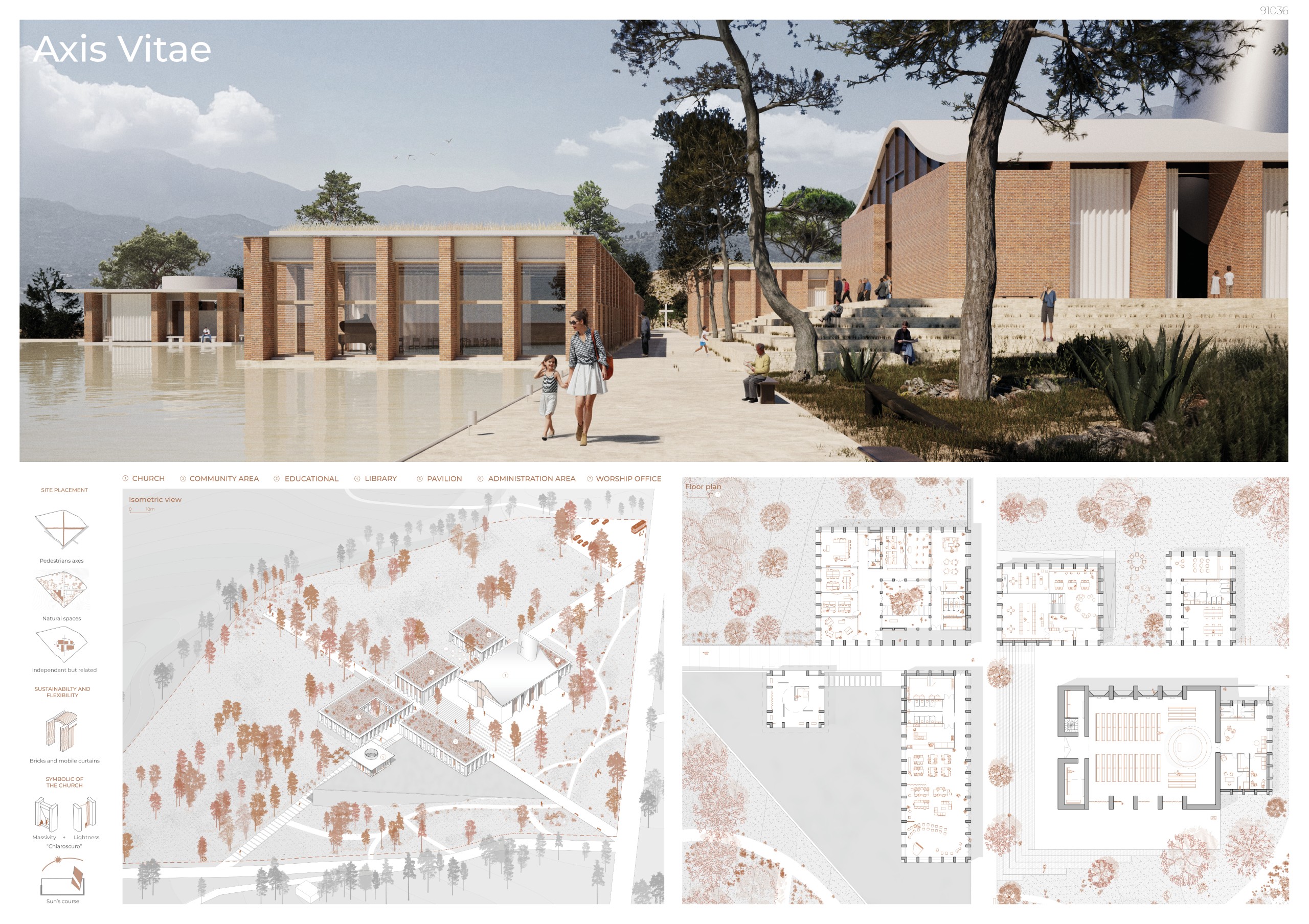
AXIS VITAE envisions a space dedicated to the community, where multiple functions coexist in synergy. From this emerges the idea of a true urban promenade weaving through various natural environments, a continuity that gives the project its name.
Organized around two structuring pedestrian axes and aligned with the natural slope of the site, the project strengthens its connections to the road network while offering a pathway between nature, spirituality, and new uses. One of these axes extends toward a landscaped cross, a belvedere overlooking the mountains. This place of retreat welcomes meditation, contemplation, and collective celebrations.
The architectural ensemble is composed of autonomous volumes, allowing each program to function independently while expressing a shared identity through careful material choices. Brick, selected for its durability and fire resistance, forms the pillars, flat vaults, and façades. In complement, a white veil acts as a light and adaptable element: it shapes atmospheres, creates contrasts with the mineral quality of the brick, and introduces an almost dreamlike dimension.
Green roofs help create a cool island and enhance the project’s integration into the landscape. The layout generates a diversity of outdoor atmospheres : a refreshing water feature, a tree-filled park, and two natural areas enriched by new plantings.
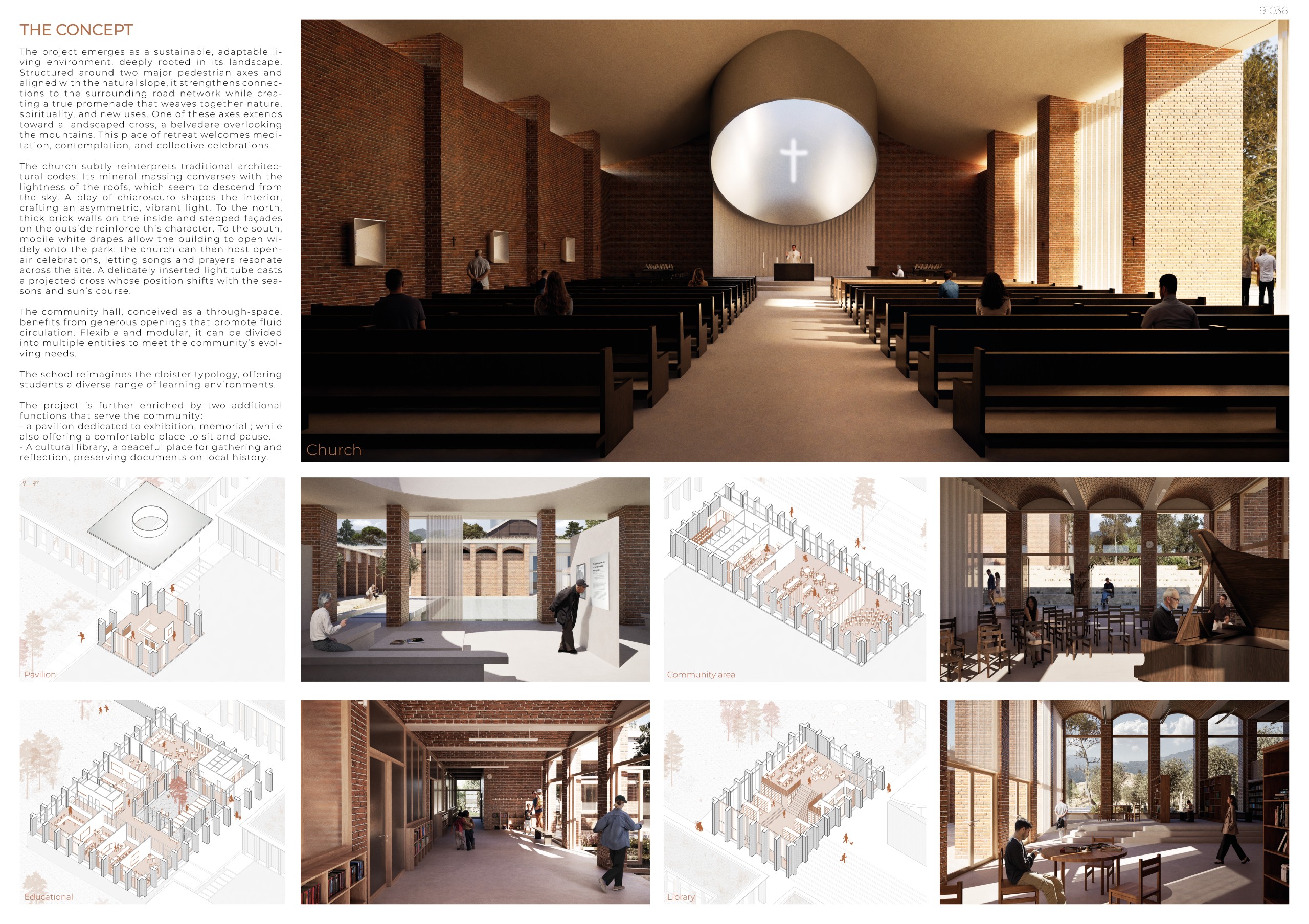
At the heart of the project, the church, visible from the main axes as well as from the street, subtly reinterprets traditional architectural codes. Rather than deconstructing the typology, we chose to preserve its essence and reveal new qualities. Resting on its forecourt and accessible from several sides, it overlooks broad steps. The brick monumentality engages in dialogue with the lightness of the white roof, which seems to descend from the sky, where light subtly reflects. A play of light and shadow also shapes an asymmetrical spatiality. To the north, thick brick walls inside and stepped façades outside reinforce this character. To the south, mobile white screens allow the building to open widely onto the park: the church can then host open-air celebrations, letting songs and prayers resonate across the site. A vertical light shaft marks the position of the priest, creating a compelling scenography: the projected cross, constantly shifting, evolves with the seasons and the movement of the sun. At the rear, private liturgical spaces unfold discreetly, concealed behind a stage curtain. Two individual prayer rooms and a mezzanine for the organ complete the volume.
The community hall, designed as a generous and traversing space, offers fluid circulation. Fully adaptable, it accommodates both daily use and large community events.
The school revisits the cloister typology to offer a variety of learning situations. The nursery, independent yet integrated into the whole, completes this space dedicated to the youngest users.
The administrative building, positioned at one of the entrances, includes shared workspaces with the possibility of extending activities into the garden.
Finally, two additional facilities enrich the project and serve the community:
– an exhibition pavilion, dedicated to the memory of the city and capable of hosting photographic archives and exhibitions ;
– a small library, a peaceful place for gathering and reflection, also serving to preserve documents related to the history and surrounding territory.
JURY COMMENT
“Extremely comprehensive, elaborately detailed design covering all aspects of the brief, seamlessly integrated into the former urban and landscape setting as a micro-urban development solution, incorporating all liturgical and communal functions of a church and community centre, presented in a fascinating and comprehensible layout.”
Ingo Krapf – Hochschule Trier & IKID
“The proposal is presented as a complete project through evaluated aspects. It gives a clear and harmonious response to the current situation. The programmatic division is successful in understanding the different needs presented by the requested program, along with the addition of a library and a memorial space, complementing the program of needs which are related and nourished by the exterior space between the buildings. The almost exclusive use of brick not only generates unity to the whole complex and provides warmth to its spaces, but also presents itself as a good material to respond to the local climatic circumstances.”
Nicolas Campodonico – Nicolas Campodonico Arquitecto
2nd PRIZE
EMOTIONS ON EARTH
Juan Pablo Lopez Isabella [Uruguay]
PROJECT DESCRIPTION
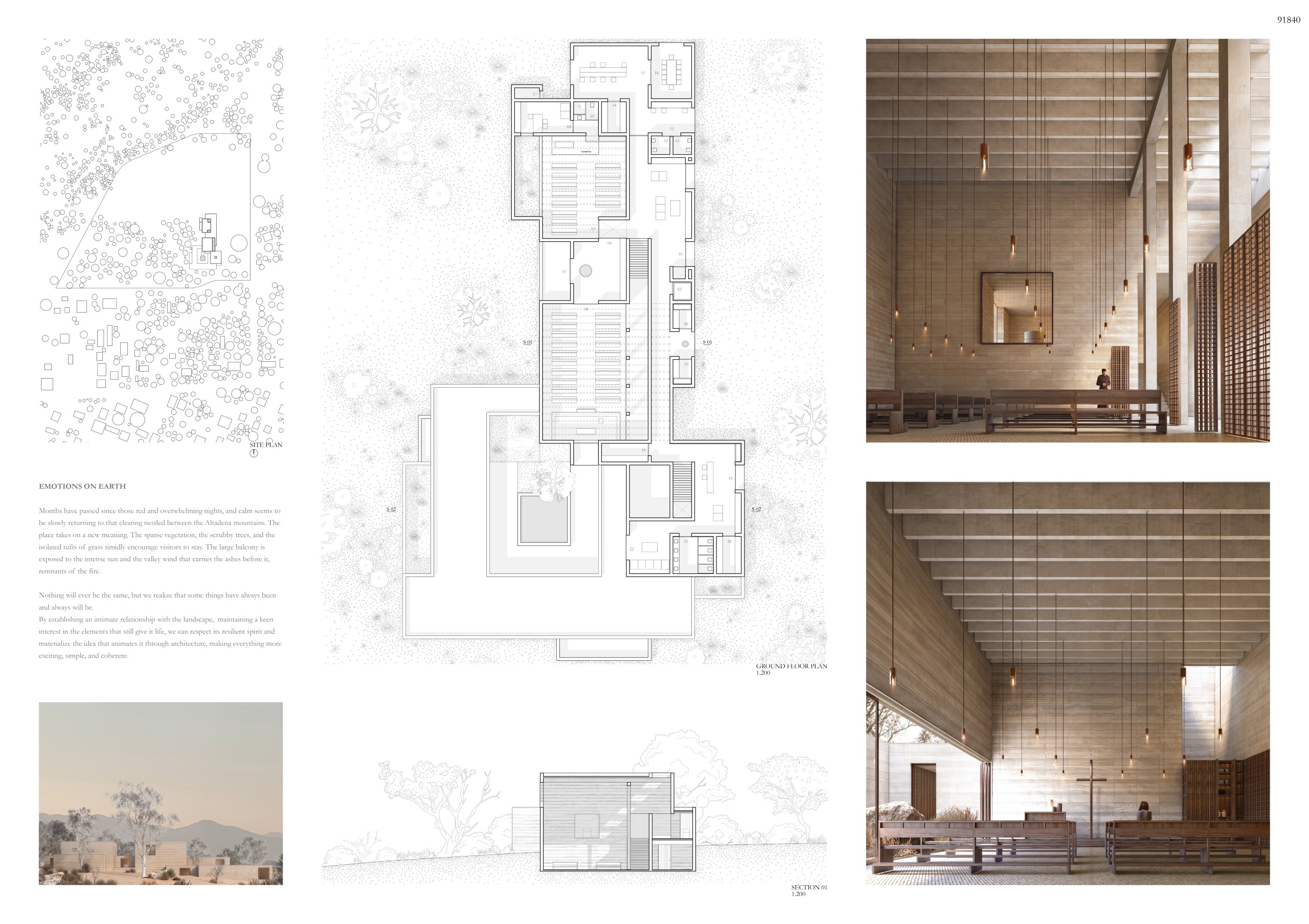
Months have passed since those red and overwhelming nights, and calm seems to be slowly returning to that clearing nestled among the Altadena mountains. The place takes on a new meaning. The sparse vegetation, the few trees, and the isolated tufts of grass timidly encourage visitors to stay. The large balcony is at the mercy of the intense sun and the valley wind that carries the ashes before it, still lingering after the fire.
Nothing will ever be the same, but we realize that some things have always been and always will be present. By establishing an intimate relationship with the landscape and maintaining a keen interest in the elements that still give it life, we can respect its resilient spirit and materialize the idea that animates it through architecture, making everything more exciting, simple, and coherent.
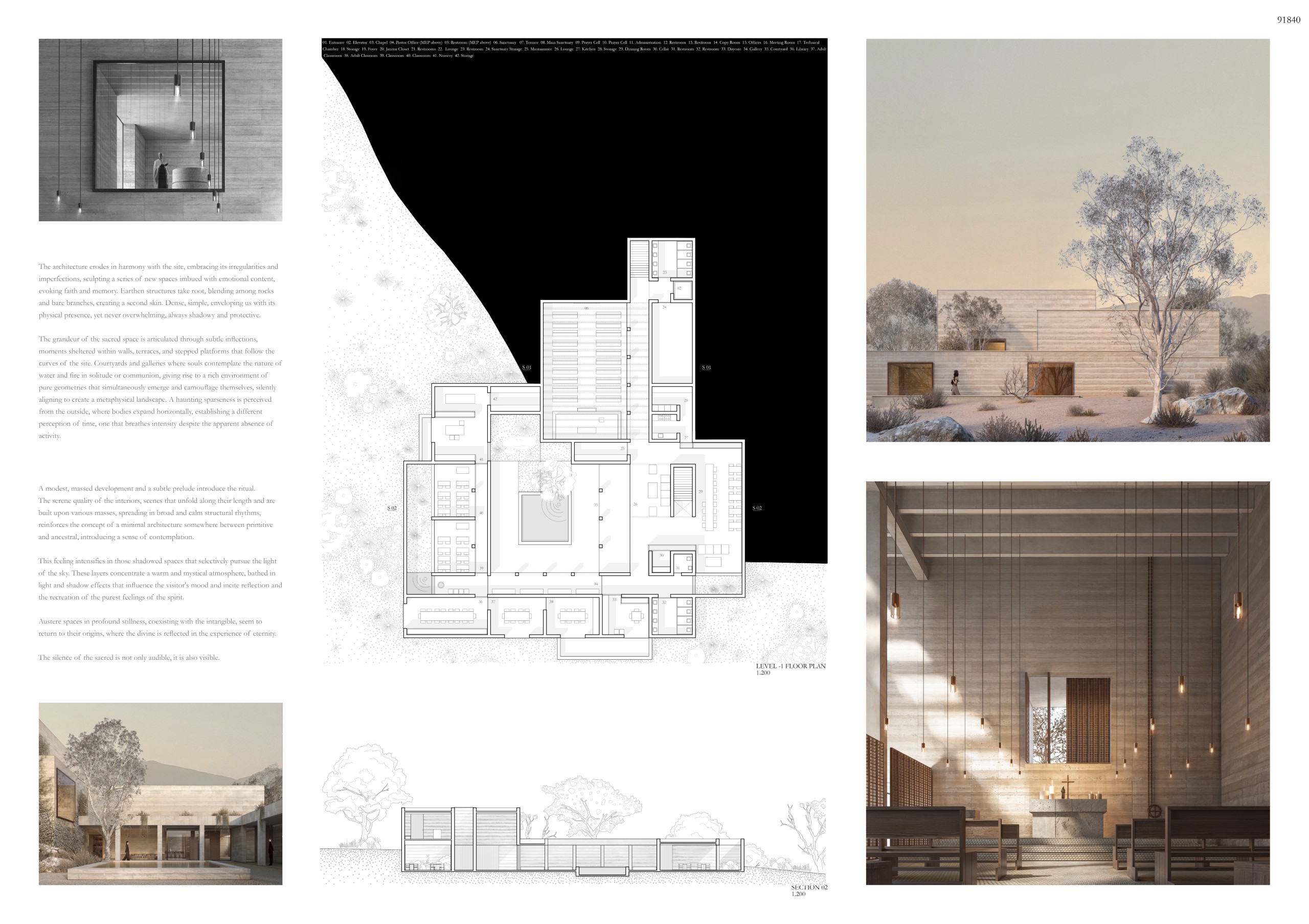
The architecture erodes in harmony with the place, accepting its imperfections and sculpting a series of new spaces with emotional content, evoking faith and memory. Earthen structures that take root in the ground, blending in with rocks and bare branches, creating a second skin. Dense, simple, enveloping us with their physical presence, yet never overwhelming, always shadowy and protective.
The grandeur of the sacred space is articulated through subtle inflections, moments sheltered within walls, terraces, and stepped platforms that follow the curves of the site. Courtyards and galleries where souls contemplate the nature of water and fire in solitude or communion, giving rise to a rich environment of pure geometries that simultaneously emerge and camouflage themselves, silently aligning to create a metaphysical landscape. A haunting sparseness is perceived from the outside, where bodies expand horizontally, establishing a different perception of time, one that breathes intensity despite the apparent absence of activity.
A modest massing and a subtle prelude introduce the ritual. The serene quality of the interiors, scenes that unfold and build upon various masses, spreading out in broad and calm structural rhythms, reinforces the concept of a minimal architecture somewhere between primitive and ancestral, introducing a sense of contemplation. This feeling intensifies in those shadowy spaces that selectively pursue the light of the sky. These layers concentrate a warm and mystical atmosphere, bathed in light and shadow—effects that influence the visitor’s mood and encourage reflection and the recreation of the purest feelings of the spirit. Stripped-down spaces in profound stillness, coexisting with the intangible, seem to return to their origins, where the divine is reflected in the experience of eternity.
The silence of the sacred is not only audible, it is also visible.
JURY COMMENT
“The “Emotions on Earth” project is richly informed by a long history of desert monasticism within the Christian church. The architecture suggests a presence of absence, telling the story of regional memory and of loss through a series of voids: apertures, openings, negative spaces, enclosures. The project’s muted exterior and desert vernacular creates a sensitive “village of forms” that is understated and non-assertive in its sacrality. This is an architecture that understand the wisdom of hiddenness.”
Amanda Iglesias – The Architecture of Prayer
3rd PRIZE
Monument of the land
Xin Yi, Han Yi [China]
PROJECT DESCRIPTION
I. Ashborne memories
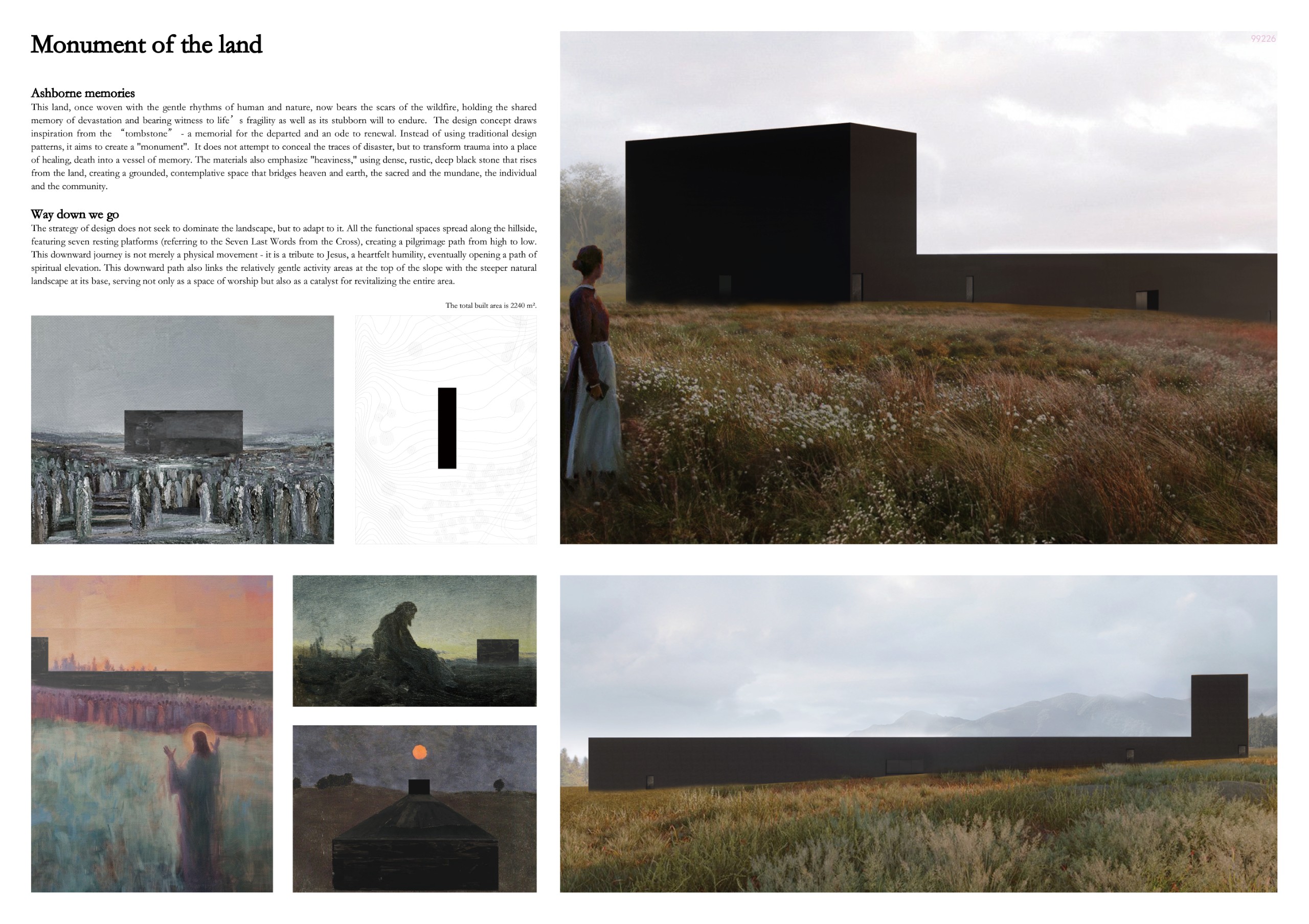
This land, once woven with the gentle rhythms of human and nature, now bears the scars of the wildfire, holding the shared memory of devastation and bearing witness to life’s fragility as well as its stubborn will to endure. The design concept draws inspiration from the “tombstone” – a memorial for the departed and an ode to renewal. Instead of using traditional design patterns, it aims to create a “monument”. It does not attempt to conceal the traces of disaster, but to transform trauma into a place of healing, death into a vessel of memory. The materials also emphasize “heaviness”, using dense, rustic, deep black stone that rises from the land, creating a grounded, contemplative space that bridges heaven and earth, the sacred and the mundane, the individual and the community.
II. Way down we go
The strategy of design does not seek to dominate the landscape, but to adapt to it. All the functional spaces spread along the hillside, featuring seven resting platforms (referring to the Seven Last Words from the Cross), creating a pilgrimage path from high to low. This downward journey is not merely a physical movement – it is a tribute to Jesus, a heartfelt humility, eventually opening a path of spiritual elevation. This downward path also links the relatively gentle activity areas at the top of the slope with the steeper natural landscape at its base, serving not only as a space of worship but also as a catalyst for revitalizing the entire area.
III. Orderliness—Narrowness
“Enter through the narrow gate. For wide is the gate and broad is the road that leads to destruction, and many enter through it. But small is the gate and narrow the road that leads to life, and only a few find it.”(Matthew 7:13-14)
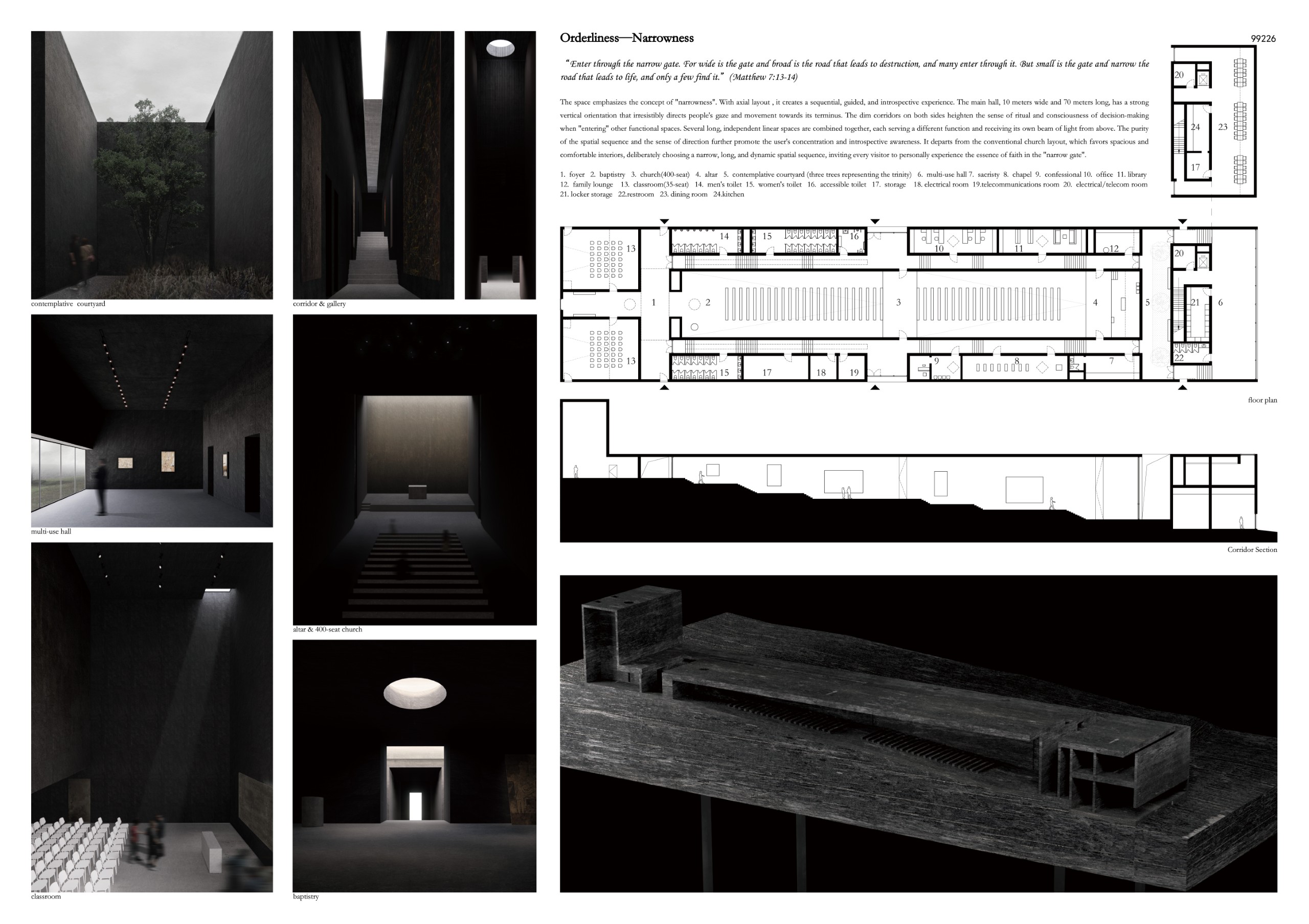
The space emphasizes the concept of “narrowness”. With axial layout , it creates a sequential, guided, and introspective experience. The main hall, 10 meters wide and 70 meters long, has a strong vertical orientation that irresistibly directs people’s gazeand movement towards its terminus. The dim corridors on both sides heighten the sense of ritual and consciousness of decision-making when “entering” other functional spaces. Several long, independent linear spaces are combined together, each serving a different function and receiving its own beam of light from above. The purity of the spatial sequence and the sense of direction further promote the user’s concentration and introspective awareness. It departs from the conventional church layout, which favors spacious and comfortable interiors, deliberately choosing a narrow, long, and dynamic spatial sequence, inviting every visitor to personally experience the essence of faith in the “narrow gate”.
JURY COMMENT
“The project demonstrates strong conceptual clarity and coherence between narrative, form, and spatial sequence. The emotional intent is legible and consistently translated into massing, light, and procession. Its restraint is a strength, giving the architecture presence and gravity.”
Jordi Espinet – Mesura
Golden Mentions
(ordered by registration code)
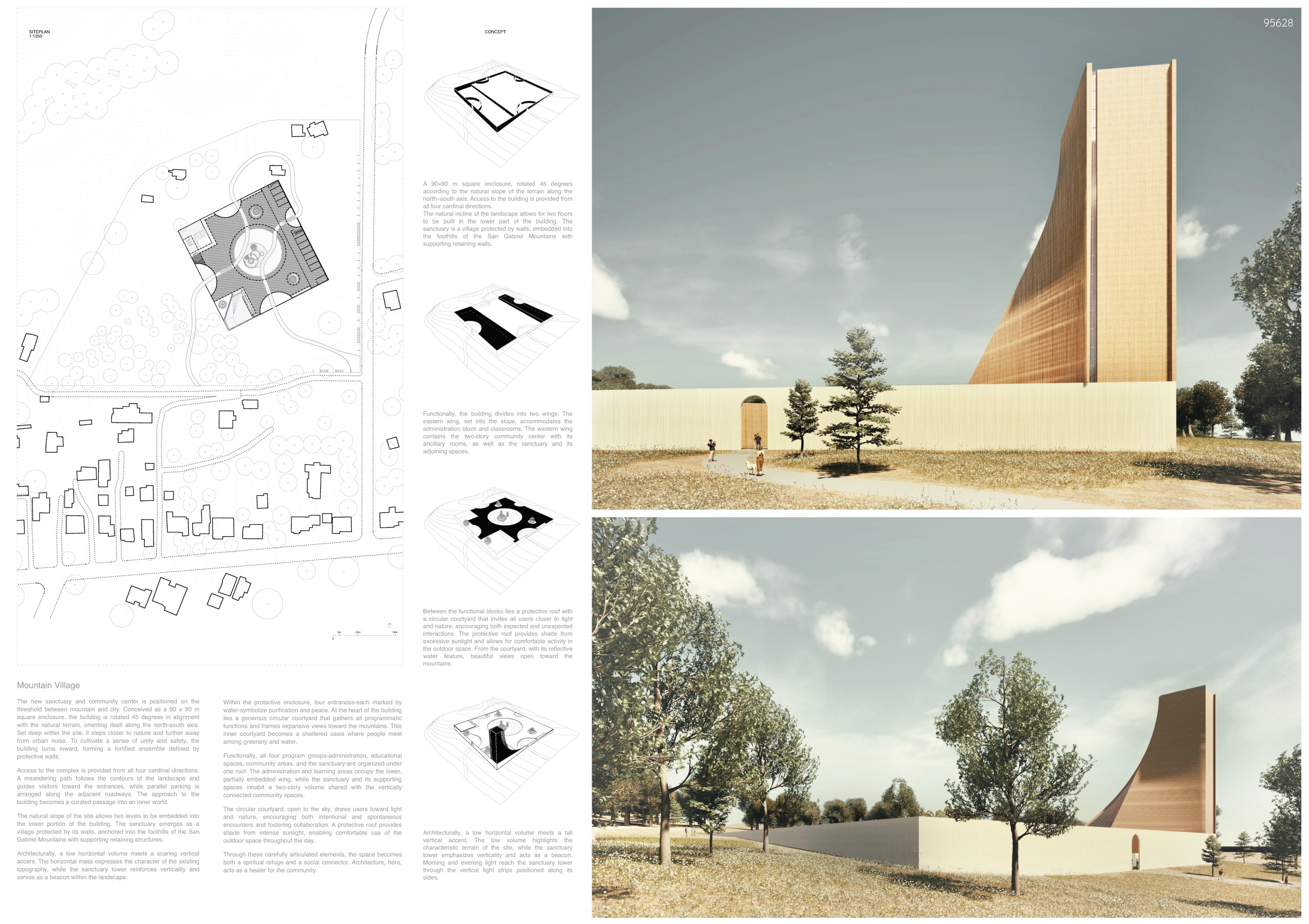
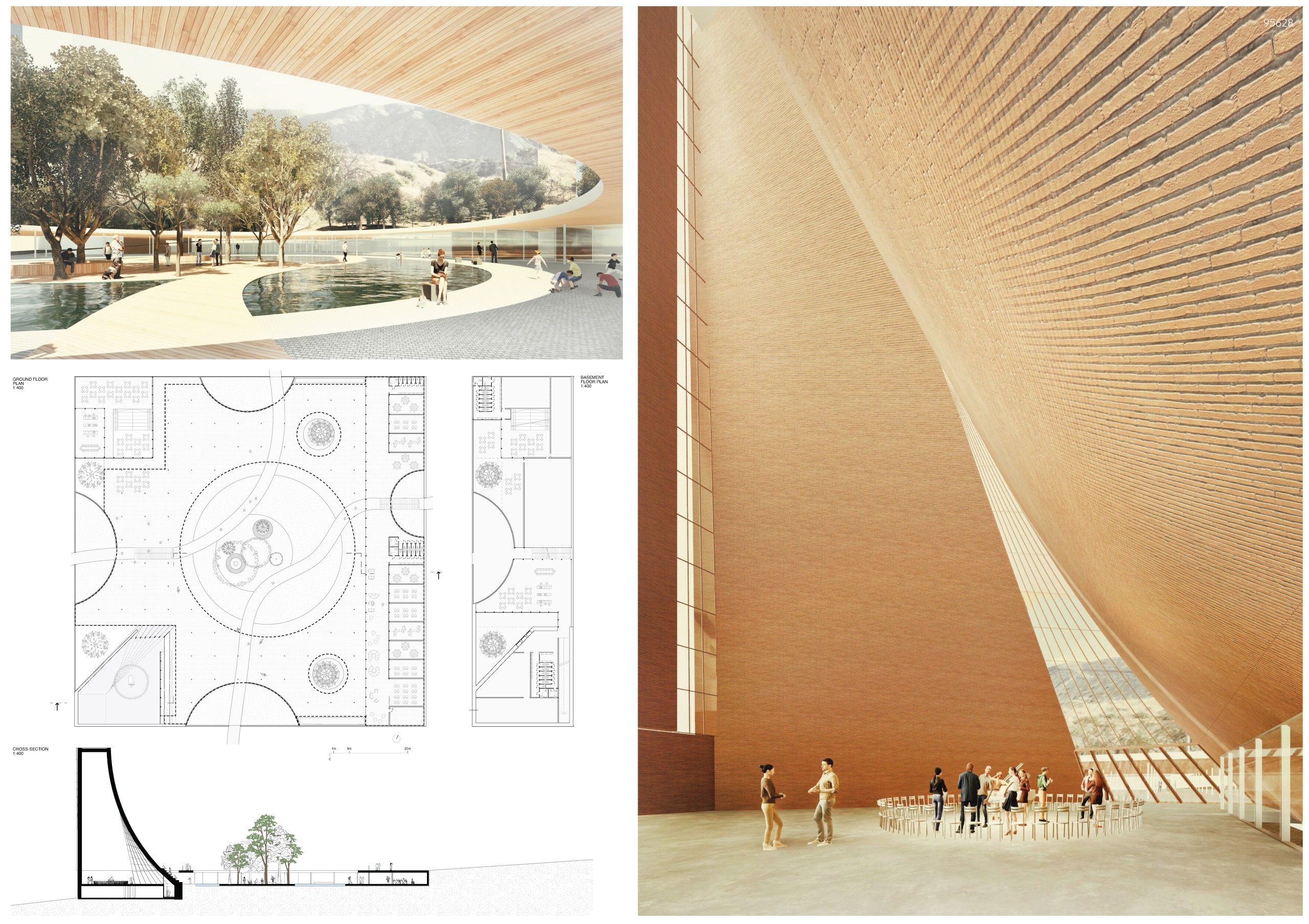
Sanctuary of Renewal
Isaac Vaarzon Morel [Netherlands]
PROJECT DESCRIPTION
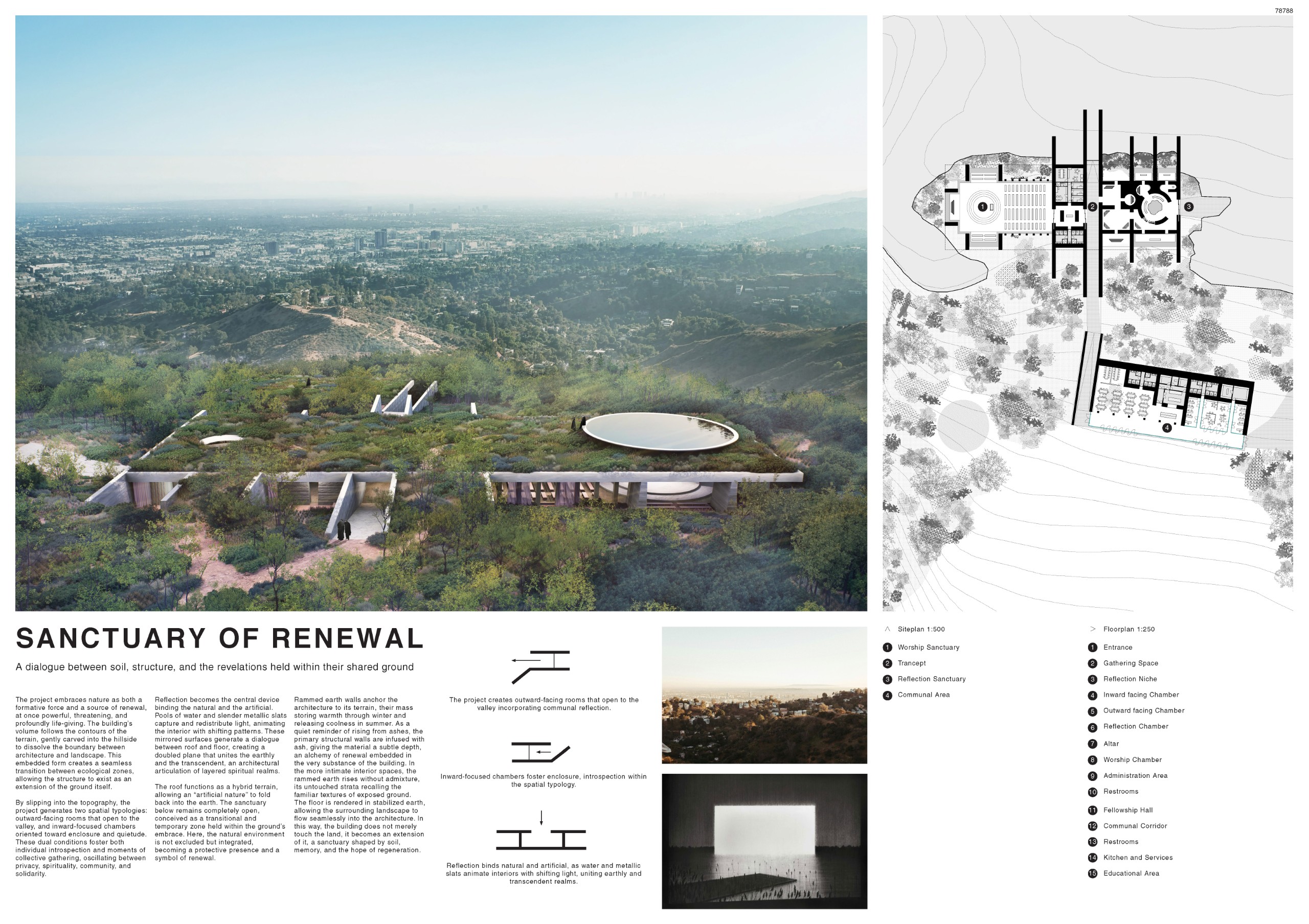
The project embraces nature as both a formative force and a source of renewal, at once powerful, threatening, and profoundly life-giving. The building’s volume follows the contours of the terrain, gently carved into the hillside to dissolve the boundary between architecture and landscape. This embedded form creates a seamless transition between ecological zones, allowing the structure to exist as an extension of the ground itself.
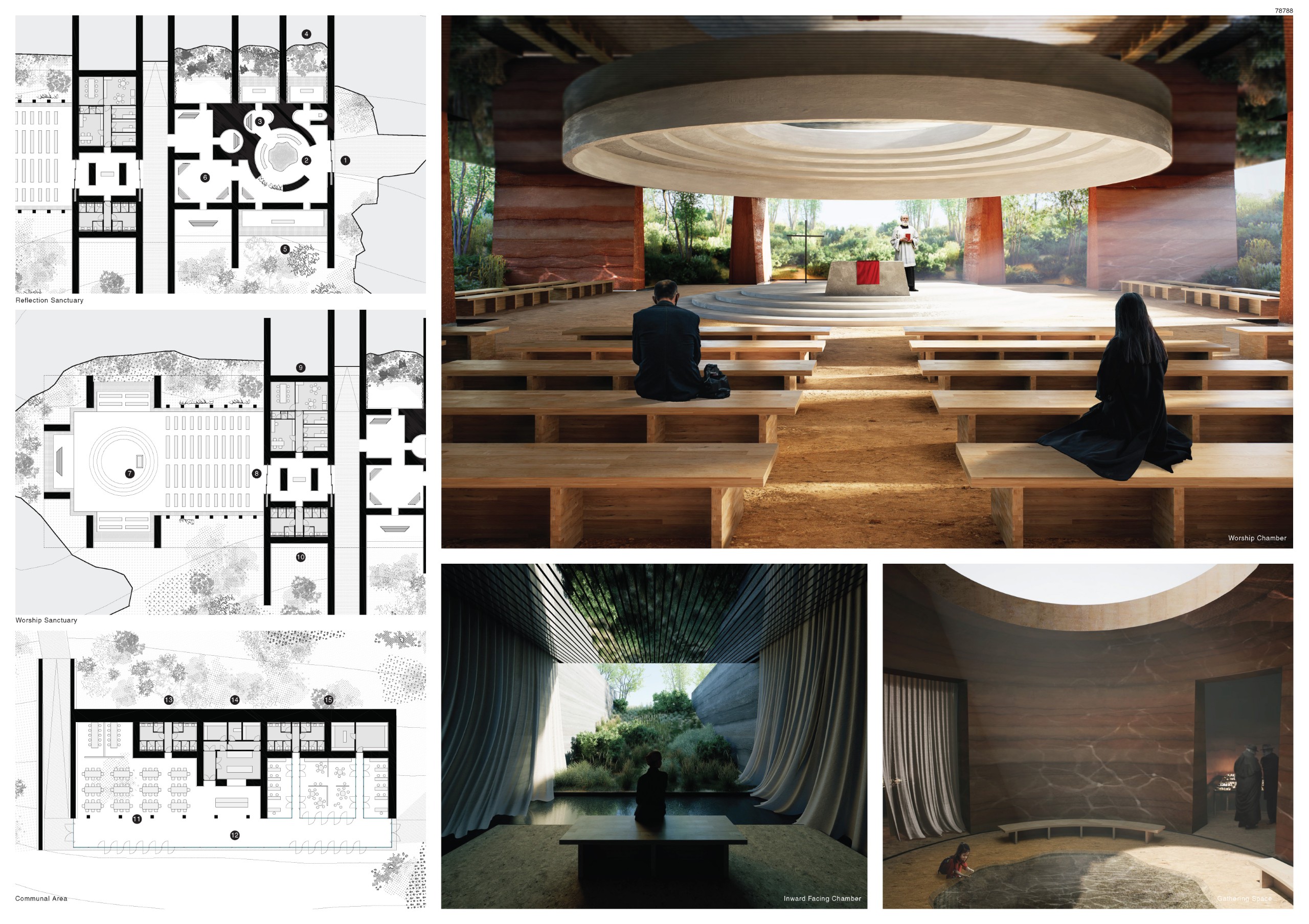
By slipping into the topography, the project generates two spatial typologies: outward-facing rooms that open to the valley, and inward-focused chambers oriented toward enclosure and quietude. These dual conditions foster both individual introspection and moments of collective gathering, oscillating between privacy, spirituality, community, and solidarity.
Reflection becomes the central device binding the natural and the artificial. Pools of water and slender metallic slats capture and redistribute light, animating the interior with shifting patterns. These mirrored surfaces generate a dialogue between roof and floor, creating a doubled plane that unites the earthly and the transcendent, an architectural articulation of layered spiritual realms.
The roof functions as a hybrid terrain, allowing an “artificial nature” to fold back into the earth. The sanctuary below remains completely open, conceived as a transitional and temporary zone held within the ground’s embrace. Here, the natural environment is not excluded but integrated, becoming a protective presence and a symbol of renewal.
Rammed earth walls anchor the architecture to its terrain, their mass storing warmth through winter and releasing coolness in summer. As a quiet reminder of rising from ashes, the primary structural walls are infused with ash, giving the material a subtle depth, an alchemy of renewal embedded in the very substance of the building. In the more intimate interior spaces, the rammed earth rises without admixture, its untouched strata recalling the familiar textures of exposed ground. The floor is rendered in stabilized earth, allowing the surrounding landscape to flow seamlessly into the architecture. In this way, the building does not merely touch the land, it becomes an extension of it, a sanctuary shaped by soil, memory, and the hope of regeneration.
JURY COMMENT
“This proposal integrates with the landscape, where architecture is conceived as an extension of the terrain rather than an imposed object. The sensitive embedding of the volumes creates a rich sequence of collective gathering spaces and more intimate, sheltered recesses, allowing both community encounter and personal contemplation to coexist naturally.”
Amparo Dominguez Soler – Open House Valencia
The Ashen Vine
Lorenzo Valdes, Leonardo Lot [Italy]
PROJECT DESCRIPTION
“To build means, first of all, to listen to what a place is asking for.”
Pope Francis – Vatican City.
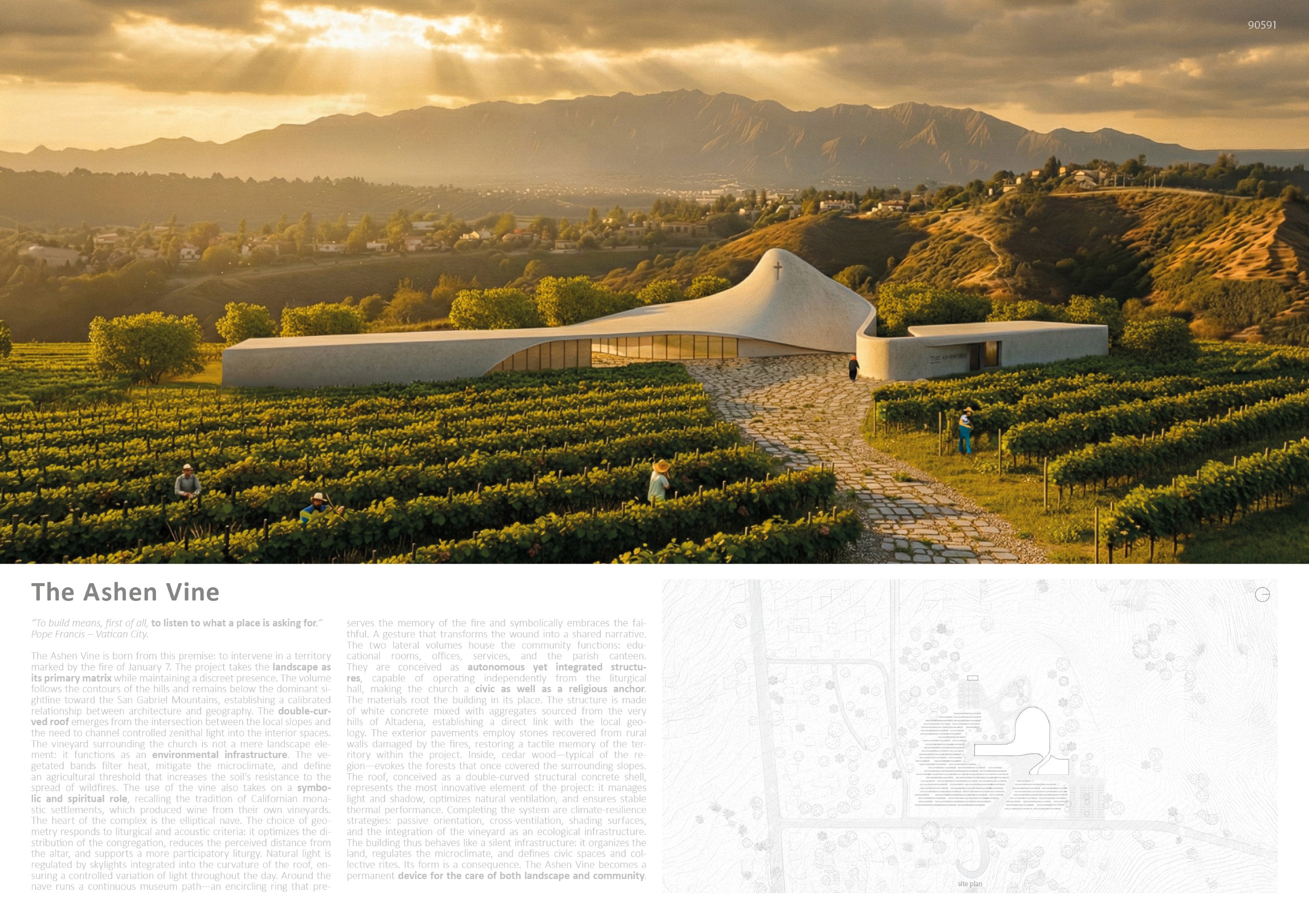
The Ashen Vine is born from this premise: to intervene in a territory marked by the fire of January 7. The project takes the landscape as its primary matrix while maintaining a discreet presence. The volume follows the contours of the hills and remains below the dominant sightline toward the San Gabriel Mountains, establishing a calibrated relationship between architecture and geography. The double-curved roof emerges from the intersection between the local slopes and the need to channel controlled zenithal light into the interior spaces.
The vineyard surrounding the church is not a mere landscape element: it functions as an environmental infrastructure. The vegetated bands filter heat, mitigate the microclimate, and define an agricultural threshold that increases the soil’s resistance to the spread of wildfires. The use of the vine also takes on a symbolic and spiritual role, recalling the tradition of Californian monastic settlements, which produced wine from their own vineyards.
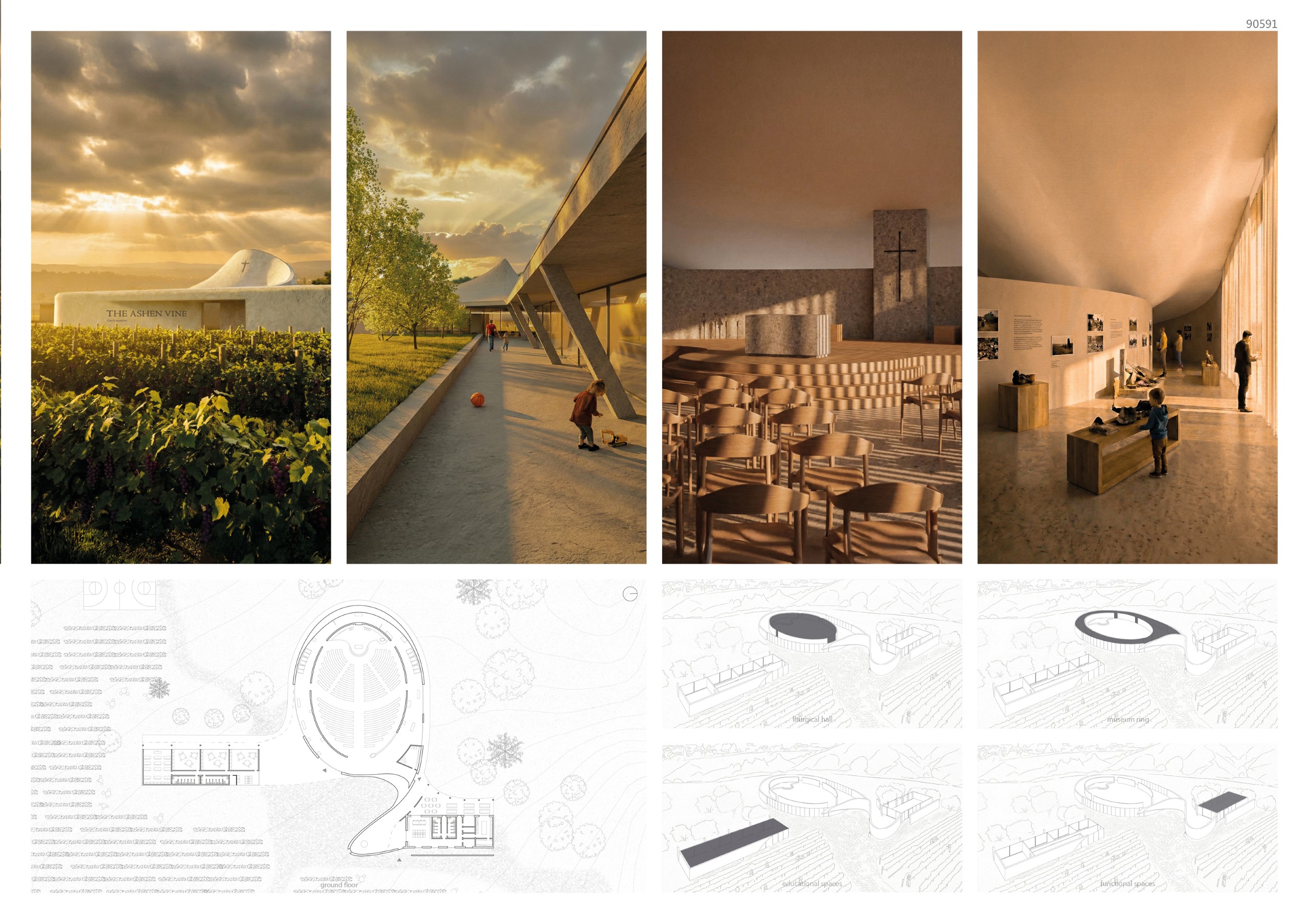
The heart of the complex is the elliptical nave. The choice of geometry responds to liturgical and acoustic criteria: it optimizes the distribution of the congregation, reduces the perceived distance from the altar, and supports a more participatory liturgy. Natural light is regulated by skylights integrated into the curvature of the roof, ensuring a controlled variation of light throughout the day. Around the nave runs a continuous museum path—an encircling ring that preserves the memory of the fire and symbolically embraces the faithful. A gesture that transforms the wound into a shared narrative.
The two lateral volumes house the community functions: educational rooms, offices, services, and the parish canteen. They are conceived as autonomous yet integrated structures, capable of operating independently from the liturgical hall, making the church a civic as well as a religious anchor.
The materials root the building in its place. The structure is made of white concrete mixed with aggregates sourced from the very hills of Altadena, establishing a direct link with the local geology. The exterior pavements employ stones recovered from rural walls damaged by the fires, restoring a tactile memory of the territory within the project. Inside, cedar wood—typical of the region—evokes the forests that once covered the surrounding slopes.
The roof, conceived as a double-curved structural concrete shell, represents the most innovative element of the project: it manages light and shadow, optimizes natural ventilation, and ensures stable thermal performance. Completing the system are climate-resilience strategies: passive orientation, cross-ventilation, shading surfaces, and the integration of the vineyard as an ecological infrastructure.
The building thus behaves like a silent infrastructure: it organizes the land, regulates the microclimate, and defines civic spaces and collective rites. Its form is a consequence. The Ashen Vine becomes a permanent device for the care of both landscape and community.
JURY COMMENT
“It is a refreshing proposal to me, the Ashen Vine presents an elevated, landscape-responsive church that confidently anchors its setting, transforming fire-scarred terrain into a visible and well-connected civic and spiritual landmark. Shaped by topography, light, and climate, the architecture integrates landscape, memory, and community functions. I appreciate the proposal which developed unique sense of resilient, quietly powerful symbol of renewal and collective care.”
Rean Yan Zhuo – Arkee Studio
Afterlight
Derin Kinacigil [United Kingdom] www.d-k-d.com
PROJECT DESCRIPTION
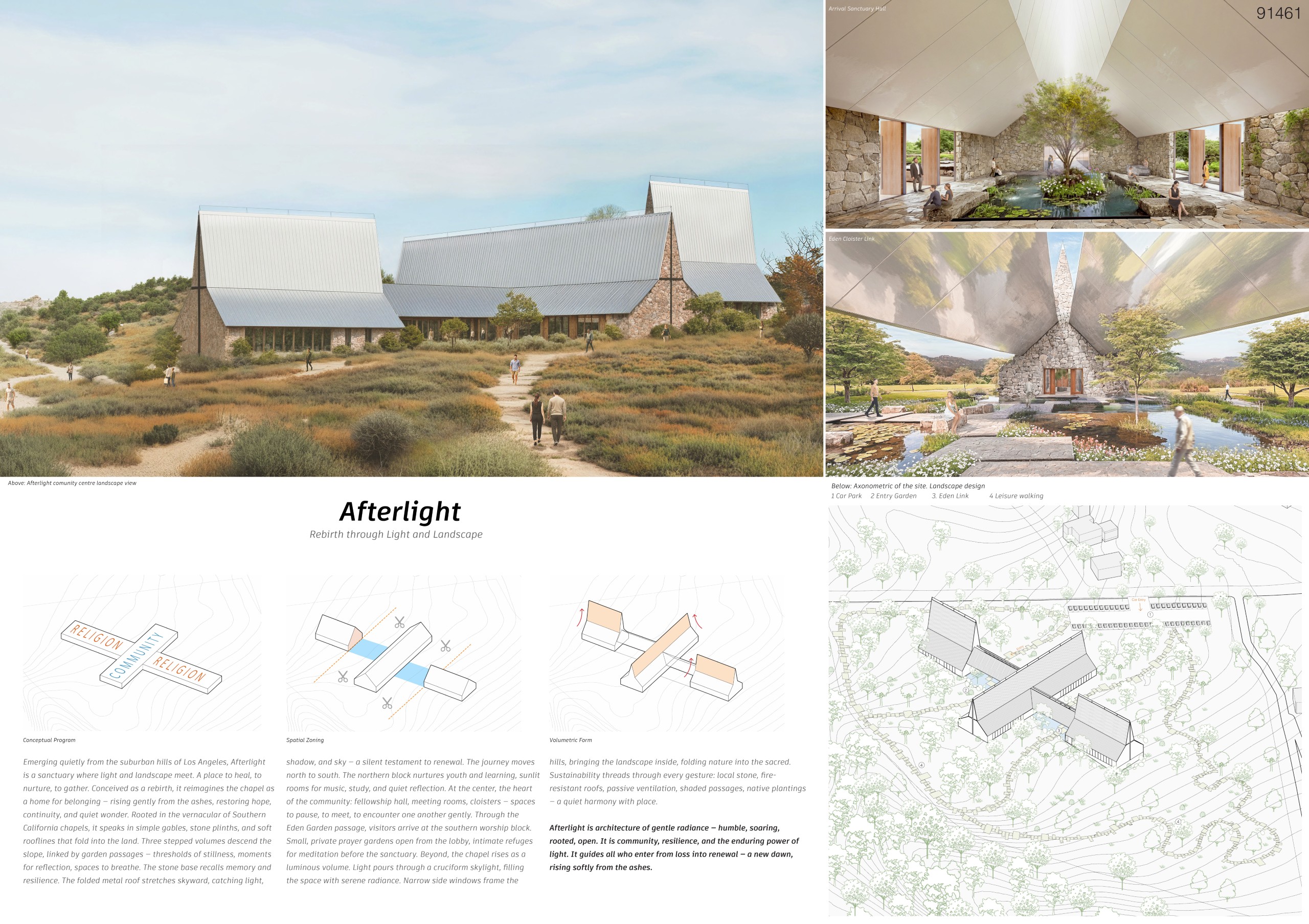
Emerging quietly from the suburban hills of Los Angeles, Afterlight embodies the gentle strength of renewal — a sanctuary where light and landscape come together to heal, nurture, and reconnect community and faith. Conceived as a rebirth through light and landscape, the project reimagines the local chapel as a place of shared belonging, rising humbly from the ashes to restore hope and continuity.
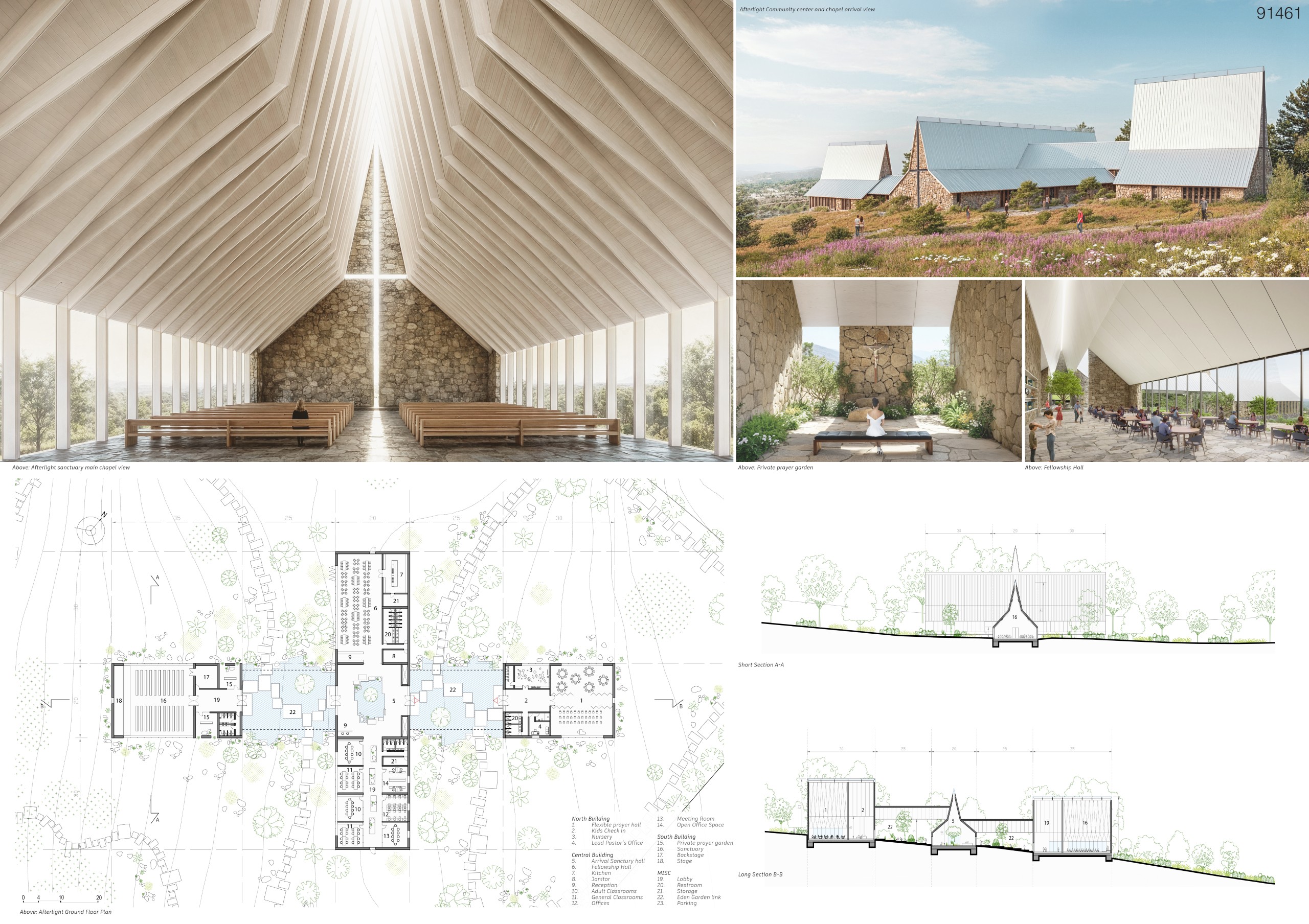
Rooted in the vernacular of Southern California chapels, the design draws from familiar forms and honest materials — simple gables, stone bases, and soft rooflines that merge naturally with the landscape. Three distinct volumes step down the sloping site, each connected by serene garden cloisters that form a contemplative sequence of movement and reflection. The stone plinth recalls the memory of burnt churches, while the folded standing-seam metal roof ascends toward the heavens, its reflective surface mirroring the changing sky and the shimmering water ponds below — a quiet metaphor for transcendence and rebirth.
The spatial journey unfolds from north to south. The northern block is dedicated to youth and learning — a nursery and community chapel bathed in natural light, nurturing young minds through bible study, music, and education. The central block anchors the ensemble as the civic heart, housing the fellowship hall, meeting rooms, and staff areas around bright interior gathering spaces and open cloisters — places of pause, exchange, and gentle encounter.
Through the Eden Garden link, visitors arrive at the southern worship block, where the architecture deepens in emotion and stillness. From the chapel lobby, small private prayer gardens open discreetly, offering spaces for personal reflection and quiet prayer before entering the main sanctuary. Beyond lies the primary chapel, a luminous volume whose roof geometry folds skyward. Light filters through a cruciform skylight, filling the interior with a sereneradiance, while narrow side windows frame views of the surrounding hills — drawing the landscape into the sacred space.
Sustainability is embedded in the project’s ethos: local stone and non-combustible metal roofing ensure resilience in wildfire-prone regions; passive ventilation, shaded cloisters, and native plantings reduce energy use while enriching the sensory experience.
Ultimately, Afterlight is an architecture of renewal — humble yet radiant, rooted in place yet reaching skyward. It stands as a testament to community resilience and the enduring power of light to guide us through loss into hope — a new dawn, rising from the ashes.
JURY COMMENT
“Well-crafted and sensitive proposal that prioritises atmosphere, continuity, and community over formal ambition. While spatially calm and carefully integrated into its setting, the project relies on familiar architectural languages and symbolic devices, positioning it as a solid and coherent entry rather than a standout or radical interpretation of the theme.”
Martina Rosati – Zaha Hadid Architects
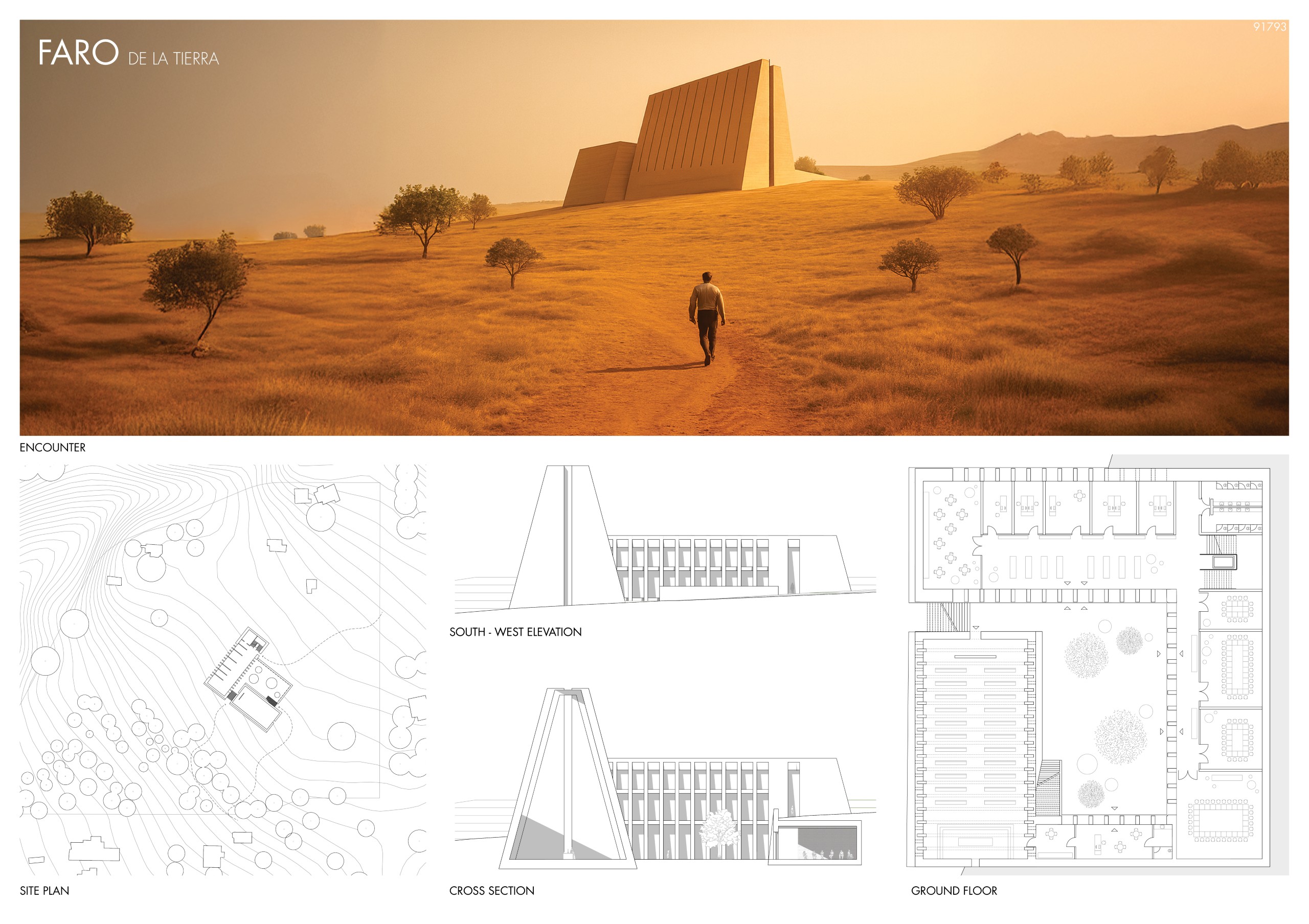
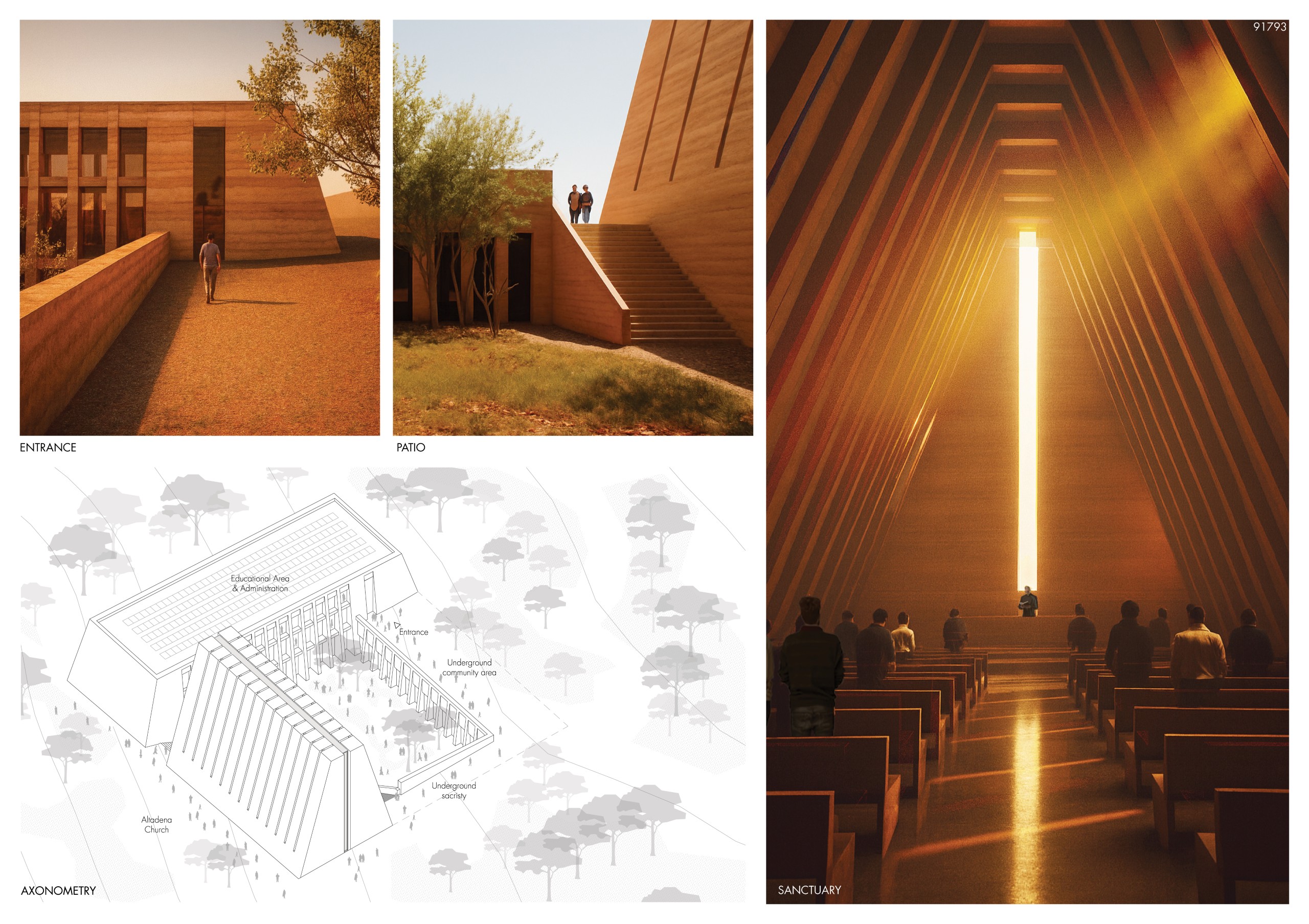
Faro de la Tierra
Juan David Botello Meza, Marc Laibacher [Colombia]
PROJECT DESCRIPTION
In Altadena, a new church is rising from the devastation of recent wildfires, becoming a place of hope and quiet reflection. The building combines earth and steel to withstand fire while also making a strong statement about sustainable construction. As a counterpoint to the technological visions of nearby Silicon Valley, it reminds us that sacred architecture does not need to rely on climate-damaging concrete and that progress without regard for the environment contributes to the climate crisis.
The church uses passive cooling, thermal mass, and deep-set openings to create shade and work in harmony with the local climate. In this way, it becomes a symbol of a future in which the community overcomes the fires of climate change, finds stillness, and takes responsibility for the Earth. It points toward a future in which humanity mitigates the consequences of climate change without falling into mere activism, drawing strength from moments of quiet, and embracing its responsibility for creation — echoing the task given to humanity in Genesis 2:15: to cultivate and care for the Earth.
Finding the right balance here, in shared responsibility for creation, is also the central theme of this year’s Venice Architecture Biennale. The church in Altadena gives this task a particularly meaningful architectural expression.
Its orientation also carries historical meaning: the church is set on a 38-degree tilt, aligning itself with the angled grid first established by the early Spanish settlers of Los Angeles. This gesture connects the building to the region’s earliest layers of urban history, acknowledging the cultural landscape that shaped Southern California long before the modern metropolis emerged.
JURY COMMENT
“The proposal is driven by a strong conceptual idea that is clearly legible and effectively supported by light, procession, and symbolic form. The main gesture has presence and communicates its intent with clarity.”
Jordi Espinet – Mesura
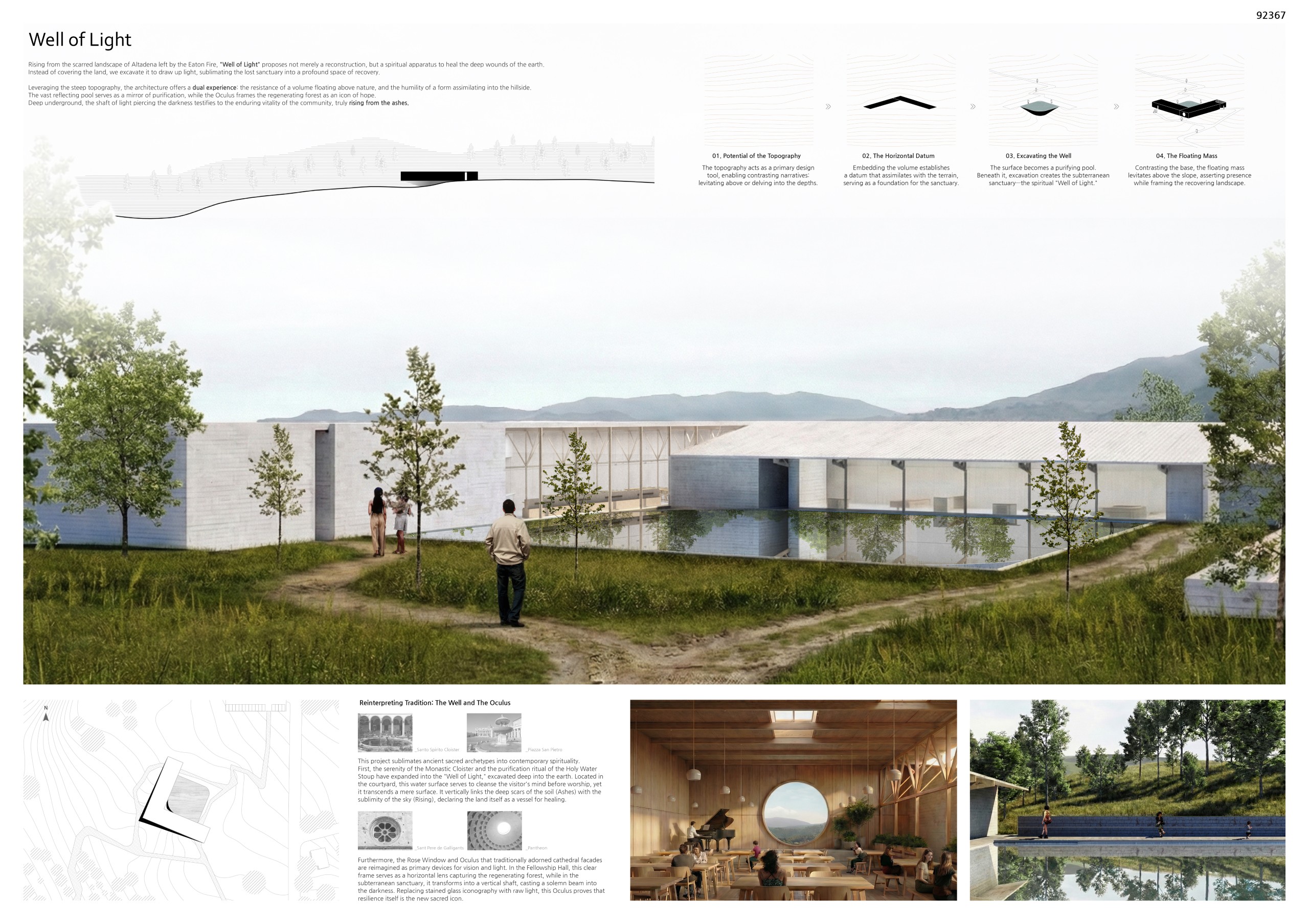
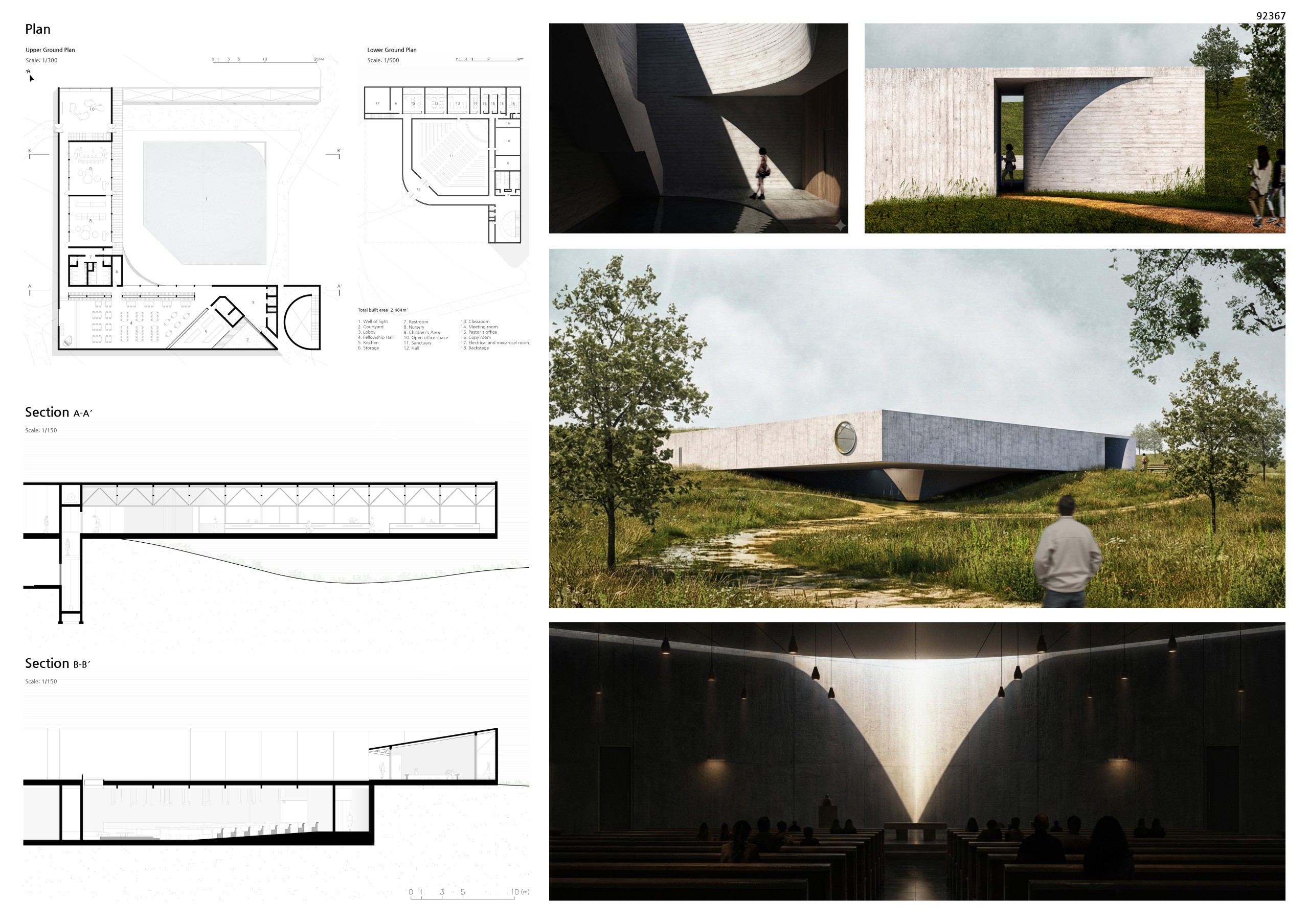
Well of Light
Seoho Kim [South Korea]
PROJECT DESCRIPTION
In the wake of the Eaton Fire, the landscape of Altadena bears deep scars. This proposal, “Well of Light,” is not merely a reconstruction of lost structures but a spiritual apparatus that excavates the earth to draw up light and healing. The design anchors itself in the steep topography, using the section of the land to narrate a journey from ashes to resilience.
The Duality of the Slope The architecture leverages the site’s gradient to create two contrasting experiences. From the lower approach, the building asserts itself as a horizontal concrete monolith floating above the rugged terrain, emphasizing resilience against the wild. Conversely, from the upper approach, the volume submerges into the hillside. Here, the architecture recedes, blending seamlessly with the contours to suggest humility and assimilation with nature.
Surface of Purification At the heart of the sequence lies a central courtyard featuring a vast reflecting pool. Reinterpreting the traditional narthex as a transitional zone for cleansing the mind, this water feature mirrors the sky and the surrounding greenery. It acts as a mirror for the earth, reflecting not the destruction of the past, but the vitality of the regenerating forest.
Framing the Recovery The Fellowship Hall features a modern reinterpretation of the sacred oculus. A large, clear circular window acts as a lens, framing the specific view of the mountains that are slowly recovering from the fire. This “Oculus of Recovery” transforms the landscape itself into a sacred icon, turning the act of looking into a ritual of hope.
The Well of Light The core of the project is the subterranean sanctuary, buried deep beneath the water level. While the surface connects with the landscape, this interior turns inward to the silence of the earth. Light pours in through a sculptural skylight that pierces the ground from above. Like a vertical shaft connecting the darkness of the soil (Ashes) with the brightness of the sky (Rising), this “Well of Light” creates a solemn atmosphere where the community can find spiritual refuge in the grounding embrace of the land.
A Vessel for Renewal Ultimately, “Well of Light” stands as a testament to the community’s endurance. By intertwining the permanence of the earth with the ephemeral quality of light, the architecture becomes a vessel for collective memory. It transforms the site of tragedy into a landscape of renewal, ensuring that from the ashes of the past, a brighter, shared future can truly rise.
JURY COMMENT
“The project proposes an “L-shaped” structure with a linear distribution, whose most acute point is cantilevered, effectively addressing the site’s topographic discontinuity.
The proposed spaces interpret the theme of the sacred through a monumental architectural language, primarily articulated through material choices and the deliberately oversized scale of certain spatial sequences.”
Laura Mucciolo – La Sapienza
Honorable Mentions
(ordered by registration code)
Radiant Path
Oleksii Zolochevskyi, David Sieliekh [Ukraine]
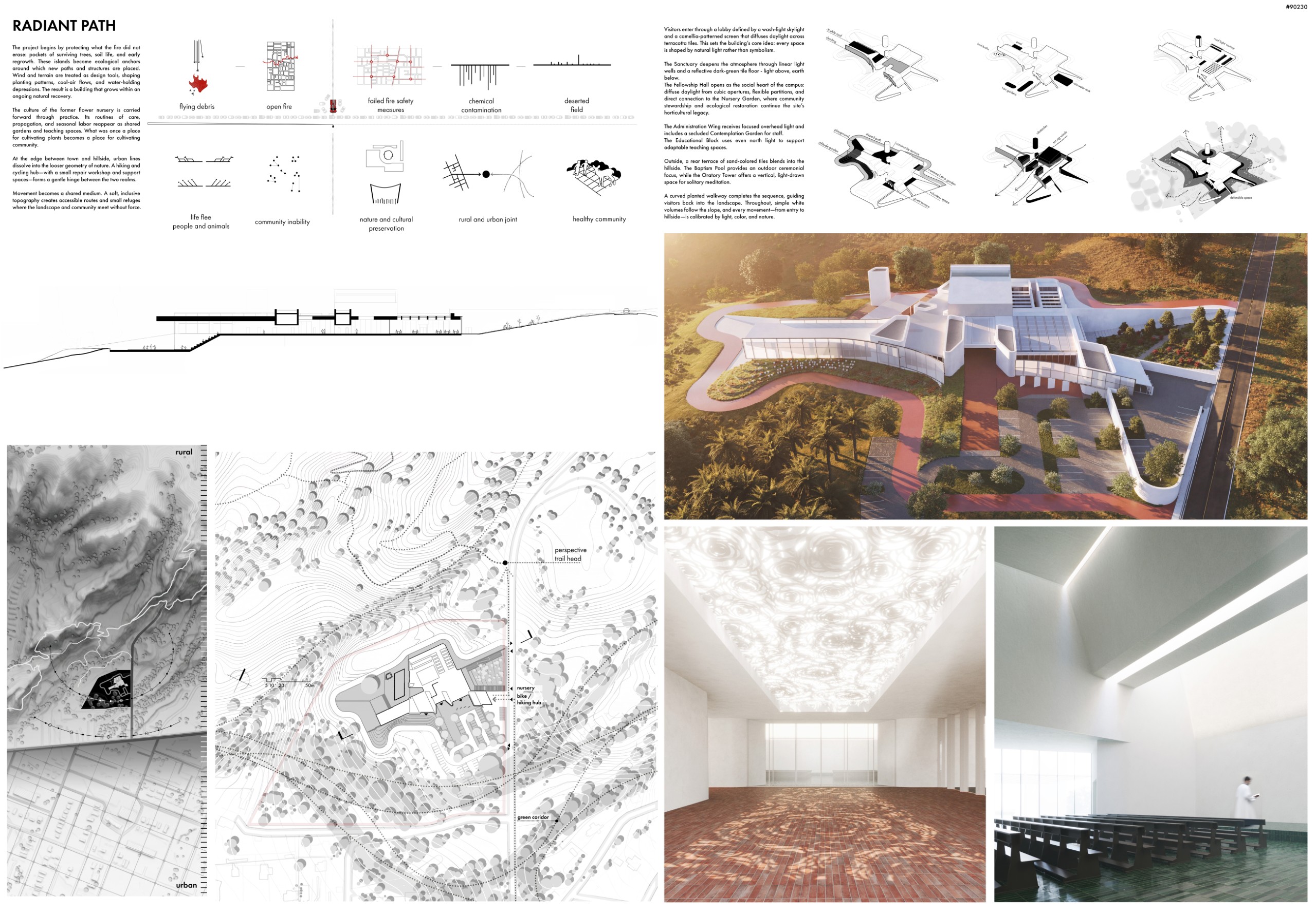
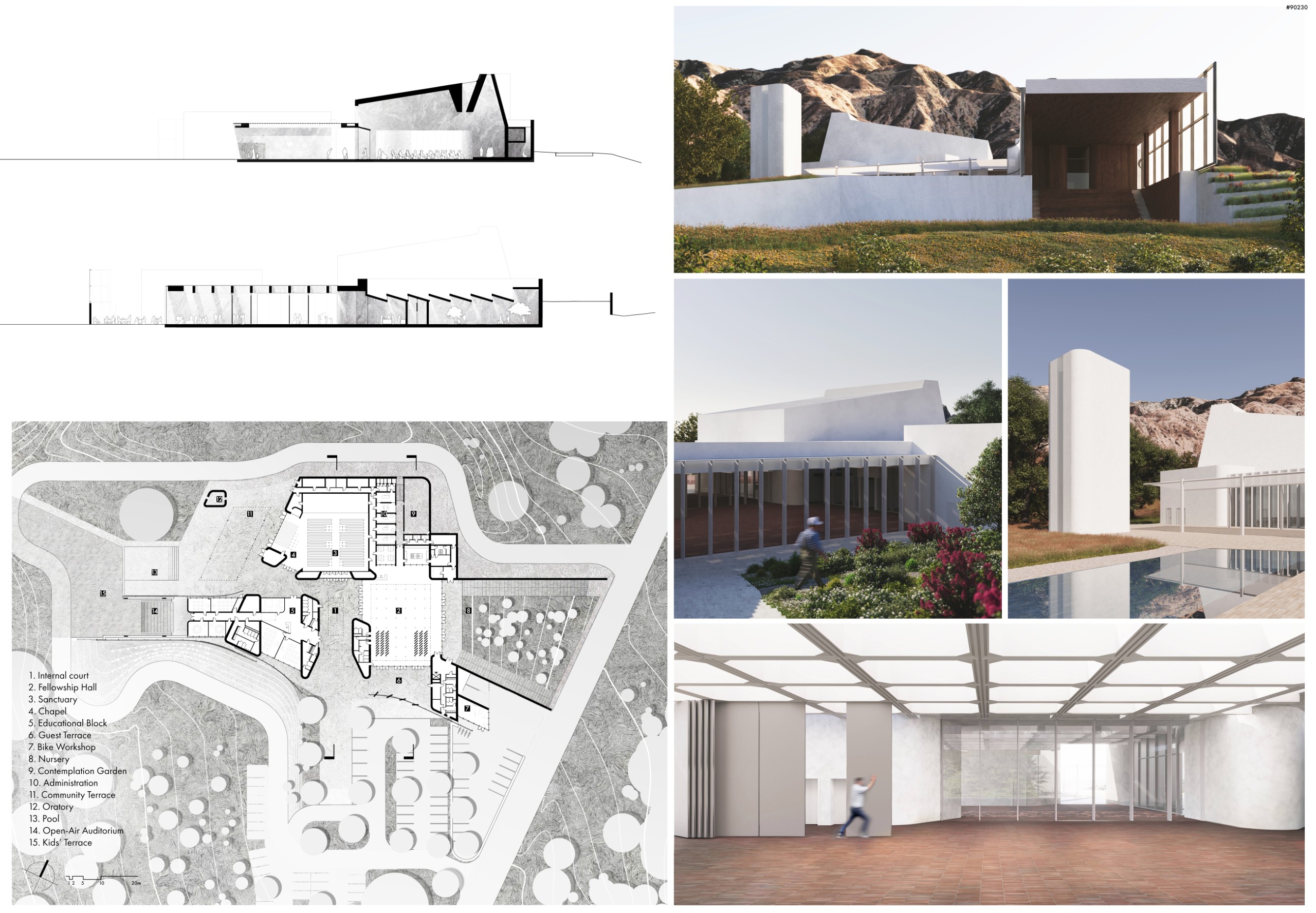
PROJECT DESCRIPTION
Entering through the main entrance, visitors arrive in a lobby defined by a wash-light skylight. A camellia-patterned screen diffuses daylight into a soft, even illumination that falls onto the terracotta tiles. The light flows almost like water, gently washing over parishioners as they step inside. This space establishes the building’s central idea: every room is shaped by natural light and oriented according to the sun path. The architecture avoids explicit religious symbols, instead, light itself becomes the expression of faith.
From here, visitors move into the Sanctuary, where the atmosphere becomes quieter and more controlled. Linear light wells introduce soft, indirect daylight that avoids glare and maintains visual comfort. The absence of ornament directs attention to the interplay between light and mass. The dark green glazed tile floor, almost aquatic in its reflectivity, anchors the space, providing tactile contrast to the soft overhead glow. It becomes a symbolic earth beneath the illuminated sky.
Continuing forward, circulation leads into the Fellowship Hall, the primary social and multifunctional space. Cubic ceiling apertures deliver diffuse daylight, keeping the room bright with minimal artificial lighting. The hall embodies community: warm, breathable, and adaptable. Moveable partitions allow reconfiguration for large gatherings, workshops, smaller group events, or shared meals. This flexibility makes it the operational heart of the campus. Panoramic glazing opens toward the Nursery Garden, where volunteers restore native vegetation and support habitats for pollinators and wildlife, linking the interior to the site’s ecological mission and referencing its historical use as a nursery.
Adjacent to the fellowship hall is the Administration Wing, a compact sequence of offices illuminated by individual skylight wells. Directly connected (but reserved exclusively for priests and staff) is the Contemplation Garden, an enclosed outdoor room used for private preparation and reflection. Filtered light, controlled planting, and acoustic separation create a focused environment for pastoral work.
Further along the circulation spine, the Educational Block opens with large north-facing windows that bring in stable, glare-free daylight. The rooms are planned for flexibility and visibility, supporting classes, workshops, and community programs.
Stepping outside to the rear terrace, the material shifts to sand-colored tiles that visually merge with the surrounding hillside. The elongated Baptism Pool anchors this space, providing a dedicated outdoor area for ceremonies with generous room for congregation. Next to it stands the Oratory Tower, a minimal vertical chamber illuminated by a slender glass line, offering a quiet space for individual meditation.
The campus experience concludes along a curved green walkway descending toward the northern slope. This planted corridor serves as both circulation and ecological connector, guiding visitors back into the landscape. The exterior forms remain simple white curved volumes set gently into the terrain, allowing the architecture to follow the natural slope. The walk ends with open sky, wind, and birds, reminding visitors that every part of the church, from entrance to hillside, is shaped by light, color, and nature.
FROM IGNITION TO REBIRTH
Julia Brzezowska [Poland]
PROJECT DESCRIPTION
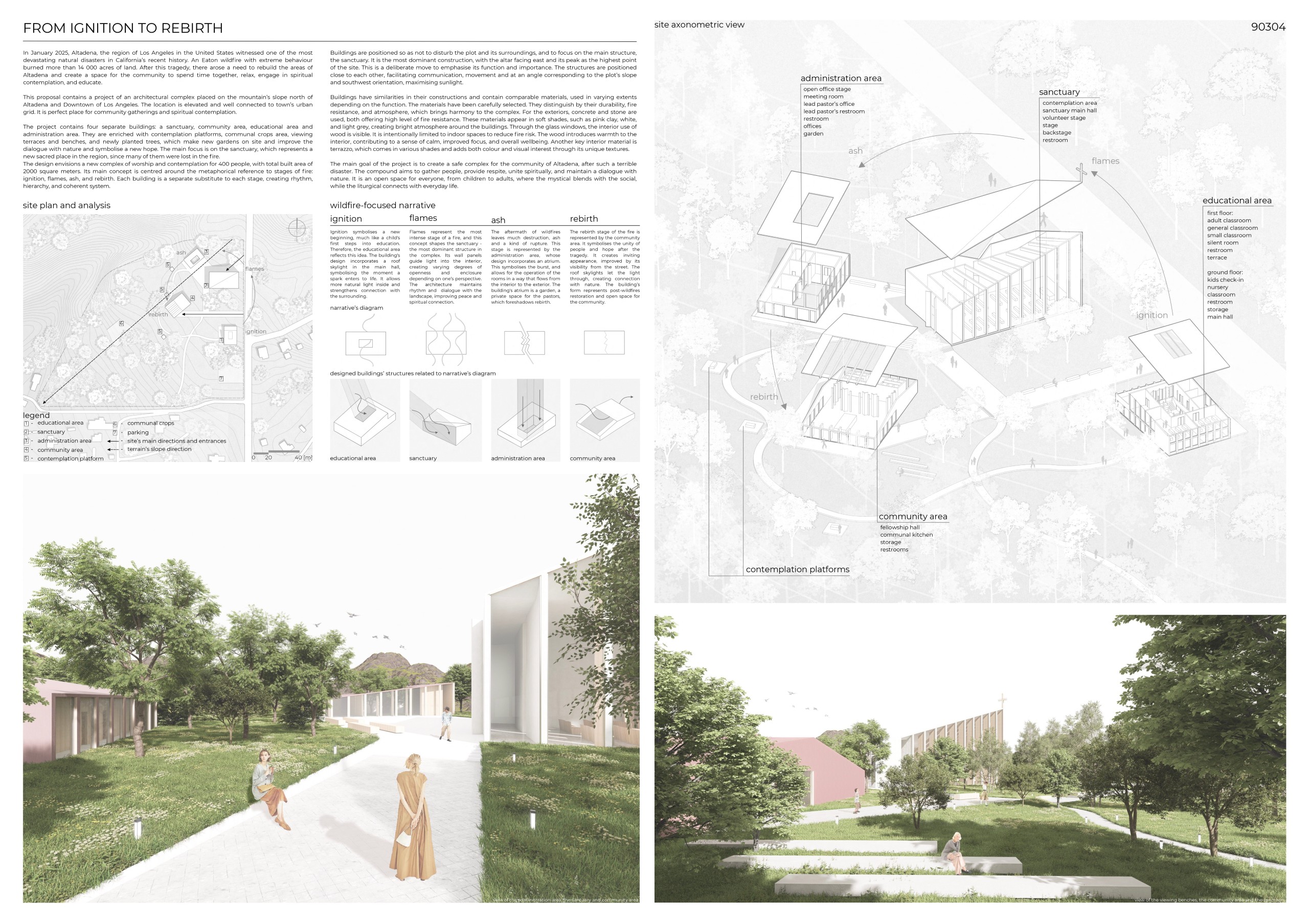
In January 2025, Altadena, the region of Los Angeles in the United States witnessed one of the most devastating natural disasters in California’s recent history. An Eaton wildfire with extreme behaviour burned more than 14 000 acres of land. After this tragedy, there arose a need to rebuild the areas of Altadena and create a space for the community to spend time together, engage in spiritual contemplation, and educate.
This proposal contains a project of an architectural complex placed on the mountain’s slope north of Altadena and Downtown of Los Angeles. The location is elevated and well connected to town’s urban grid.
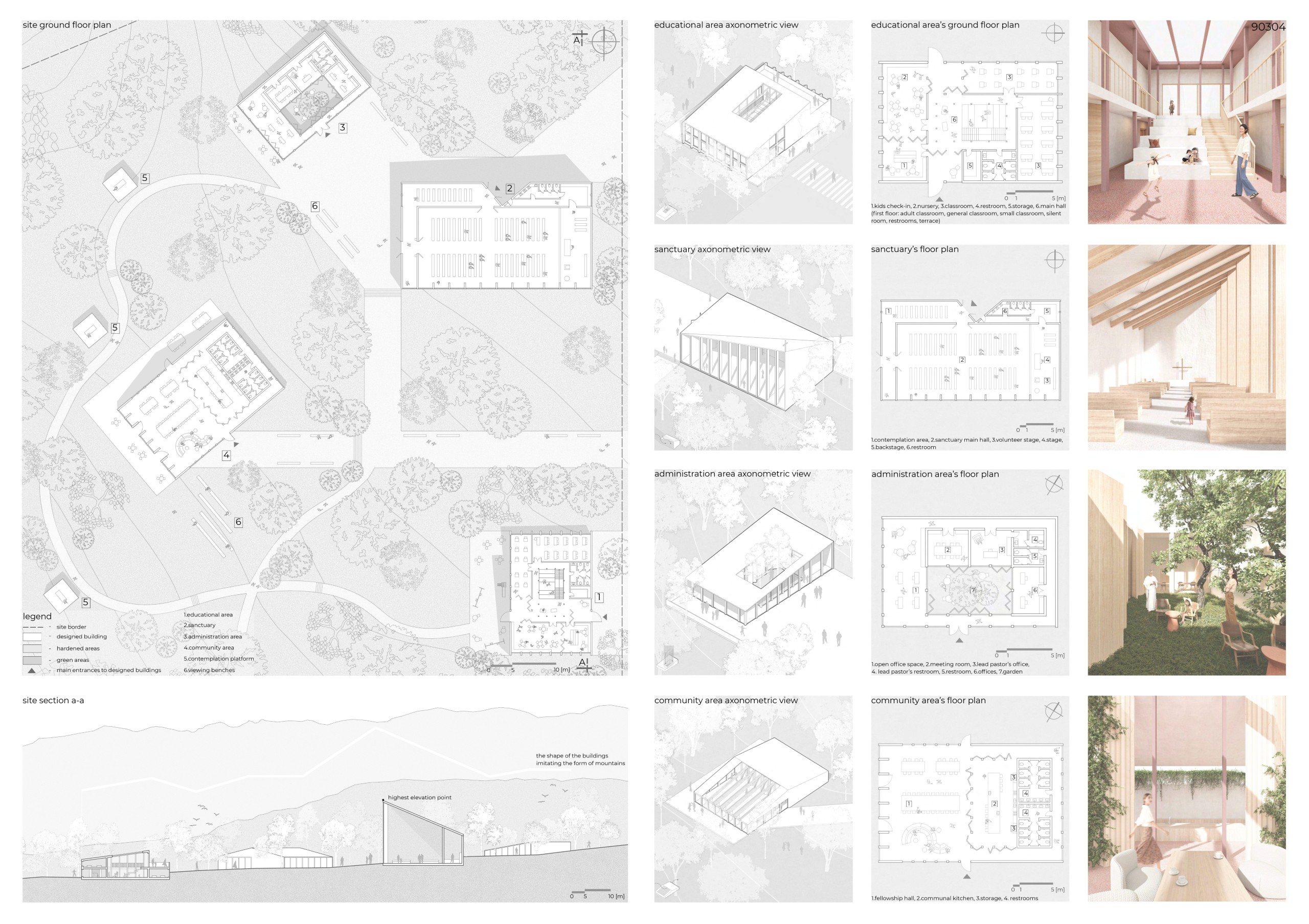
The project contains four separate buildings: a sanctuary, community area, educational area and administration area. They are enriched with contemplation platforms, communal crops area, viewing terraces and benches, and newly planted trees, which make new gardens on site and improve the dialogue with nature and symbolise a new hope. The main focus is on the sanctuary, which represents a new sacred place in the region, since many of them were lost in the fire.
The design envisions a new complex of worship and contemplation for 400 people, with total built area of 2000 square meters. Its main concept is centred around the metaphorical reference to stages of fire: ignition, flames, ash, and rebirth. Each building is a separate substitute to each stage, creating rhythm and coherent system.
Buildings are positioned so as not to disturb the plot and its surroundings, and to focus on the main structure, the sanctuary. It’s the most dominant construction, with the altar facing east and its peak as the highest point of the site. This is a deliberate move to emphasise its function and importance. The structures are positioned close to each other, facilitating movement and at an angle corresponding to the plot’s slope and southwest orientation.
Buildings have similarities in their constructions and contain comparable materials, used in varying extents depending on the function. The materials have been carefully selected. They distinguish by their durability, fire resistance, and atmosphere. For the exteriors, concrete and stone are used, both offering high level of fire resistance. These materials appear in soft shades, such as pink clay, white, and light grey, creating bright atmosphere around the buildings. Through the glass windows, the interior use of wood is visible. It’s intentionally limited to indoor spaces to reduce fire risk. The wood introduces warmth to the interior, contributing to a sense of calm, improved focus, and overall wellbeing. Another key interior material is terrazzo, which comes in various shades and adds both colour and visual interest through its unique textures.
The main goal of the project is to create a safe complex for the community of Altadena, after such a terrible disaster. The compound aims to gather people, unite spiritually, and maintain a dialogue with nature. It’s an open space for everyone, from children to adults, where the mystical blends with the social, while the liturgical connects with everyday life.
The Forest : Built of Memories
Seongjune Park [South Korea]
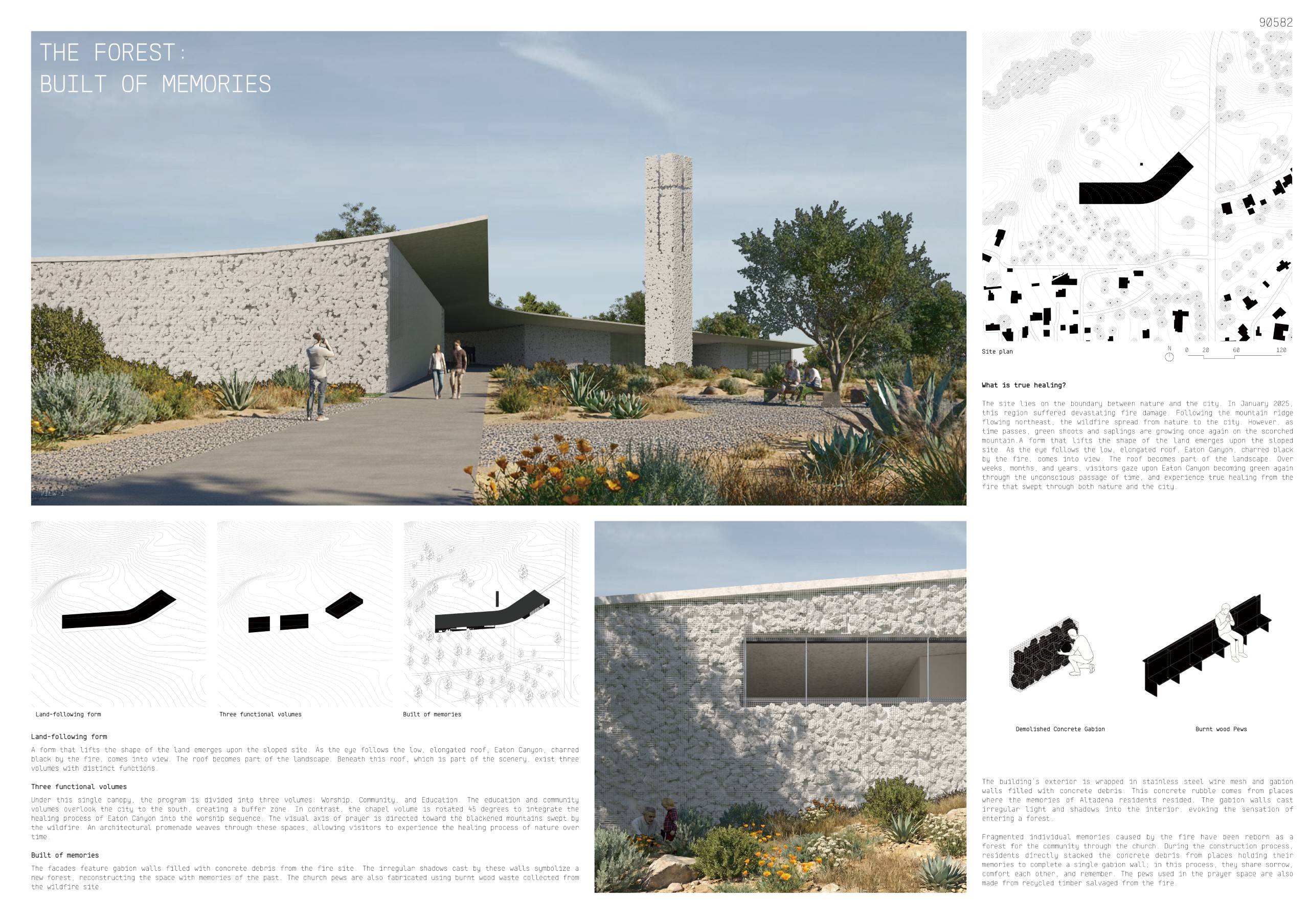
PROJECT DESCRIPTION
What defines true healing?
The site lies on the boundary between nature and the city. In January 2025, this region suffered a devastating fire. Following the mountain ridge flowing northeast, the wildfire spread from nature to the city. Yet, as time passes, green shoots are sprouting once again on the scorched mountain, and saplings are rising.
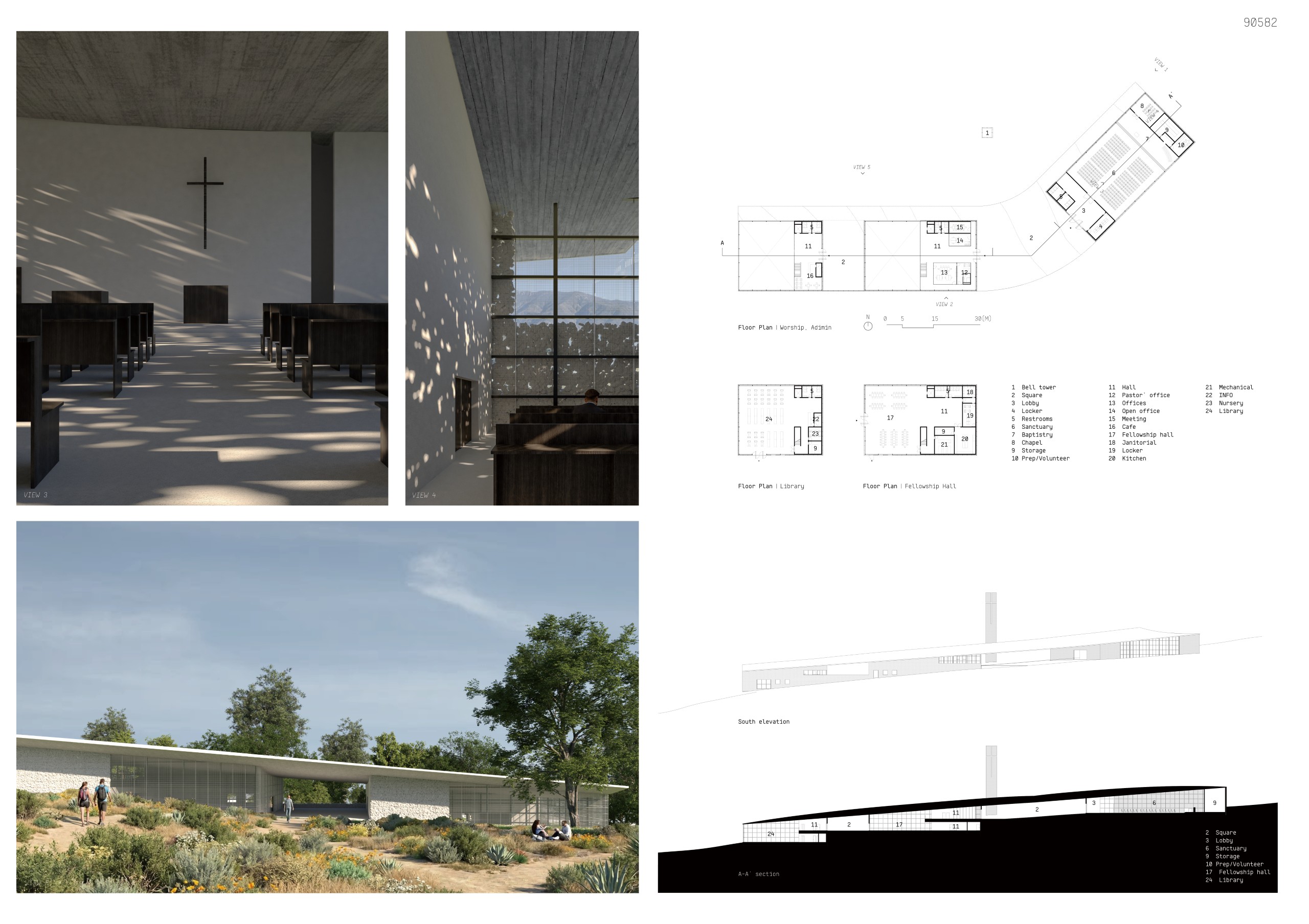
A form that lifts the shape of the land emerges from the sloped site. As the eye follows the low, elongated roof, Eaton Canyon, charred black by the fire, comes into view. The roof acts as part of the landscape. Beneath this roof, which is part of the scenery, lie three volumes with distinct functions. These volumes take the form of separate buildings, adopting an attitude of conformity rather than resistance to the contours. The medium connecting each volume is voided natural space, transforming the entire movement within the building into a process of pilgrimage.
The building’s exterior is wrapped in stainless steel wire mesh and gabion walls made of concrete debris. This concrete rubble comes from places imbued with the memories of Altadena residents. The gabion walls cast irregular light and shadows into the interior, evoking the sensation of entering a forest.
Fragmented individual memories caused by the fire have become a forest for the community through the church. During construction, residents directly build the gabion walls using concrete debris from places holding their memories; in this process, the community shares sorrow, commemorates, and remembers.
The pews used in the prayer space are also made from recycled timber salvaged from the fire.
The education and community volumes face the city to the south, creating a buffer zone to the north. In contrast, the chapel volume is rotated 45 degrees to capture the healing process of Eaton Canyon during worship. At the end of the gaze of prayer lies the scorched Eaton Canyon, swept by the wildfire. After passing through all three volumes, one returns to daily life along a promenade under the roof opening toward the north.
Over weeks, months, and years, visitors witness Eaton Canyon becoming green again through the unconscious passage of time, experiencing true healing from the fire that swept through both nature and the city.
Church of Ripples
Zihao Wang [United States]
PROJECT DESCRIPTION
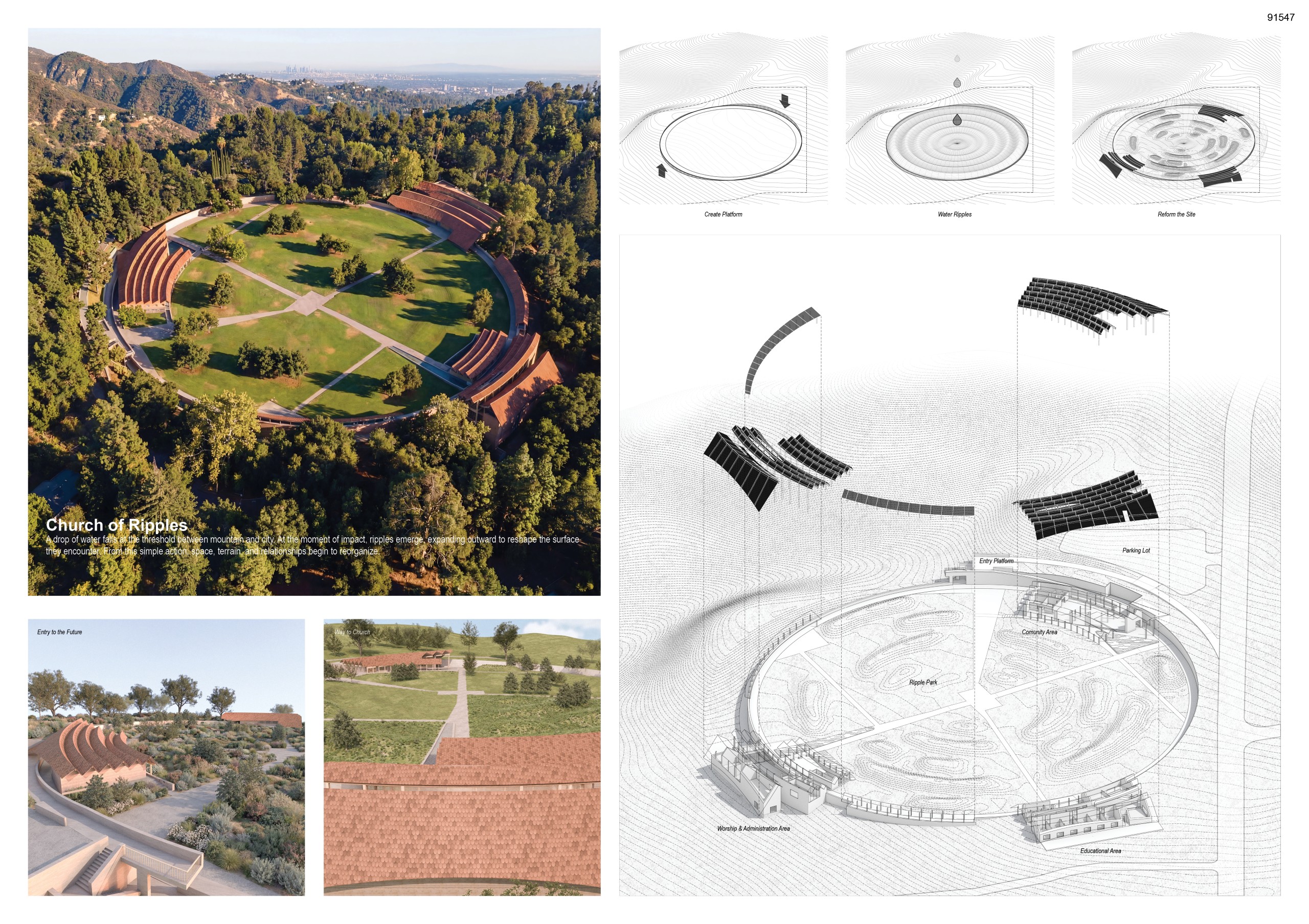
A drop of water falls at the threshold between mountain and city. At the moment of impact, ripples emerge, expanding outward to reshape the surface they encounter. From this simple action, space, terrain, and relationships begin to reorganize.
Months after the devastating wildfire in Los Angeles, the effects in Altadena remain legible across the landscape. Burned hillsides and vacant plots bear witness to the loss of homes, vegetation, and places of communal gathering. In this context, reconstruction requires more than physical rebuilding. It calls for restoring spiritual life, social connections, ecological continuity, and a renewed understanding of the relationship between human settlement and nature.
Located on a steep slope where Altadena meets the San Gabriel Mountains, Church of Ripples embraces this condition of transition. Rather than imposing a singular object, the project reshapes the site as a sacred landscape shaped by collective movement and gradual healing. A circular platform is embedded into the hillside, conceived as a basin placed within the terrain, awaiting a single drop from above. Water is understood not as a literal presence, but as a generative principle. In a hot and dry climate, this approach allows the symbolism of water to guide form and experience without ecological compromise.
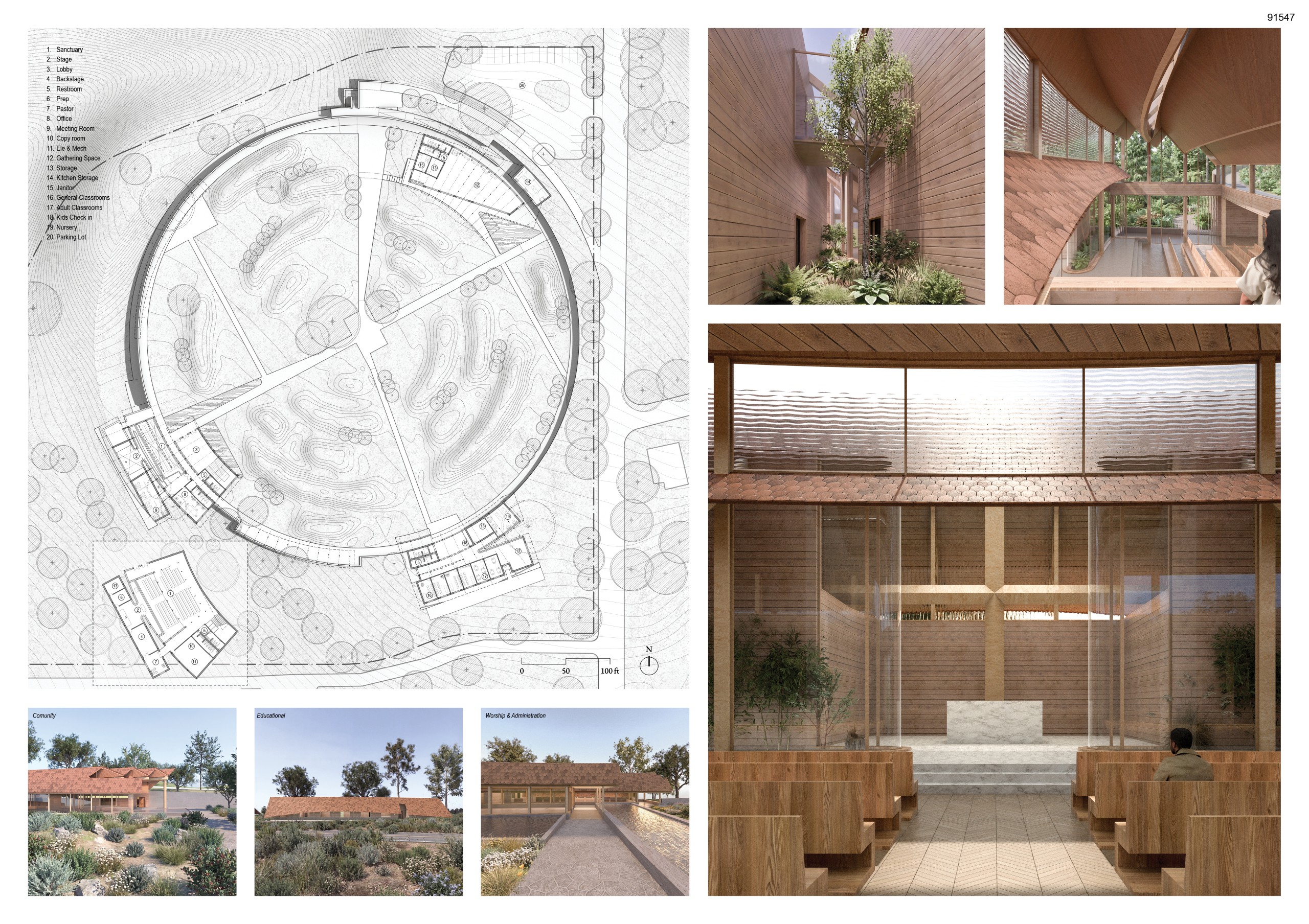
Architectural form emerges from the intentional intersection of two systems: a rational orthogonal grid that ensures spatial clarity and constructive order, and a circular ripple grid derived from the project’s generative concept. Where these systems intersect, deviations occur. Gaps, overlaps, and misalignments are consciously preserved and articulated. In plan, these intersections become apertures for daylight, pockets of outdoor space, moments of vegetation, and entrances into interior volumes. In elevation, the encounter between curved ripple-generated roofs and vertical walls produces subtle arcs that allow occupants to perceive the presence of ripples throughout space.
The project is organized into three primary programmatic zones connected by a continuous circular ramp, ensuring full accessibility across the steep site. The Community Hub, located near the entrance, acts as the first threshold. Open to the circular platform, it provides a place of arrival and pause, allowing visitors to transition from the external world into the interior sequence. From the hub, one may move gradually toward the sanctuary or follow a more ceremonial route through a central lobby, descending into the worship space below.
The Main Sanctuary forms the spiritual core of the project, defined by a double-height altar space filled with filtered light. Offices and administrative functions are integrated within this volume, while Educational Facilities complete the third zone, extending communal life beyond worship. Movement between these dispersed volumes repeatedly alternates between interior and exterior, architecture and landscape.
Through this choreographed sequence, Church of Ripples transforms circulation into ritual. Like water shaping land over time, the project proposes healing through continuity, collective presence, and resonance with the surrounding environment.
Fireproof oasis
Federico Pazzaglia, Mattia Tabellini, Lorenzo Martinelli [Italy]
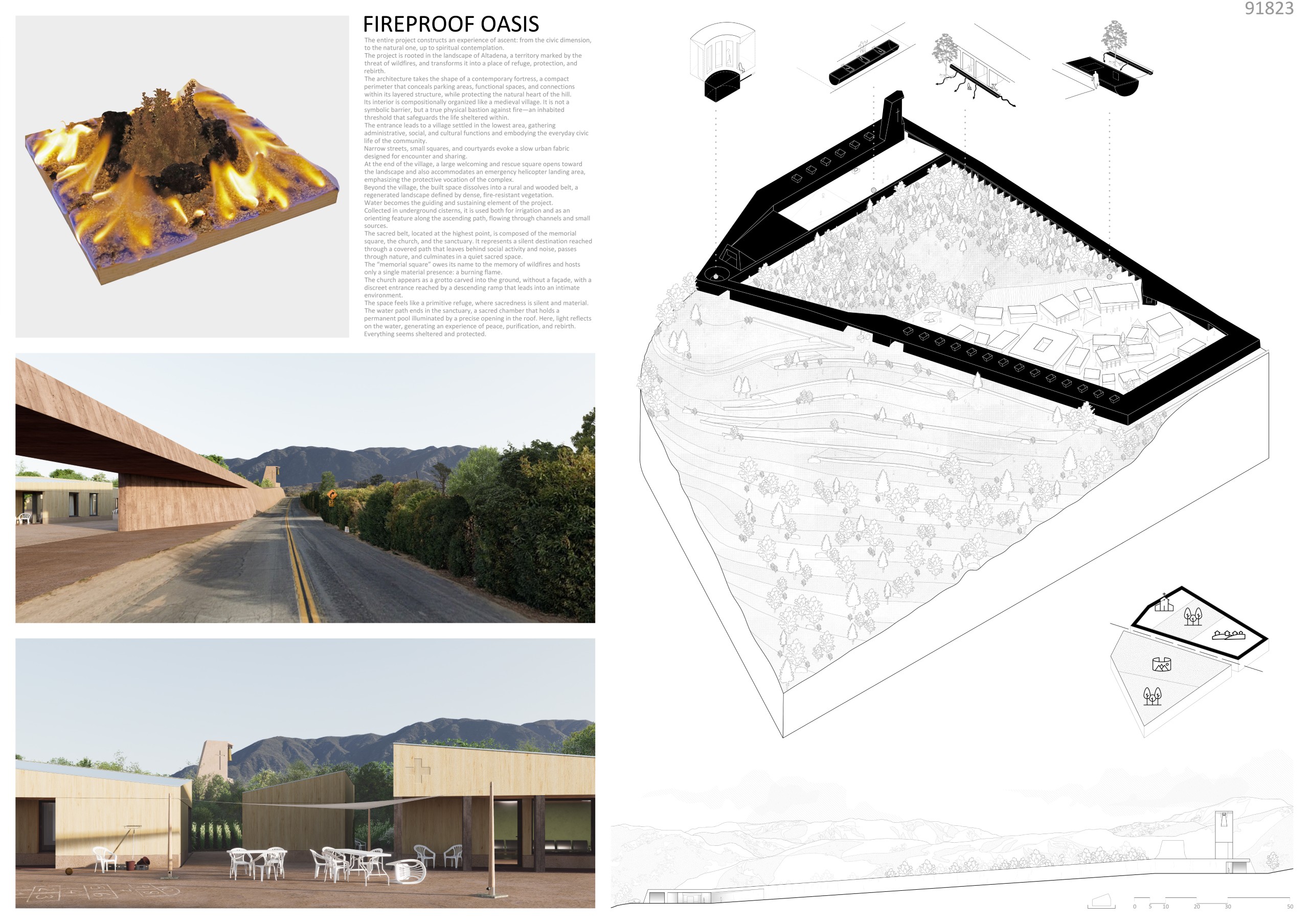
PROJECT DESCRIPTION
The entire project constructs an experience of ascent: from the civic dimension, to the naturalone, up to spiritual contemplation.
The project is rooted in the landscape of Altadena, a territory marked by the threat ofwildfires, and transforms it into a place of refuge, protection, and rebirth.
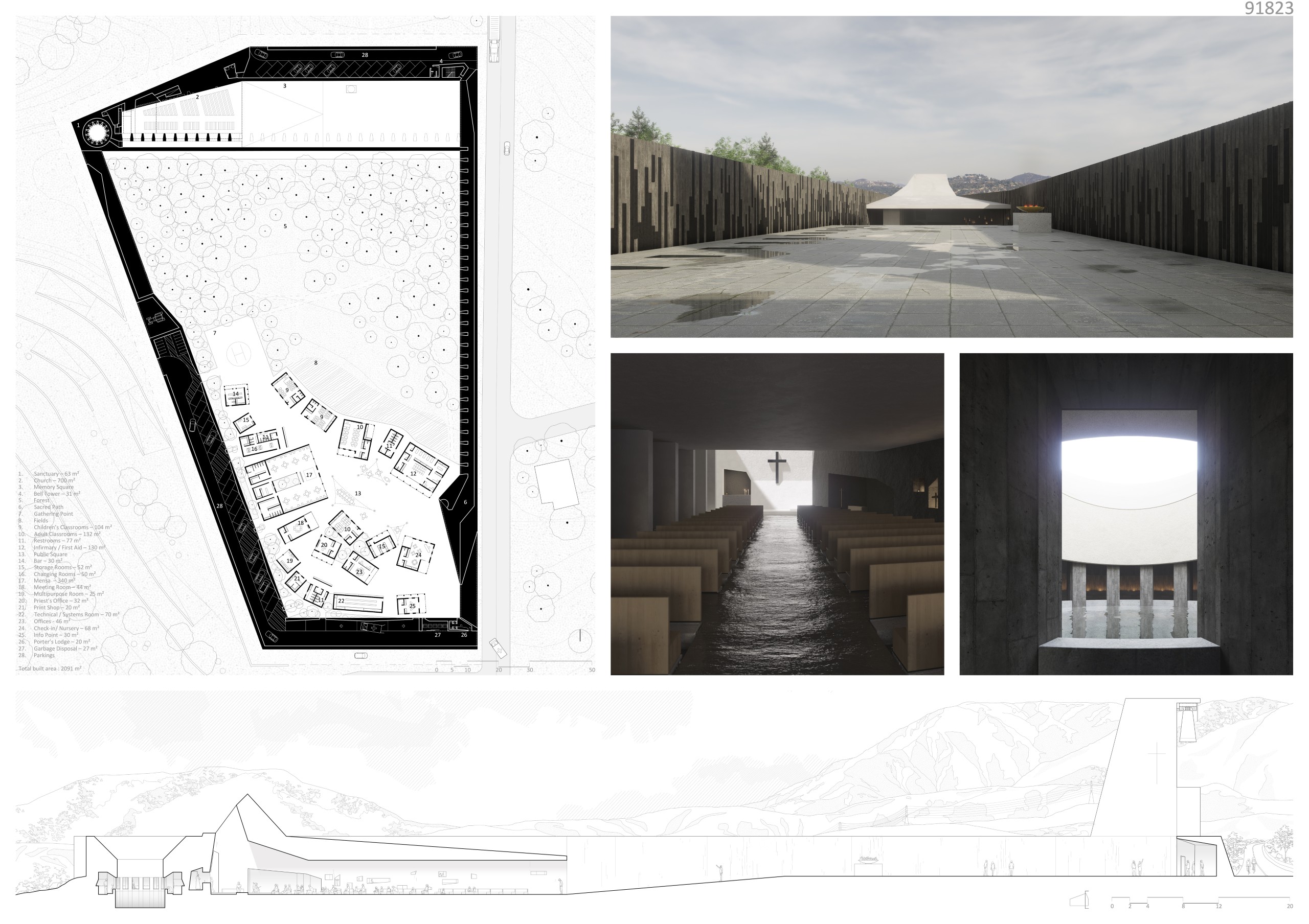
The architecture takes the shape of a contemporary fortress, a compact perimeter thatconceals parking areas, functional spaces, and connections within its layered structure, whileprotecting the natural heart of the hill.
Its interior is compositionally organized like a medieval village. It is not a symbolic barrier, buta true physical bastion against fire, an inhabited threshold that safeguards the life shelteredwithin.
The entrance leads to a village settled in the lowest area, gathering administrative, social, and cultural functions and embodying the everyday civic life of the community.
Narrow streets, small squares, and courtyards evoke a slow urban fabric designed forencounter and sharing.
At the end of the village, a large welcoming and rescue square opens toward the landscapeand also accommodates an emergency helicopter landing area, emphasizing the protectivevocation of the complex.
Beyond the village, the built space dissolves into a rural and wooded belt, a regeneratedlandscape defined by dense, fire-resistant vegetation.
Water becomes the guiding and sustaining element of the project.
Collected in underground cisterns, it is used both for irrigation and as an orienting featurealong the ascending path, flowing through channels and small sources.
The sacred belt, located at the highest point, is composed of the memorial square, the church, and the sanctuary. It represents a silent destination reached through a covered paththat leaves behind social activity and noise, passes through nature, and culminates in a quietsacred space.
The “memorial square” owes its name to the memory of wildfires and hosts only a single material presence: a burning flame.
The church appears as a cave carved into the ground, without a façade, with a discreetentrance reached by a descending ramp that leads into an intimate environment.
The space feels like a primitive refuge, where sacredness is silent and material.
The water path ends in the sanctuary, a sacred chamber that holds a permanent pool illuminated by a precise opening in the roof. Here, light reflects on the water, generating anexperience of peace, purification, and rebirth.
Everything seems sheltered and protected.
Symbállein
Julia Ribosa, Marta Fernández, Pablo Fargas [Spain]
PROJECT DESCRIPTION
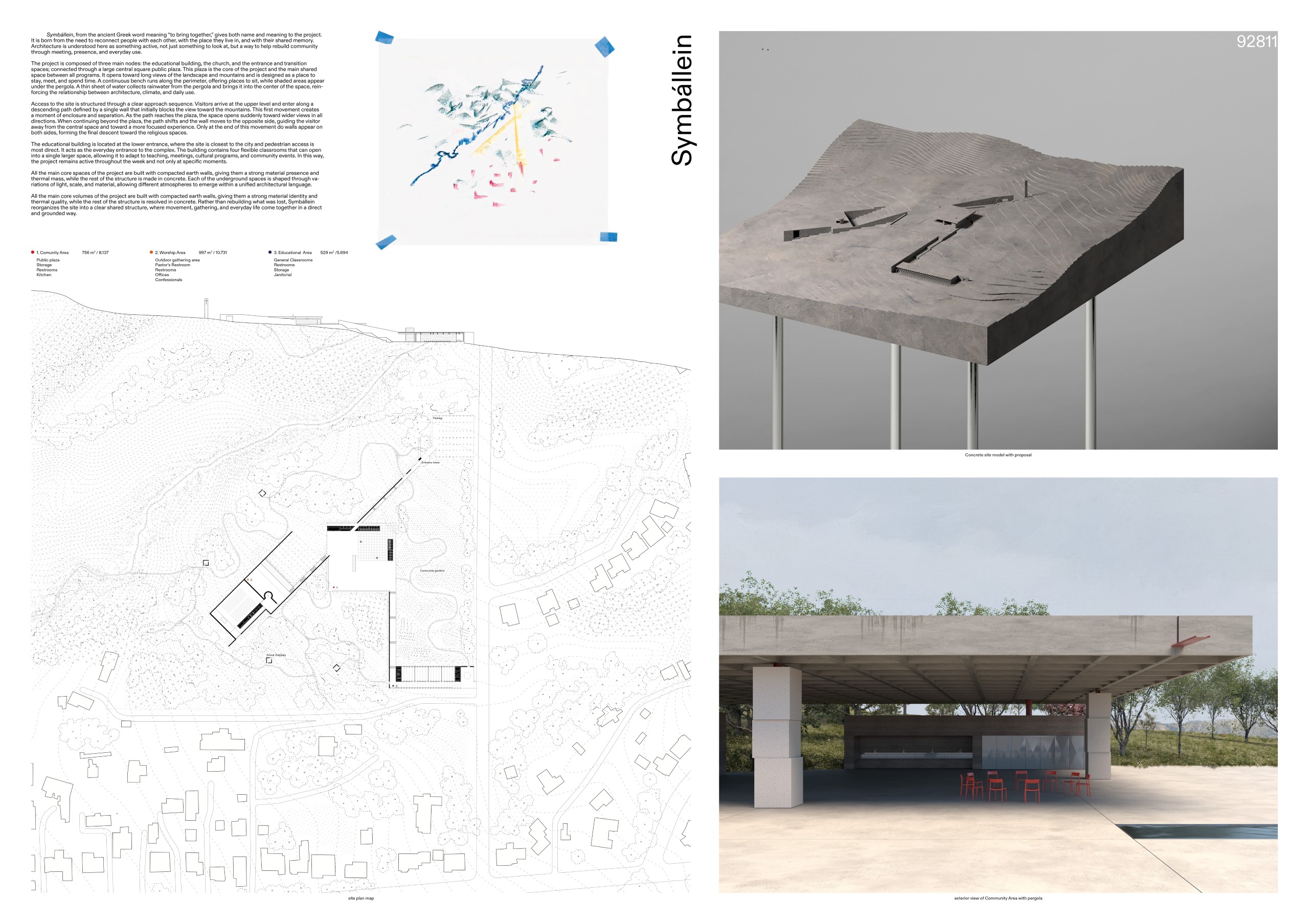
A community exists through real encounters. When people stop truly meeting, places lose their voice. The word Symbállein, from ancient Greek, means “to bring together.” This idea guides the entire project: reconnecting what has been separated—people, nature, memory, and spirit. The architecture becomes a place of attention and presence, where relationships can grow again.
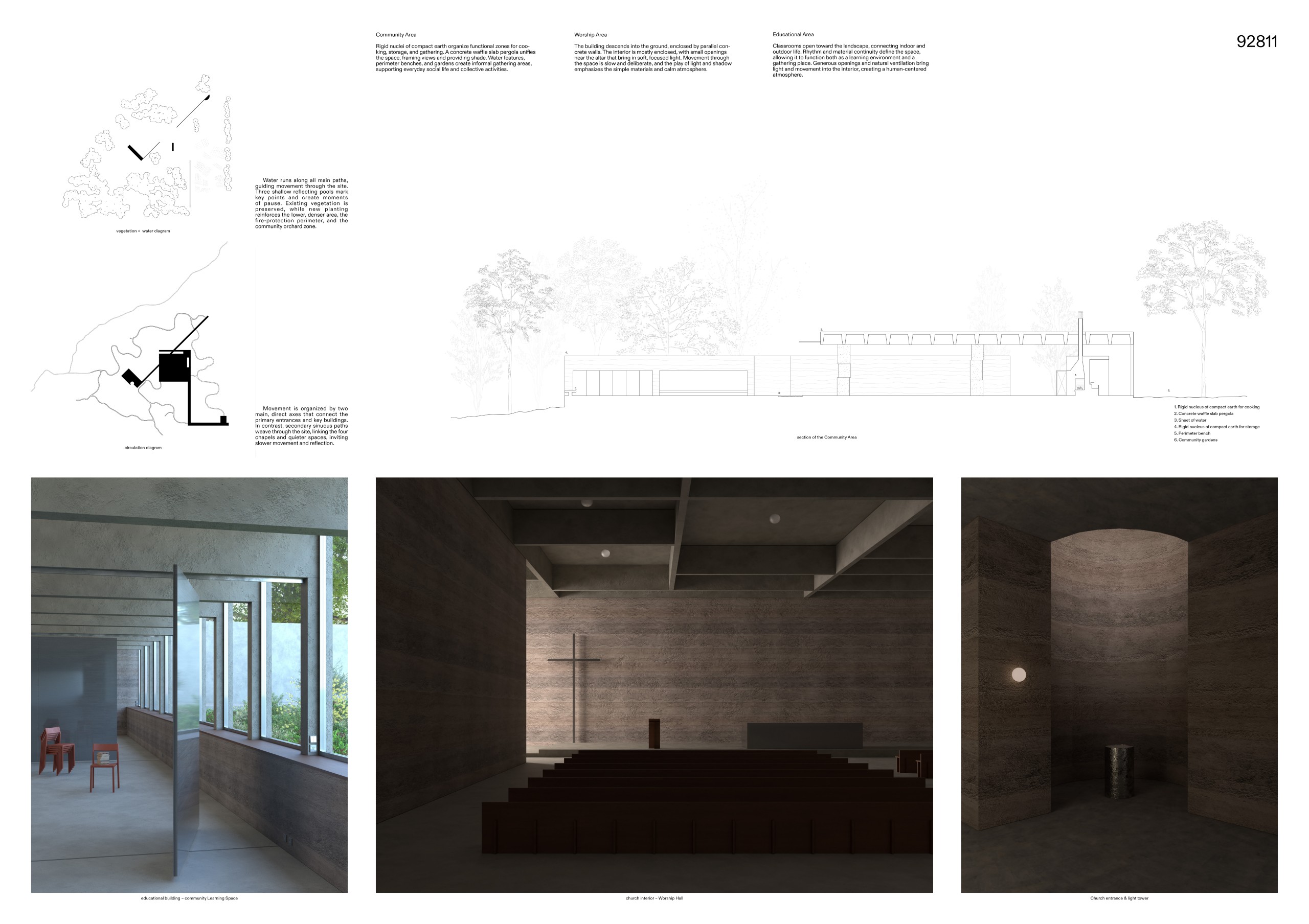
The project unfolds across the site as a landscape of meeting points, bringing together nature and construction, daily life and ritual, private moments and shared experiences. At its heart is a large communal plaza, an open space within the recovering landscape. This is where life happens: shared meals, gatherings, celebrations, and everyday encounters. A pergola creates a place of shade and rest at the top edge of the plaza. Two rammed-earth volumes anchor the square, giving it physical presence and stability, while housing the main service spaces and supporting daily activities.
The site is structured by two main axes, each offering a different way of moving through and experiencing the place.
From the upper ridge—where the main entrance to the plot is located—the first axis begins at a slender concrete tower and slowly descends toward the sacred core. Along the way, the path narrows and opens again through retaining walls and planted edges, creating a rhythm between enclosure and openness. Views appear and disappear, always reconnecting with the wide landscape of the Angeles National Forest. This slow descent encourages a calm and focused state of movement.
The path ends at the church, a space for 400 people, partially embedded in the ground. A tall, shadowed entrance space, lit from above by a circular tower, marks the transition inside. The interior is quiet and inward-looking, shaped by controlled light and solid surfaces. Light enters through a single opening beside the altar, directing attention to the focal point of the space. Before entering, a thin sheet of water runs along the outside of the axis, marking the end of the descending path and the threshold into the sacred space.
From below, a second axis rises from the city. Here, the educational building forms the second, more everyday entrance to the site. Shaped by two rammed-earth cores, it contains four flexible classrooms that can open into one large hall. This space supports teaching, cultural activities, and community events, connecting the project to the daily life of Altadena beyond religious use.
Between these two axes, softer paths move through small chapels, native vegetation, and quiet resting areas.
A dense belt of trees protects the site and helps reduce future fire risk. The choice of materials—rammed earth, concrete, water, and drought-resistant planting—roots the project in its climate and landscape, while ensuring durability over time.
Symbállein is not about simply rebuilding what was lost, but about reconnecting land, community, and shared life—creating a place where people can come together again after destruction.
Communion Beneath the Shadecloth
Jinsil Kim, Taeeun An [South Korea]
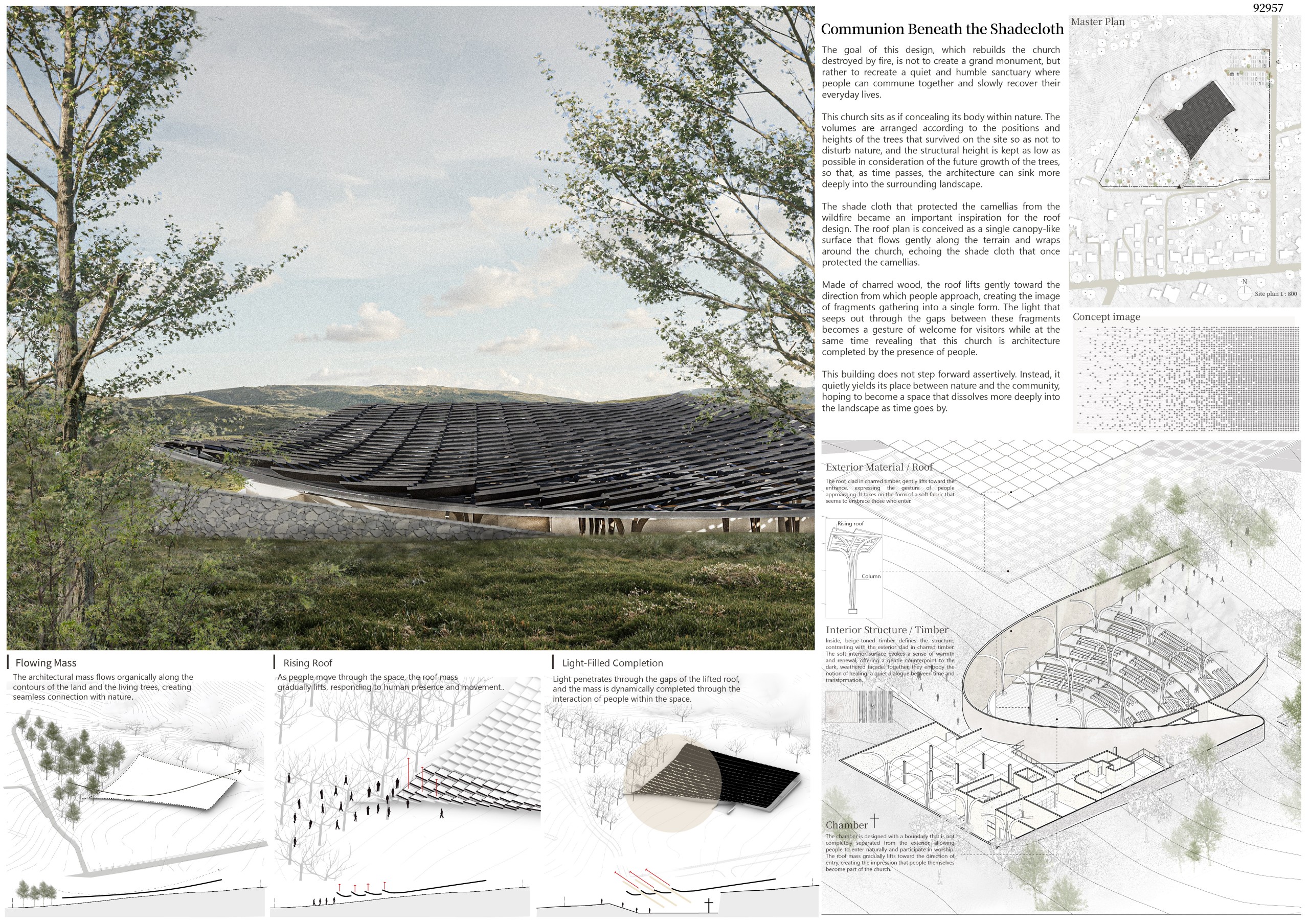
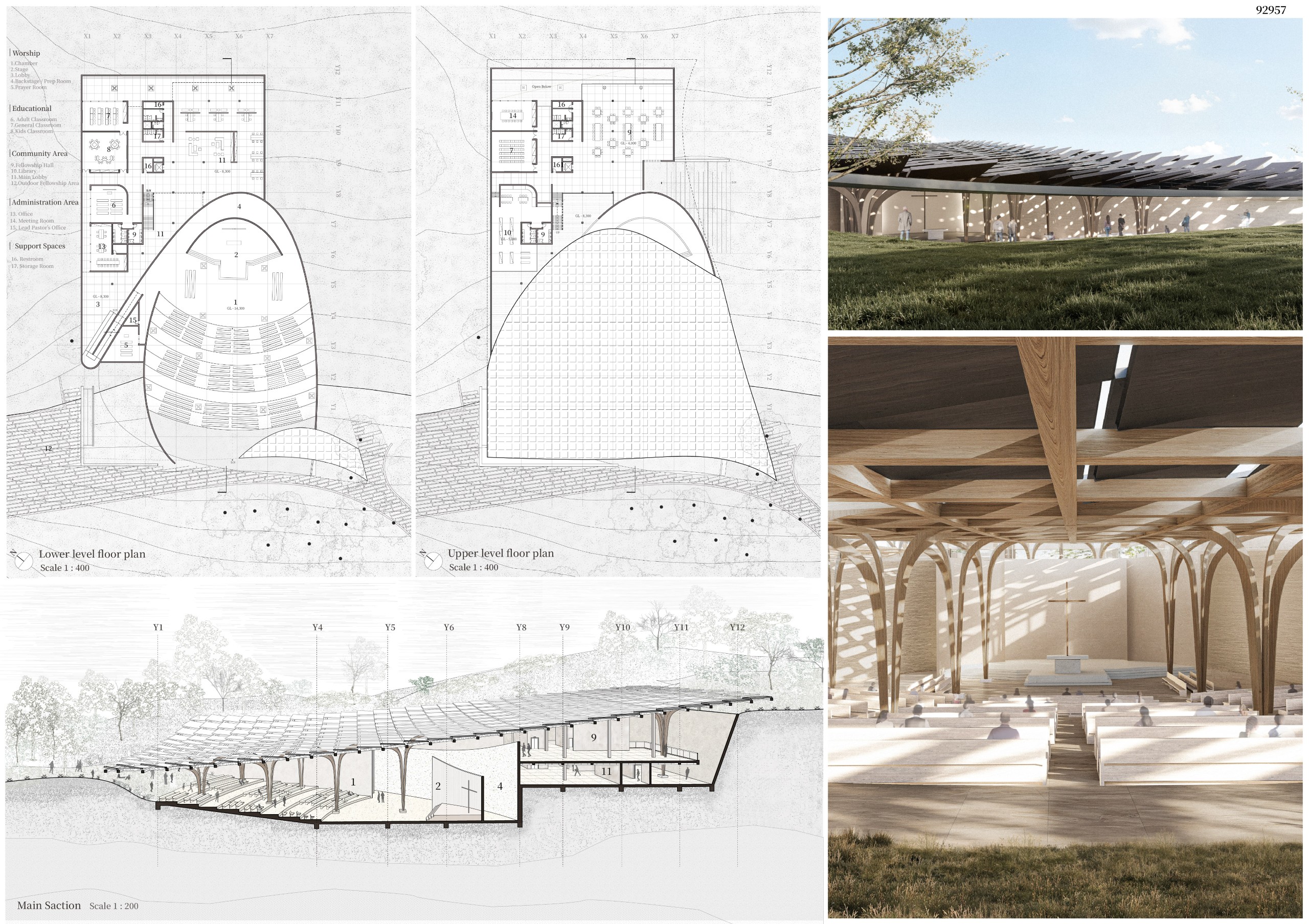
PROJECT DESCRIPTION
The goal of this design, which rebuilds the church destroyed by fire, is not to create a grand monument, but rather to recreate a quiet and humble sanctuary where people can commune together and slowly recover their everyday lives.
This church sits as if concealing its body within nature. The volumes are arranged according to the positions and heights of the trees that survived on the site so as not to disturb nature, and the structural height is kept as low as possible in consideration of the future growth of the trees, so that, as time passes, the architecture can sink more deeply into the surrounding landscape.
The shade cloth that protected the camellias from the wildfire became an important inspiration for the roof design. The roof plan is conceived as a single canopy-like surface that flows gently along the terrain and wraps around the church, echoing the shade cloth that once protected the camellias.
Made of charred wood, the roof lifts gently toward the direction from which people approach, creating the image of fragments gathering into a single form. The light that seeps out through the gaps between these fragments becomes a gesture of welcome for visitors while at the same time revealing that this church is architecture completed by the presence of people.
This building does not step forward assertively. Instead, it quietly yields its place between nature and the community, hoping to become a space that dissolves more deeply into the landscape as time goes by.
Ashen Path to Rising
Youngki Kim [South Korea]
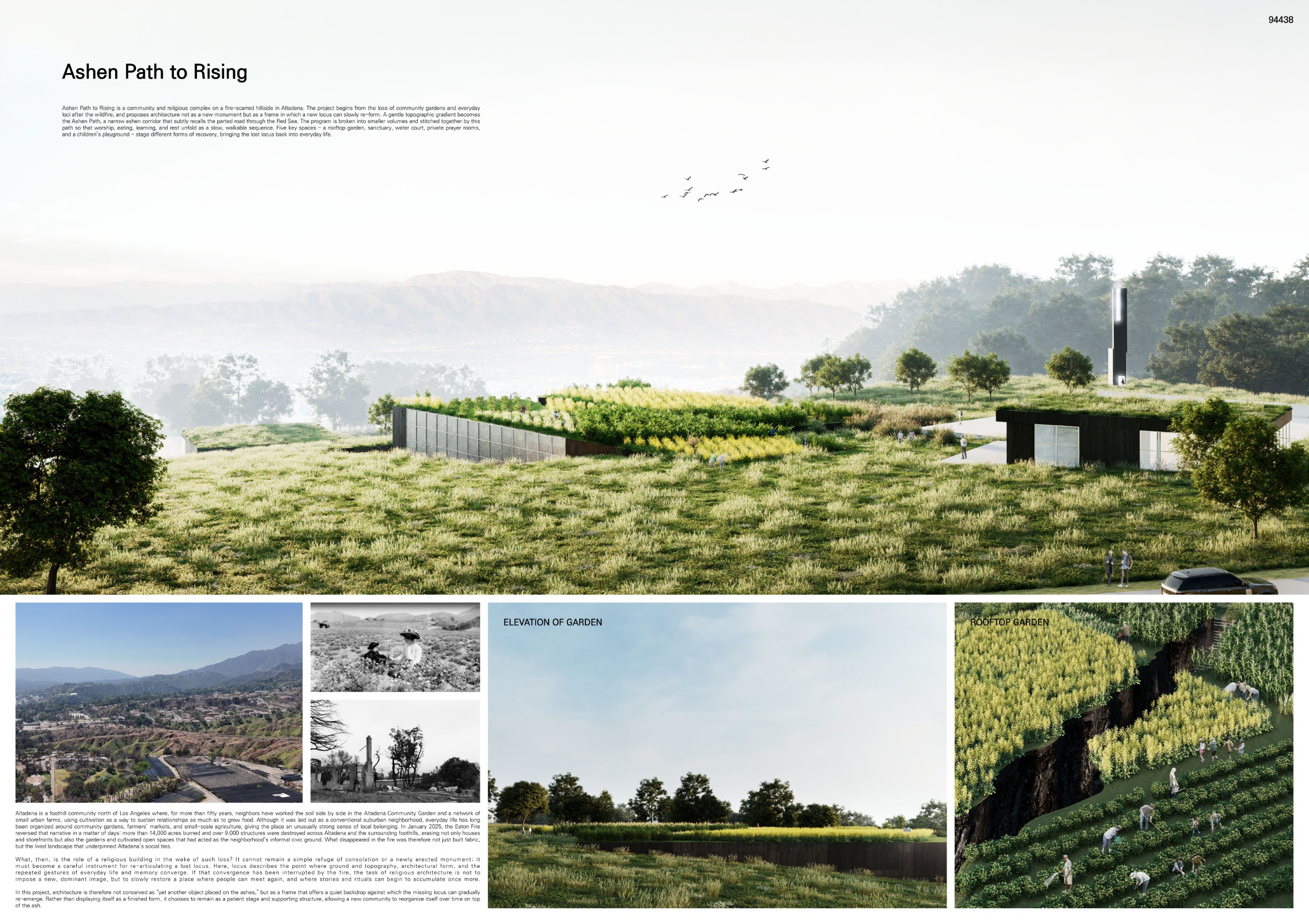
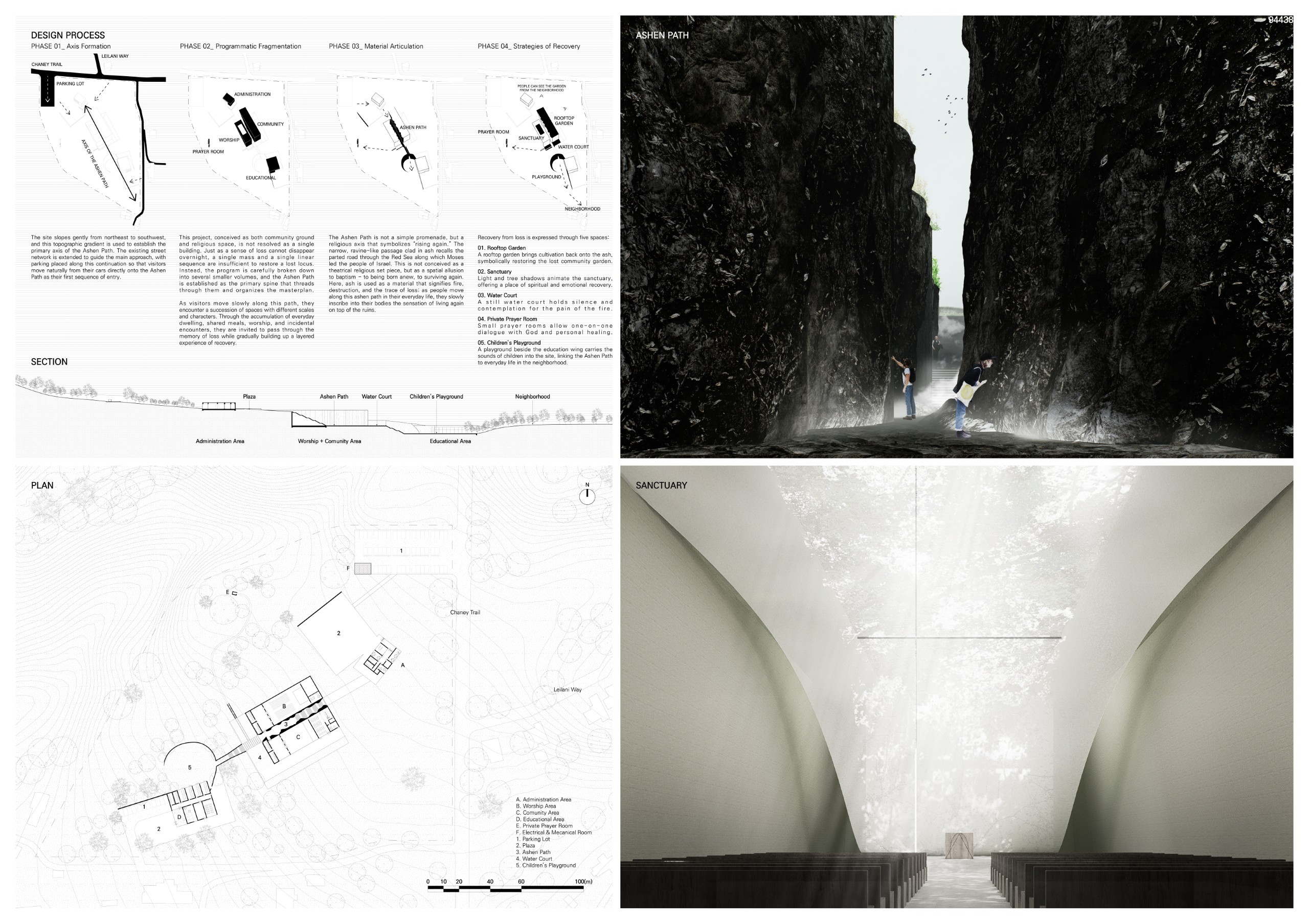
PROJECT DESCRIPTION
Ashen Path to Rising is a community and religious complex on a fire-scarred hillside in Altadena. It responds to the loss of community gardens and everyday loci by treating architecture not as a monument but as a frame where a new locus can slowly return. A sloping site axis becomes the Ashen Path, with small volumes and five key spaces staging different forms of recovery.
Ember Genesis
Miao Wang, Tianchi Zhao [United States]
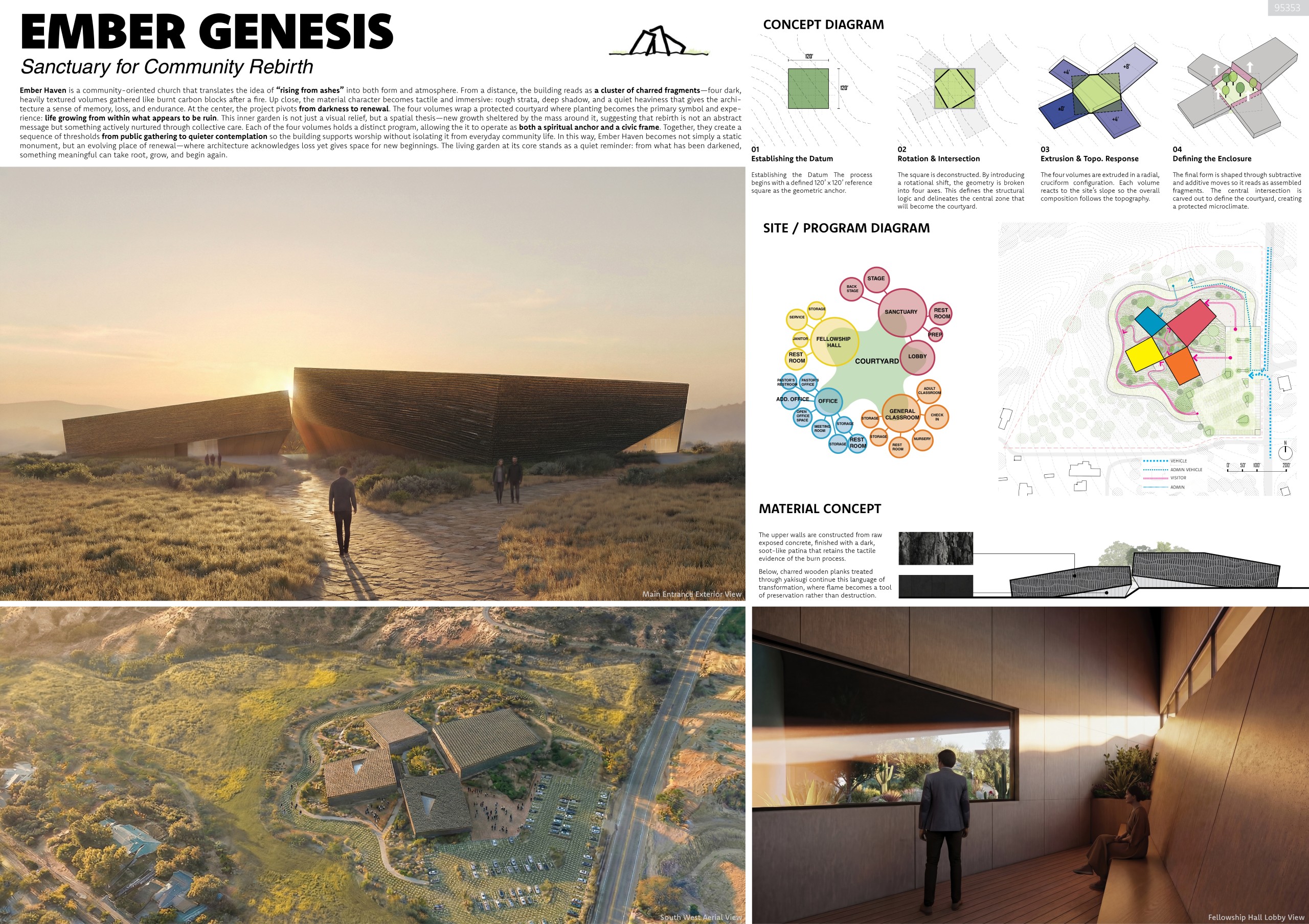
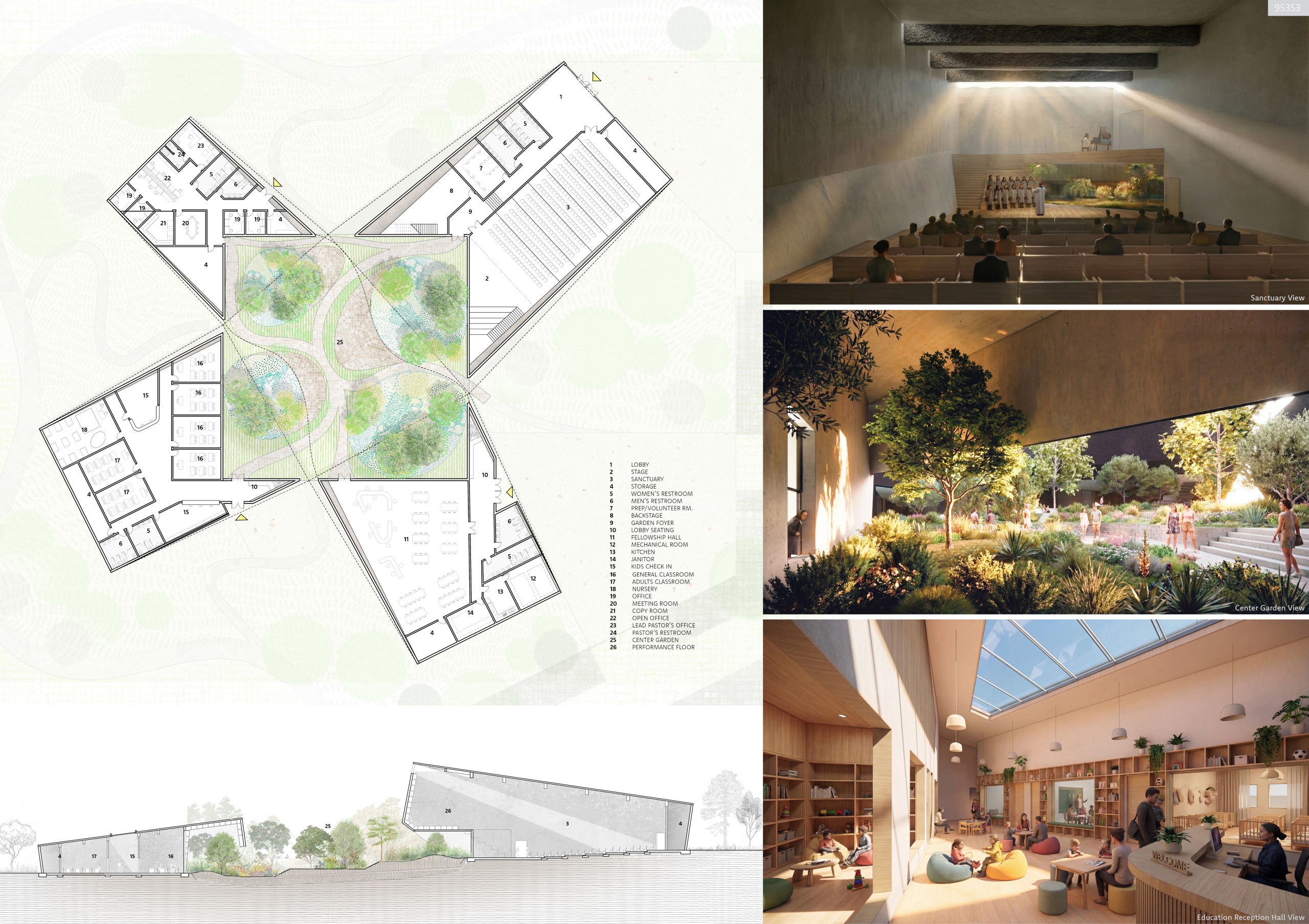
PROJECT DESCRIPTION
Outside charred, inside garden. The project begins with a simple dual idea: a darkened exterior shaped by fire, and a protected interior defined by growth, care, and renewal.
From the outside, Ember Haven appears as if it has already lived through a story—one of burning, loss, and survival. Its form evokes a set of fractured remnants gathered after a fire, four dark volumes clustered like carbon blocks pulled from ash. The surfaces feel aged rather than newly built, as if time and flame have passed over them. At first encounter, the building is quiet, heavy, almost defensive—holding its history close. Yet this darkness is not an ending, but a threshold. The charred exterior suggests that what has been burned is not erased; it becomes the ground from which something new might emerge.
Ember Haven is a community-oriented church that translates the idea of “rising from ashes”into both form and atmosphere. Up close, the material character becomes tactile and immersive: rough strata, deep shadow, and a quiet heaviness that gives the architecture a sense of memory, loss, and endurance.
The material strategy reinforces this narrative. The upper walls are constructed from raw exposed concrete, finished with a dark, soot-like patina that retains the tactile evidence of the burn process. Below, charred wooden planks treated through yakisugi continue this language of transformation, where flame becomes a tool of preservation rather than destruction. Together, the materials form a quiet gradient—moving from permanence to fragility, from weight to texture—suggesting that the memory of fire remains present, yet no longer defines the whole.
At the center, the project pivots from darkness to renewal. The four volumes wrap a protected courtyard where planting becomes the primary symbol and experience: life growing from within what appears to be ruin. This inner garden is not just a visual relief, but a spatial thesis—new growth sheltered by the mass around it, suggesting that rebirth is not an abstract message but something actively nurtured through collective care.
Each of the four volumes holds a distinct program, allowing the project to operate as both a spiritual anchor and a civic frame. Together, they create a sequence of thresholds that move from public gathering toward quieter contemplation, so the building supports worship without isolating it from everyday community life. The slow transition from darkened exterior surfaces to the planted interior echoes the emotional experience of moving from grief toward hope.
In this way, Ember Haven becomes not simply a static monument, but an evolving place of renewal—where architecture acknowledges loss yet gives space for new beginnings. The living garden at its core stands as a quiet reminder: from what has been darkened, something meaningful can take root, grow, and begin again.
Sentinel of memory
Elhouan Richard, Nathan Marron [France]
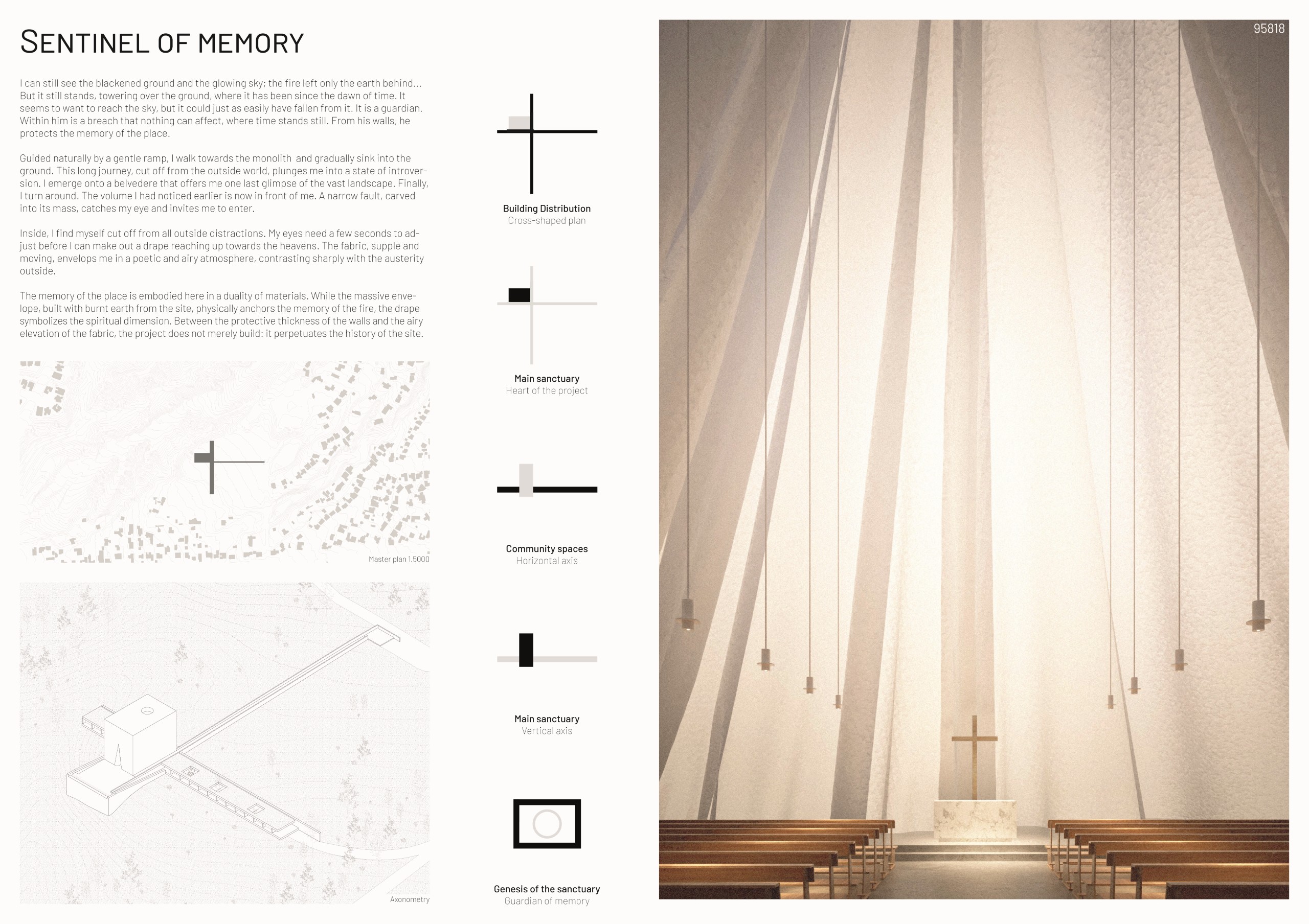
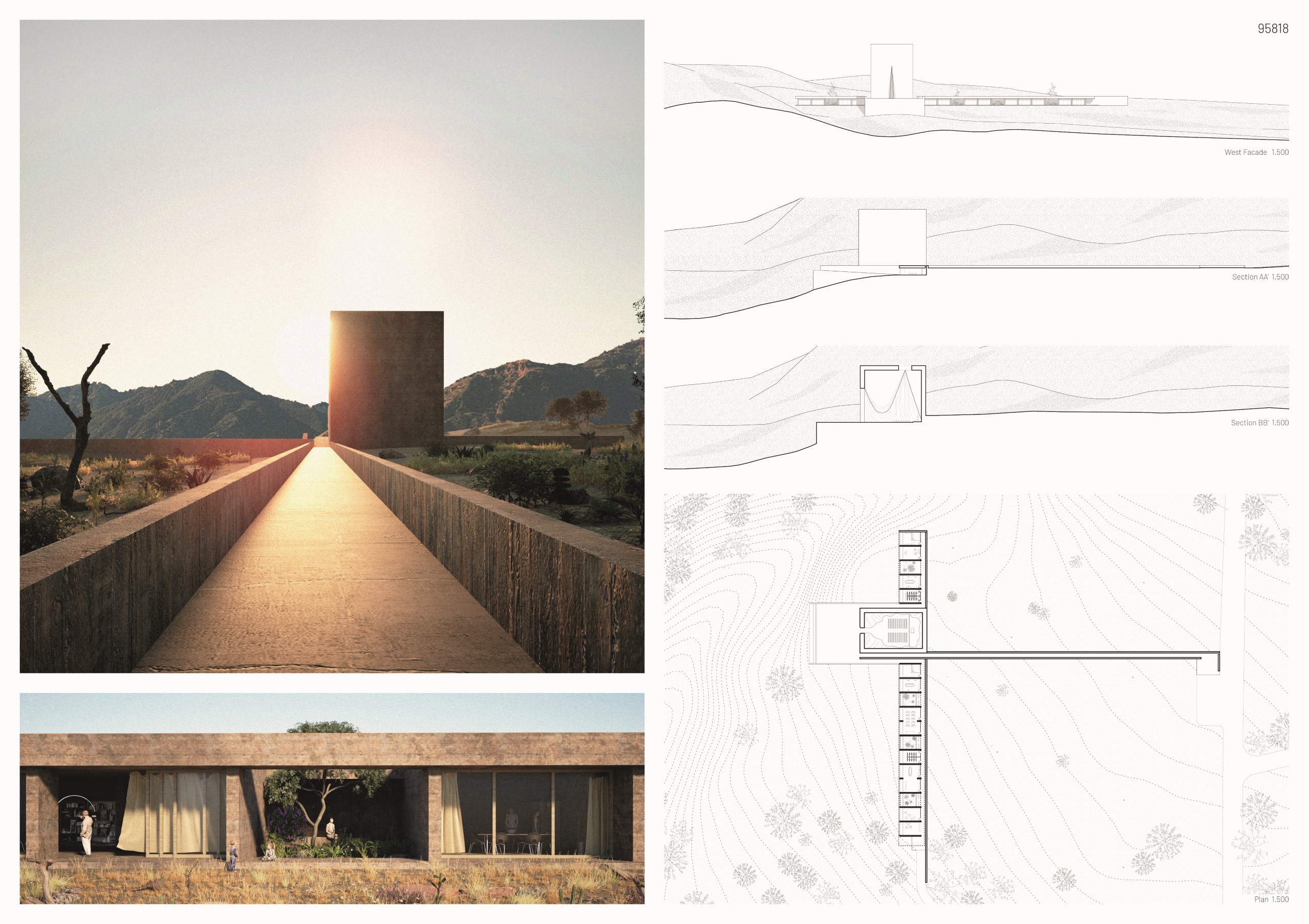
PROJECT DESCRIPTION
I can still see the blackened ground and the glowing sky; the fire left only the earth behind… But it still stands, towering over the ground, where it has been since the dawn of time. It seems to want to reach the sky, but it could just as easily have fallen from it. It is a guardian. Within him is a breach that nothing can affect, where time stands still. From his walls, he protects the memory of the place.
Guided naturally by a gentle ramp, I walk towards the monolith and gradually sink into the ground. This long journey, cut off from the outside world, plunges me into a state of introversion. I emerge onto a belvedere that offers me one last glimpse of the vast landscape. Finally, I turn around. The volume I had noticed earlier is now in front of me. A narrow fault, carved into its mass, catches my eye and invites me to enter.
Inside, I find myself cut off from all outside distractions. My eyes need a few seconds to adjust before I can make out a drape reaching up towards the heavens. The fabric, supple and moving, envelops me in a poetic and airy atmosphere, contrasting sharply with the austerity outside.
Reinterpreting traditional typology, the project is organized on a cross plan, with the heart facing east and the nave opening to the west. The annexes extend laterally to the north and south. The cross is also evident in the composition of the façade: while the sanctuary rises vertically to serve as a landmark, the annexes are buried horizontally into the slope, disappearing beneath the ground. This anchoring in the ground is reinforced by thick walls built with earth from the site, punctuated by patios that, adapted to the Californian climate, provide natural ventilation. At its heart, the volume houses a monumental drape anchored between the ground and the zenith; traversed by a white, pearly light from an opening in the roof, this moving textile reacts to air currents and contrasts with the inert mass of the walls.
The memory of the place is embodied here in a duality of materials. While the massive envelope, built with burnt earth from the site, physically anchors the memory of the fire, the drape symbolizes the spiritual dimension. Between the protective thickness of the walls and the airy elevation of the fabric, the project does not merely build: it perpetuates the history of the site.
Finalists
(ordered by registration code)
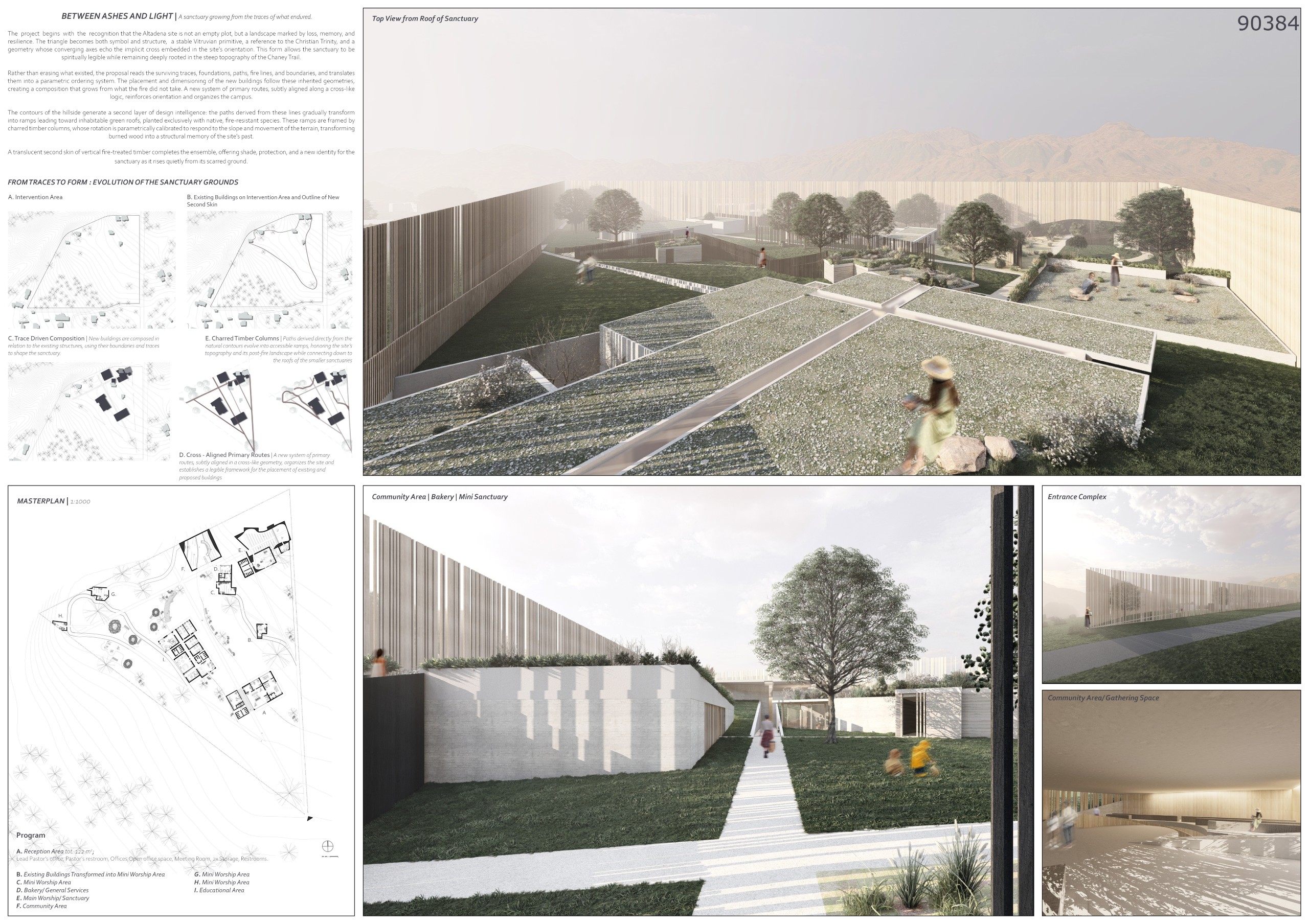
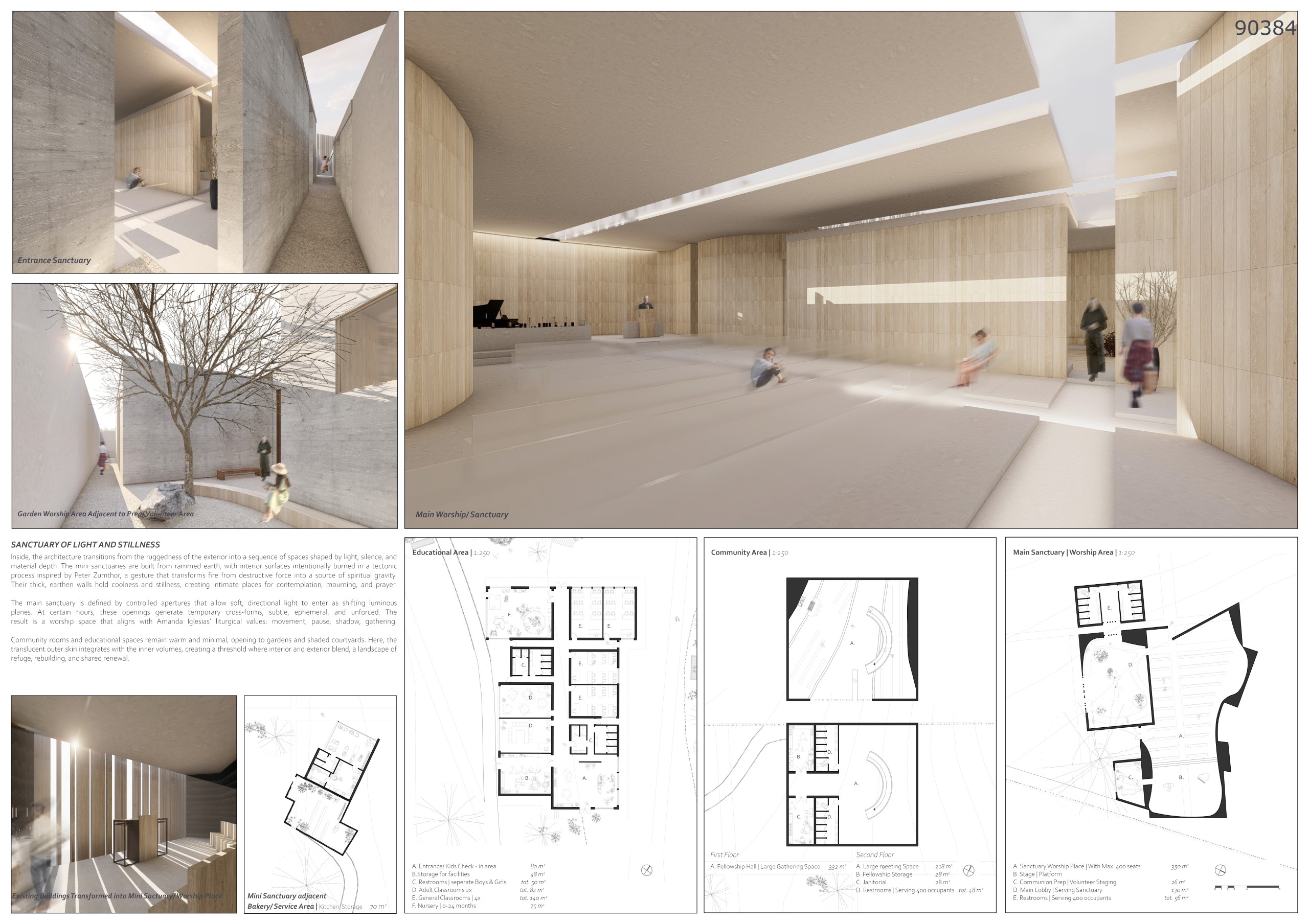
Between Ashes and Light | A sanctuary growing from the traces of what endured.
Kübra Mercan Harputluoğlu [Turkey – Netherlands] www.qhstudio.nl
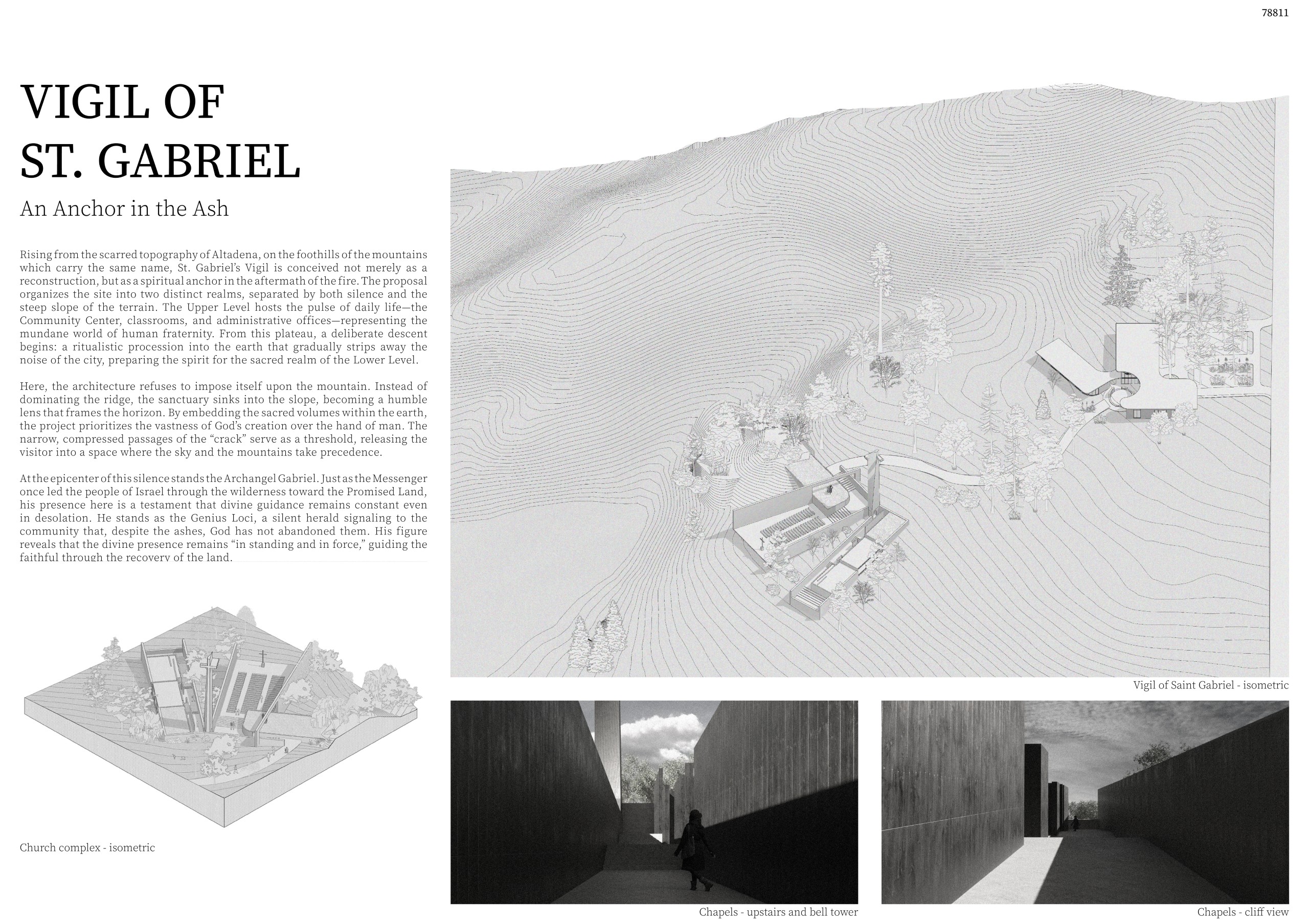
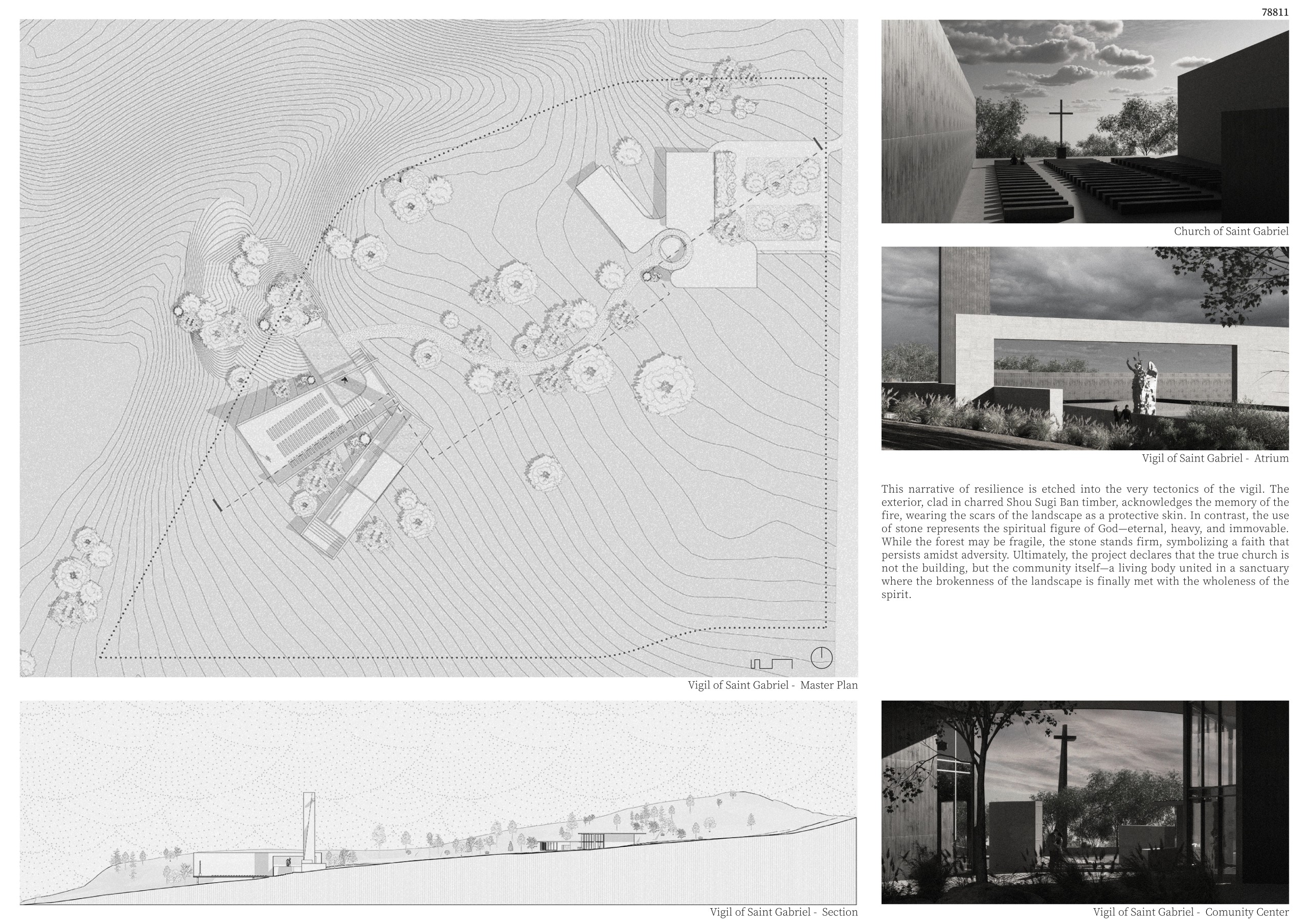
St. Gabriels Vigil
Aldo Bianchi, Miguel Rios [Mexico]
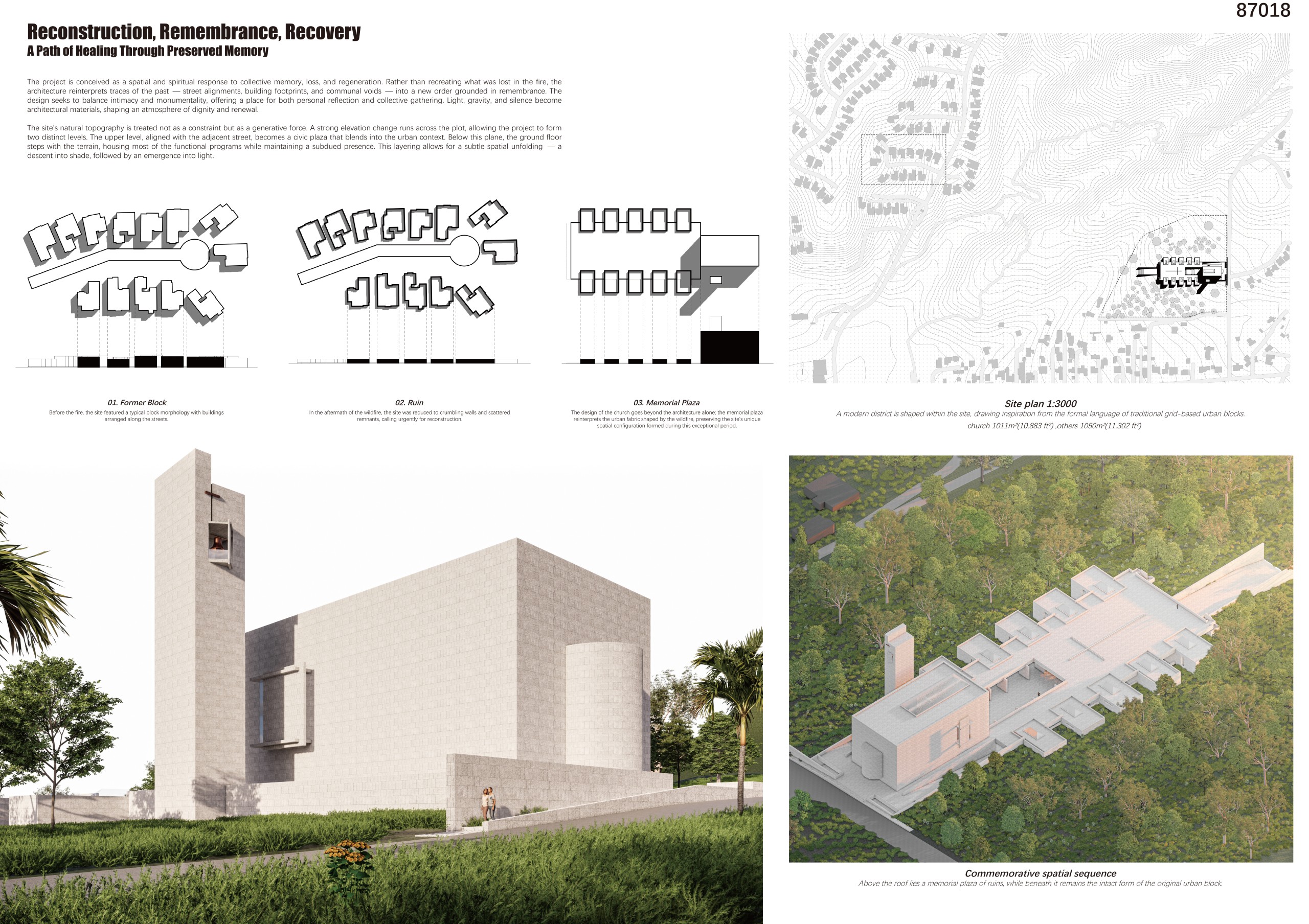
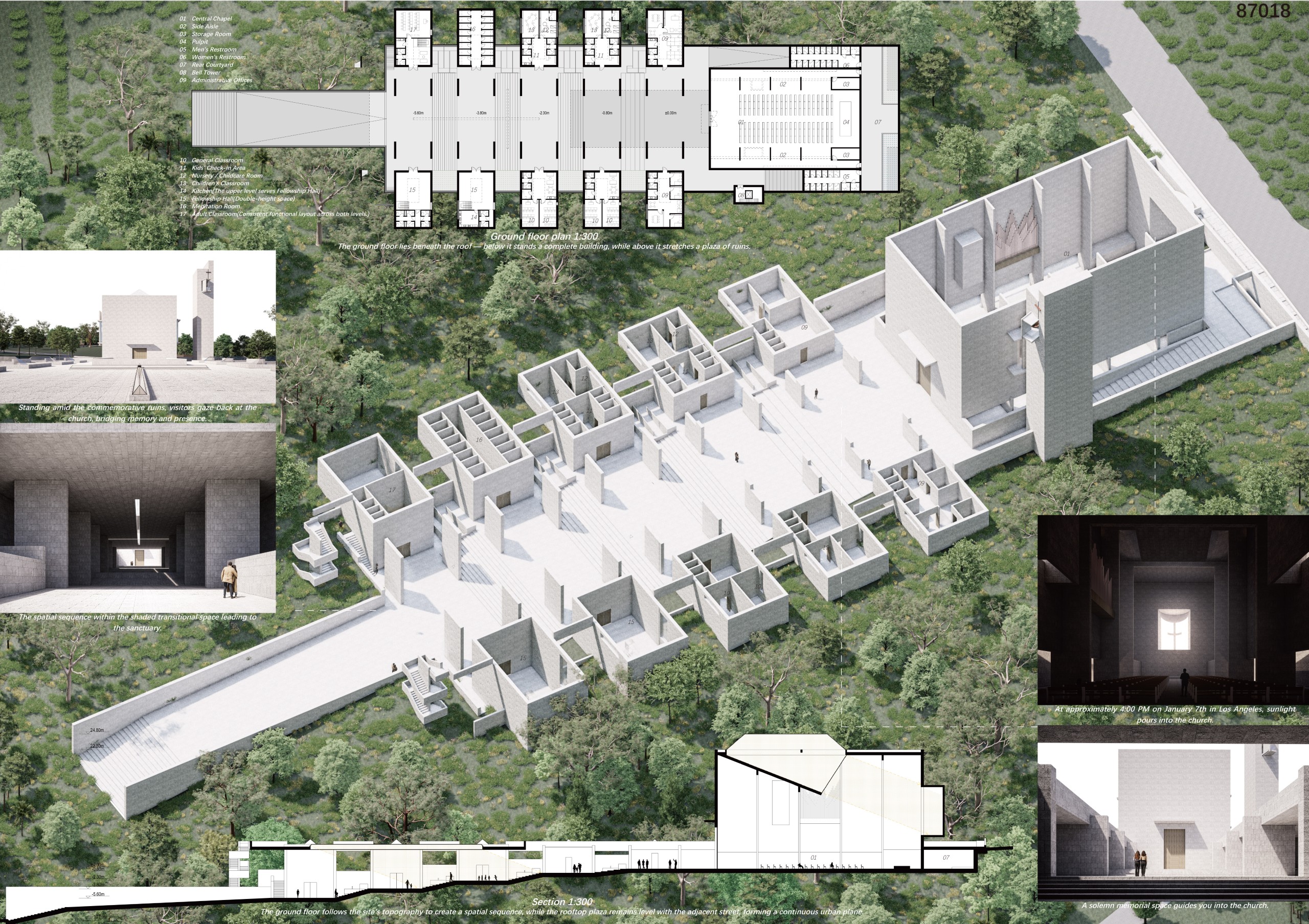
Reconstruction, Remembrance, Recovery
Jianmian Zhang [China]
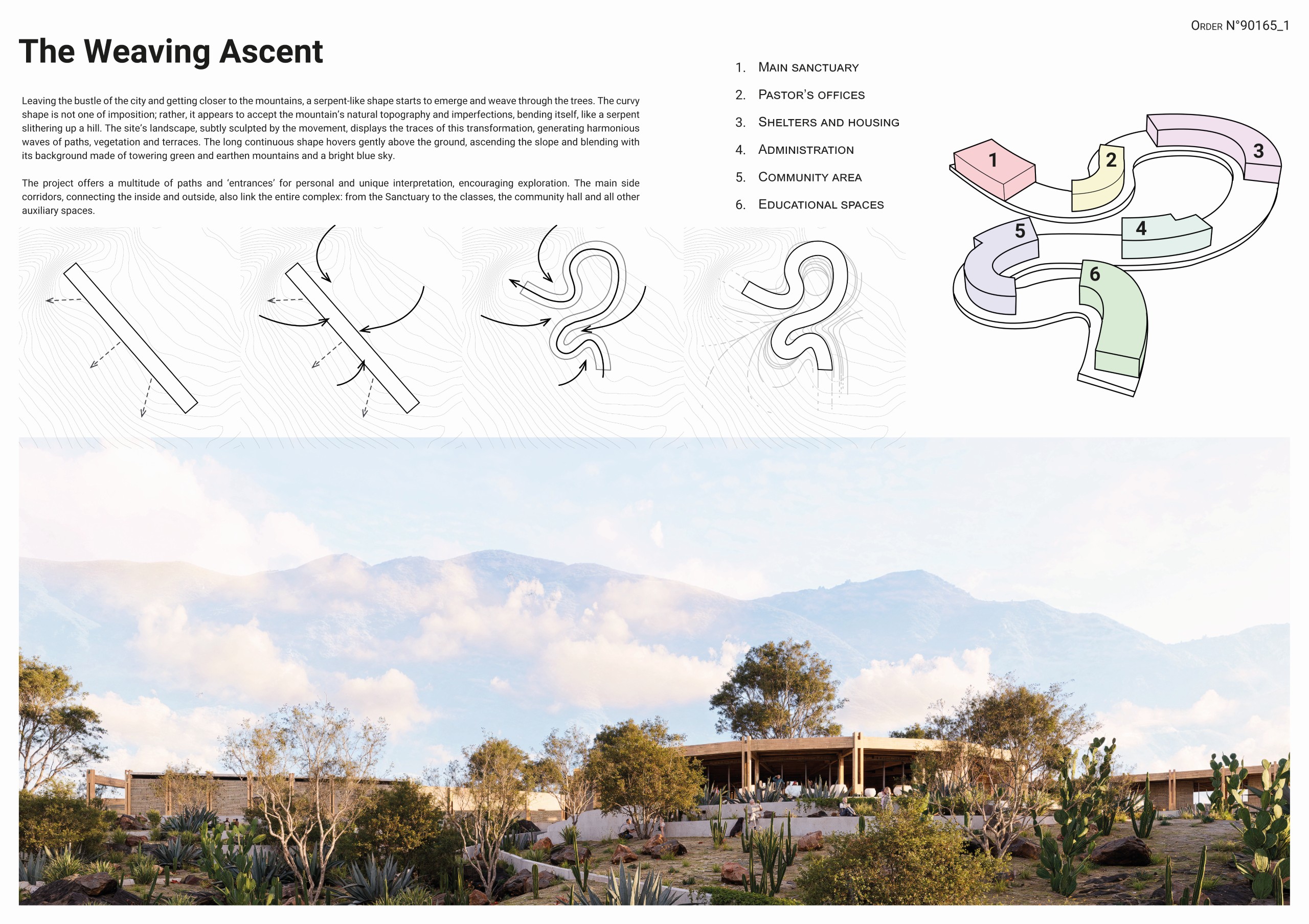
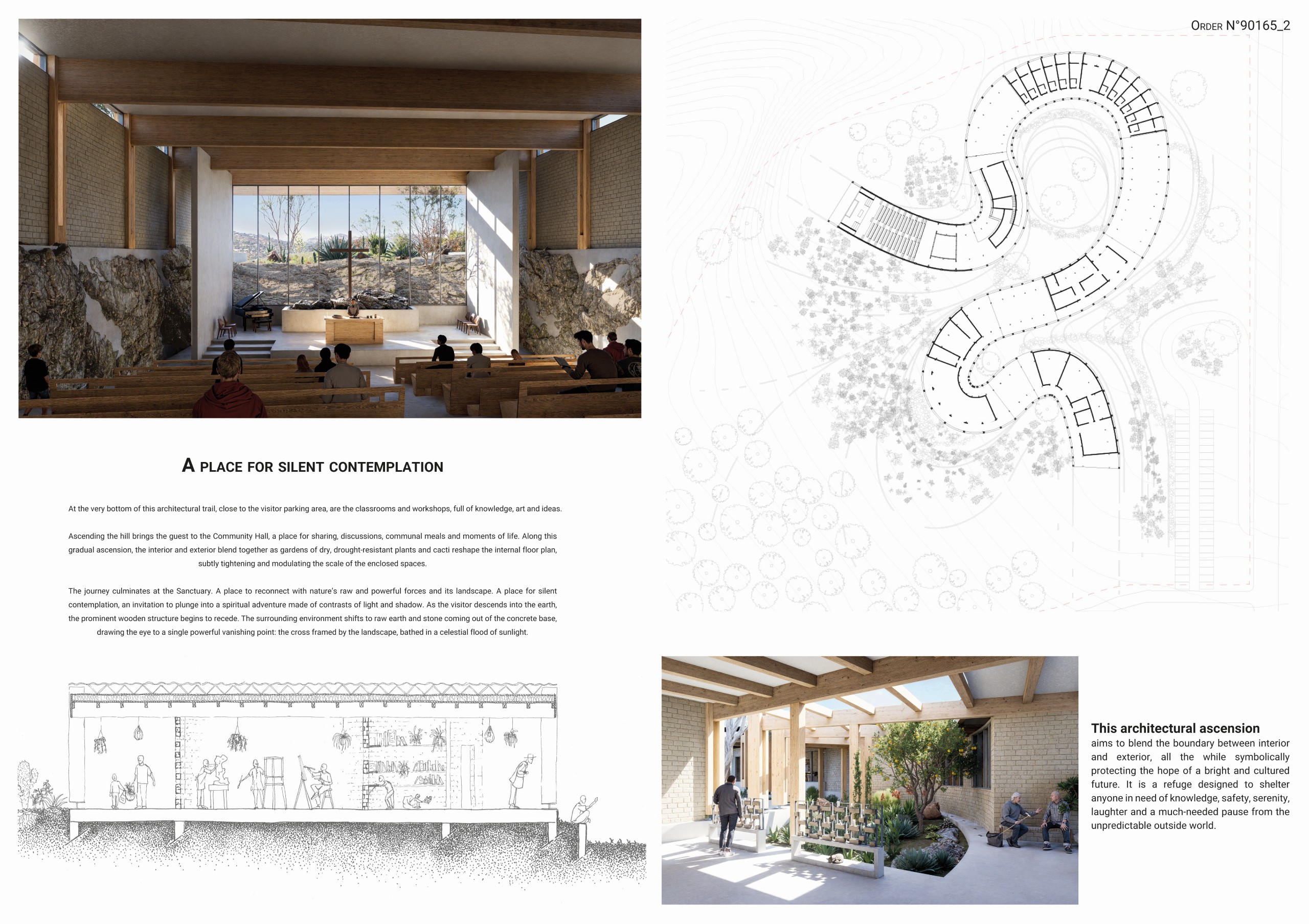
The Weaving Ascent
Mathéo Cadart, Mansour Darsi, Quentin Proust [France – Morocco]
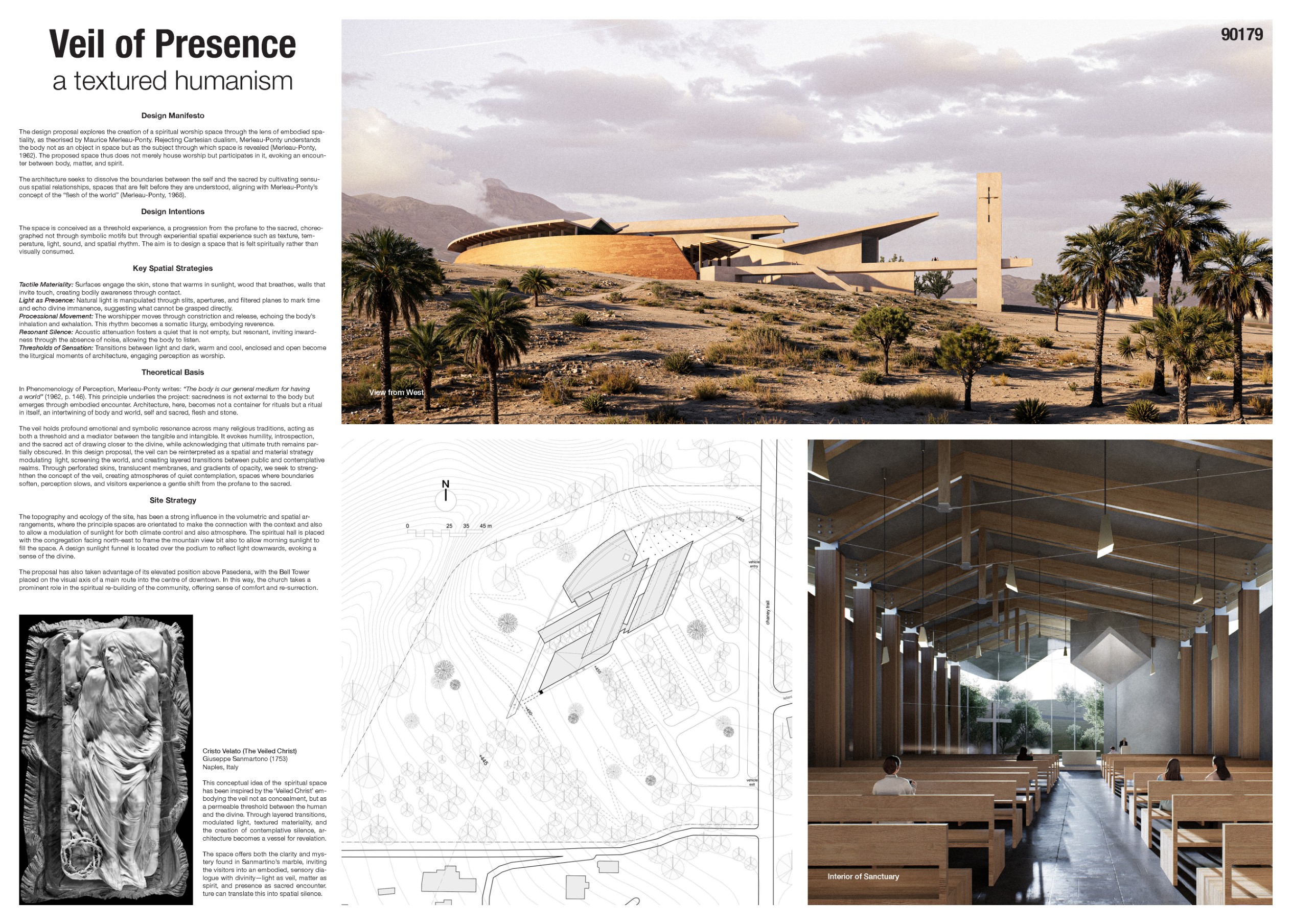
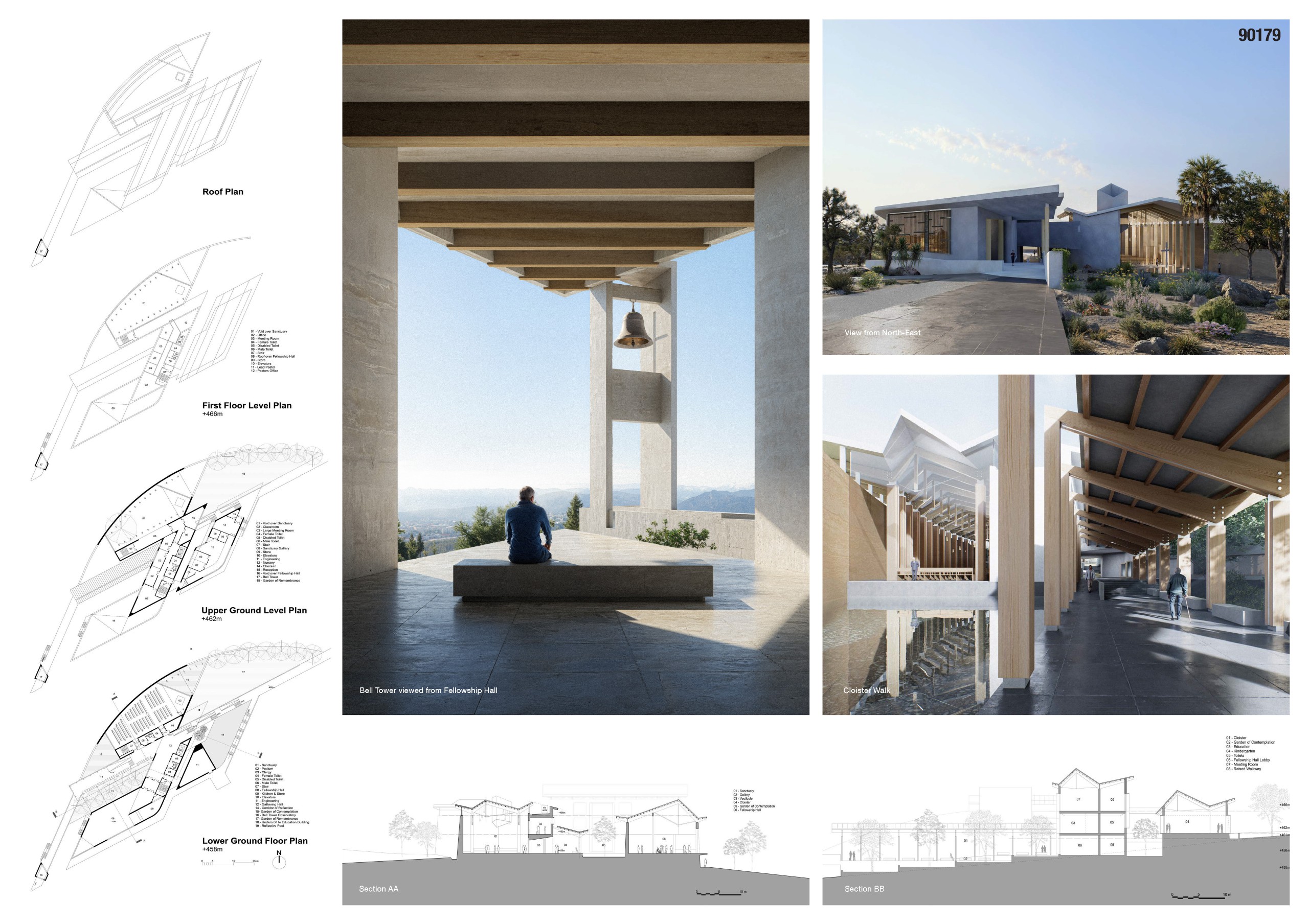
Veil of Presence; a textured humanism
John Latto, Wenyu Wang, Yiyang Wang, Zhaoyixuan Zeng [United Kingdom – China]
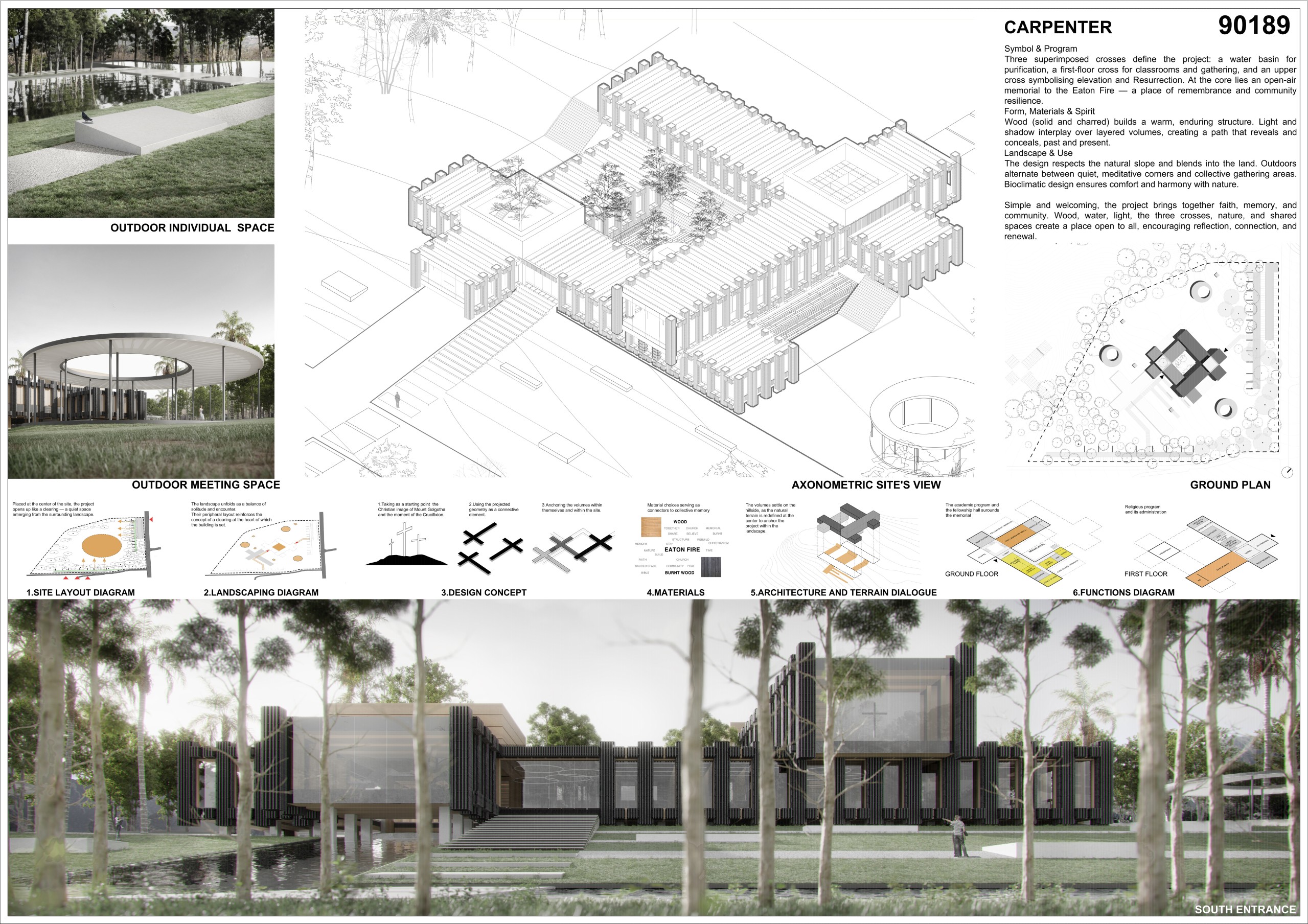
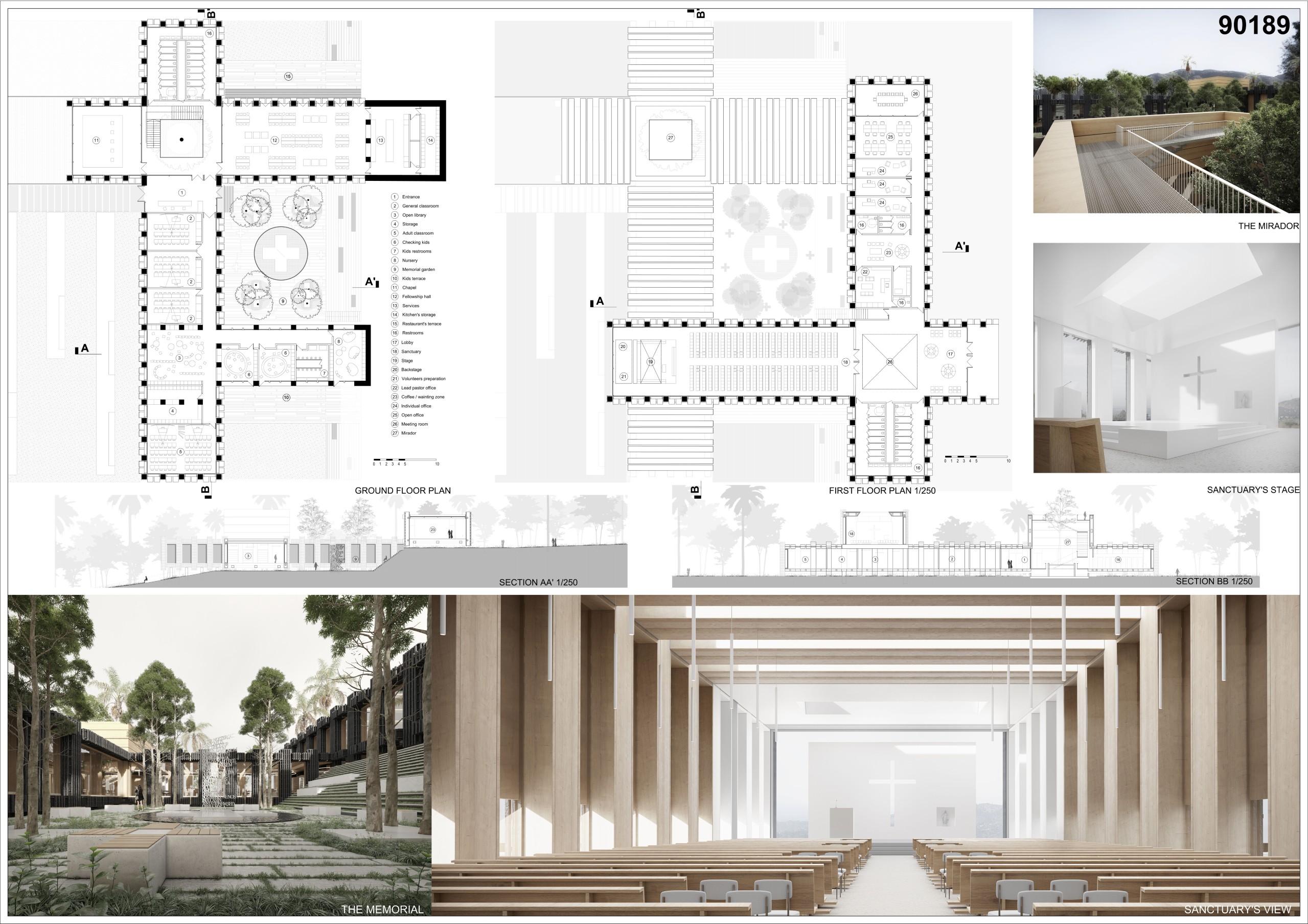
Carpenter
Olivier Hernandez Richard, Hernan Jose Vielma Millan [Colombia]
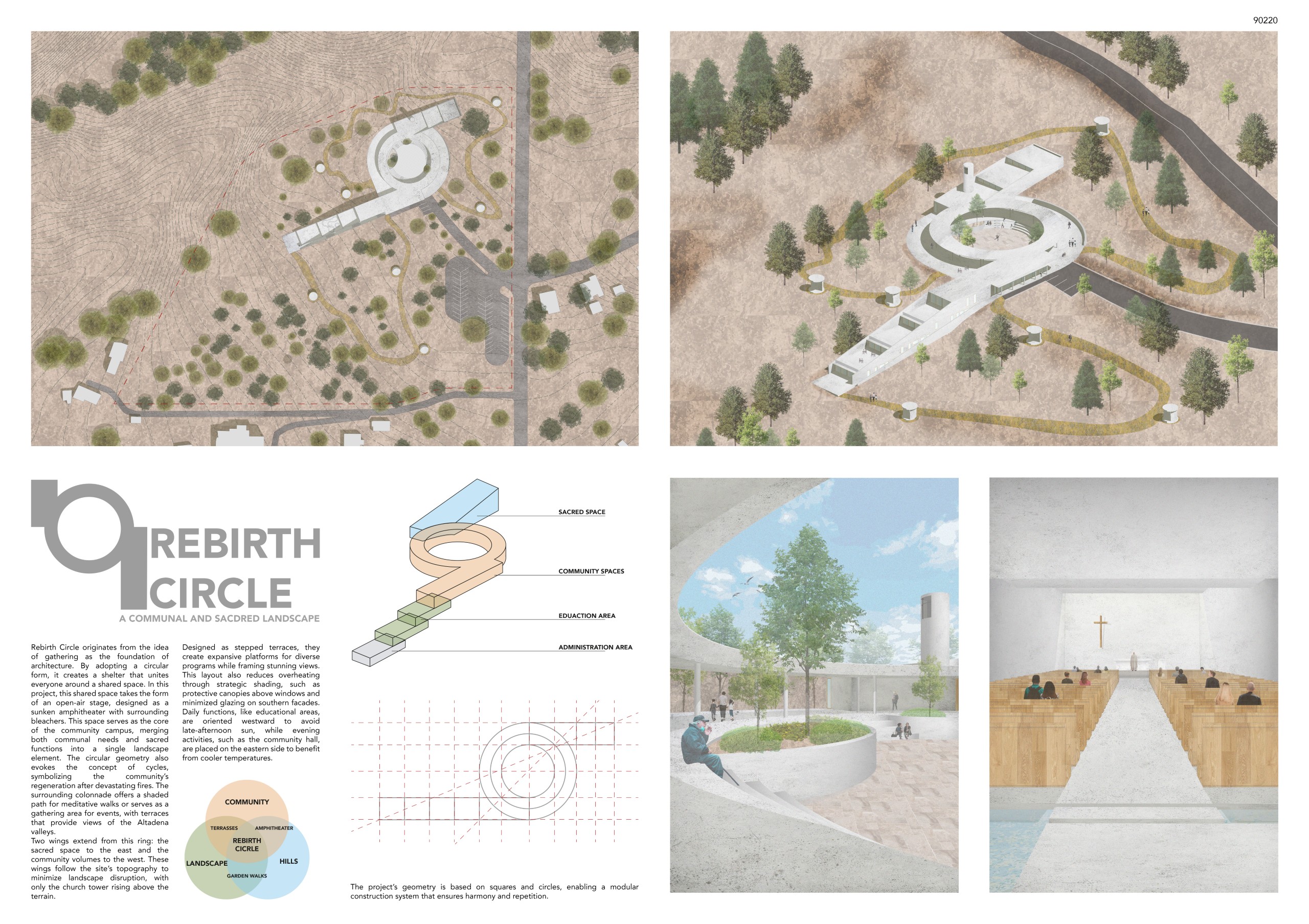
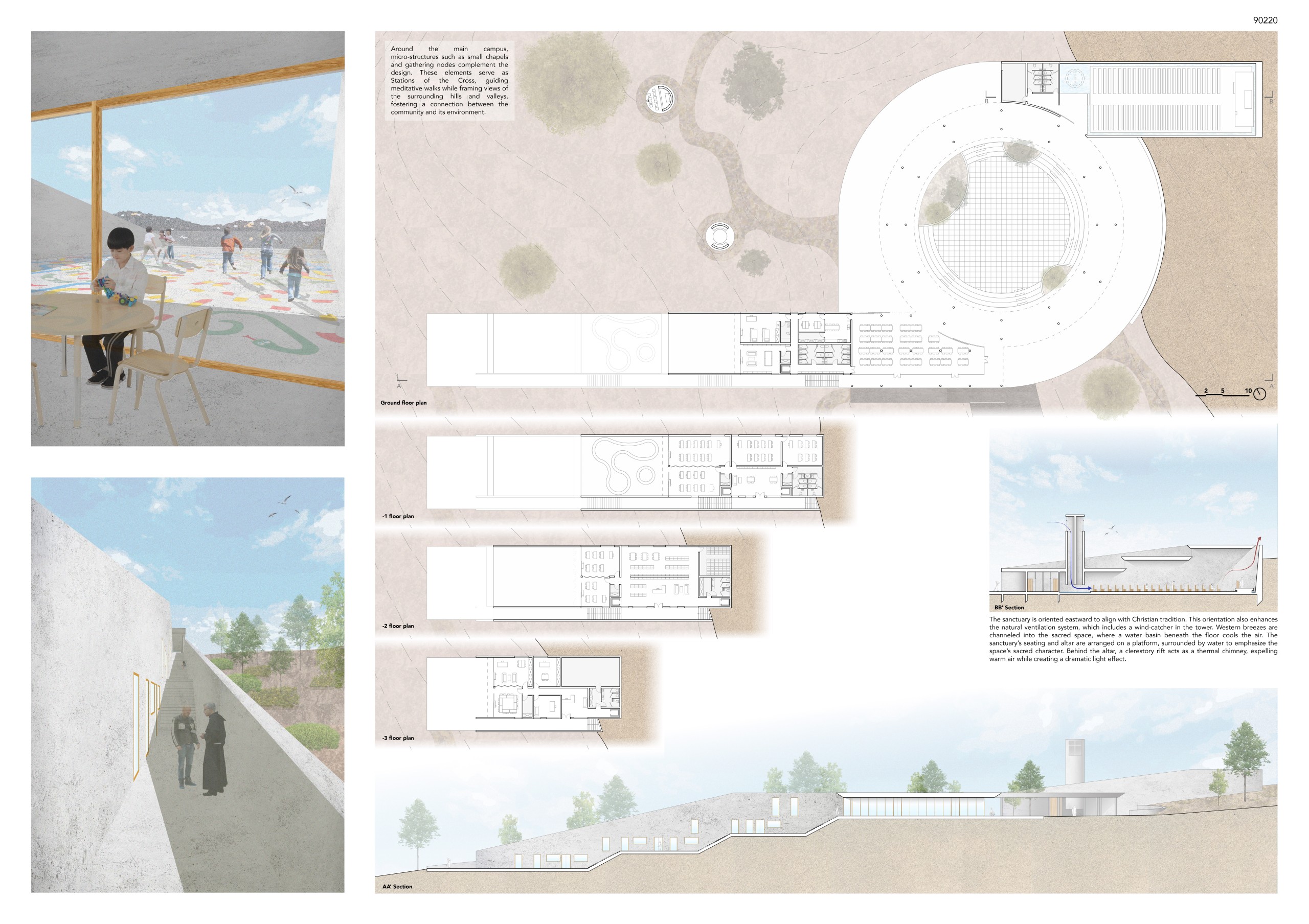
Rebirth Circle
Hannetel Rémi [France]
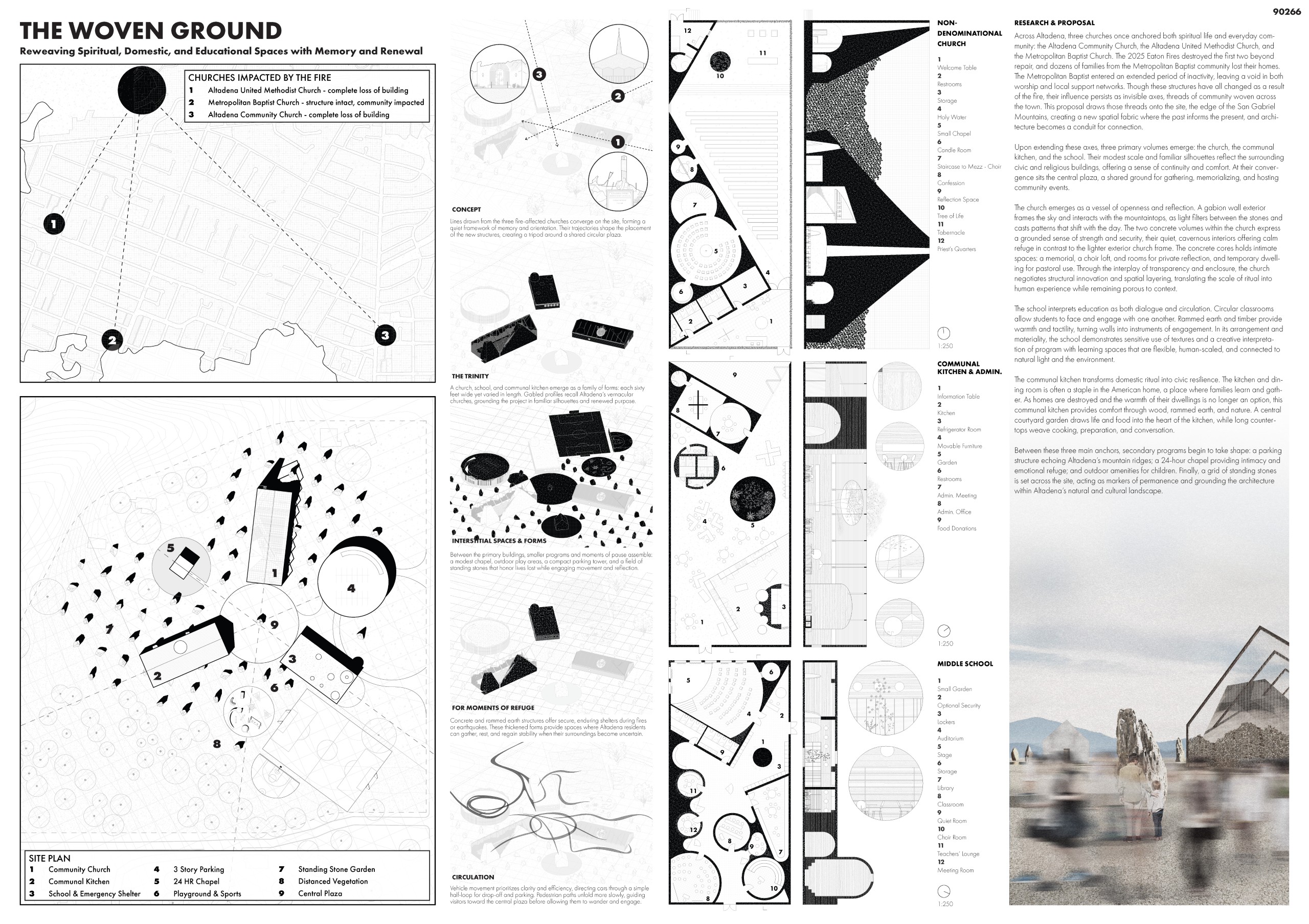
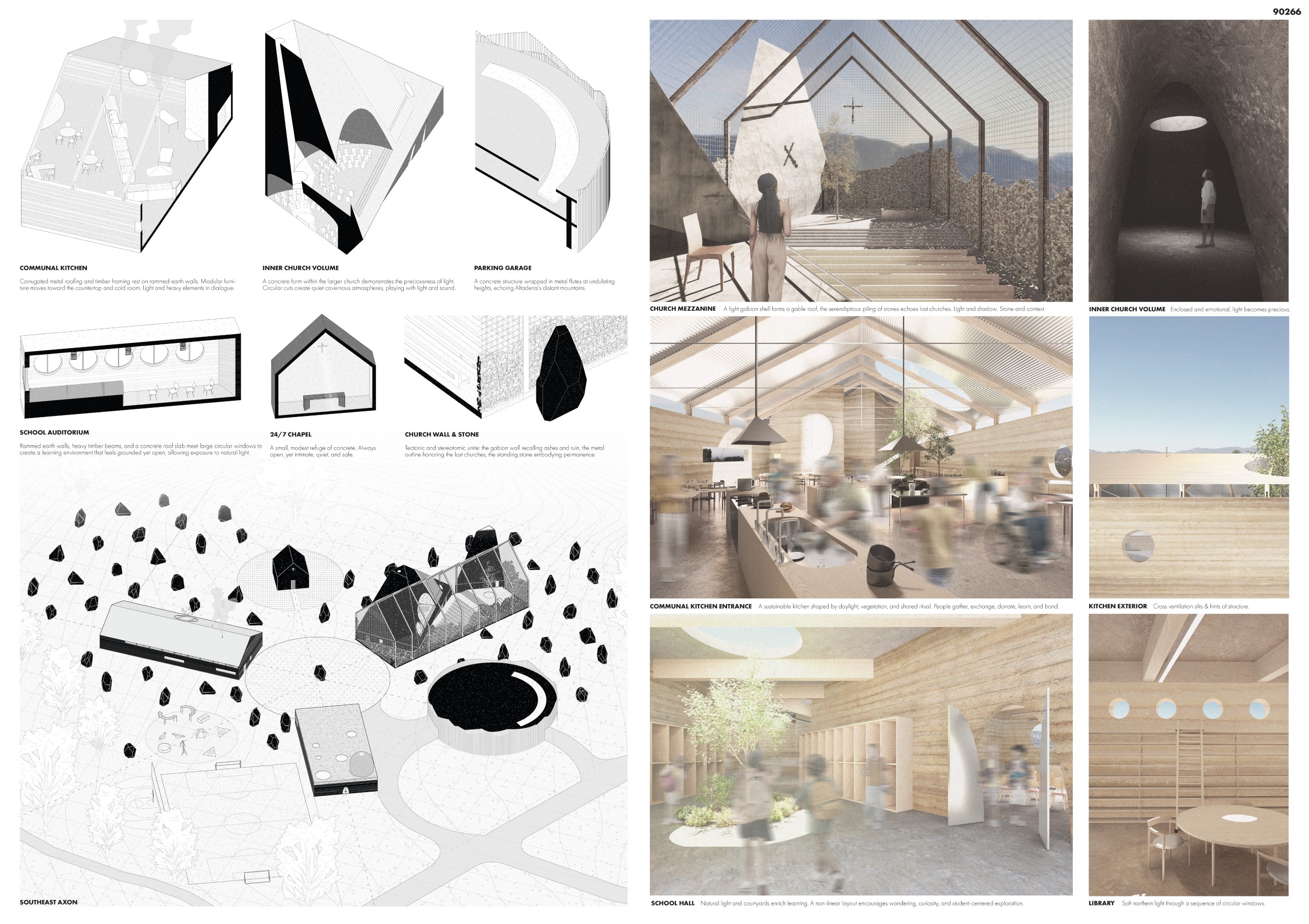
The Woven Ground
Brandon Gicquel [United States]
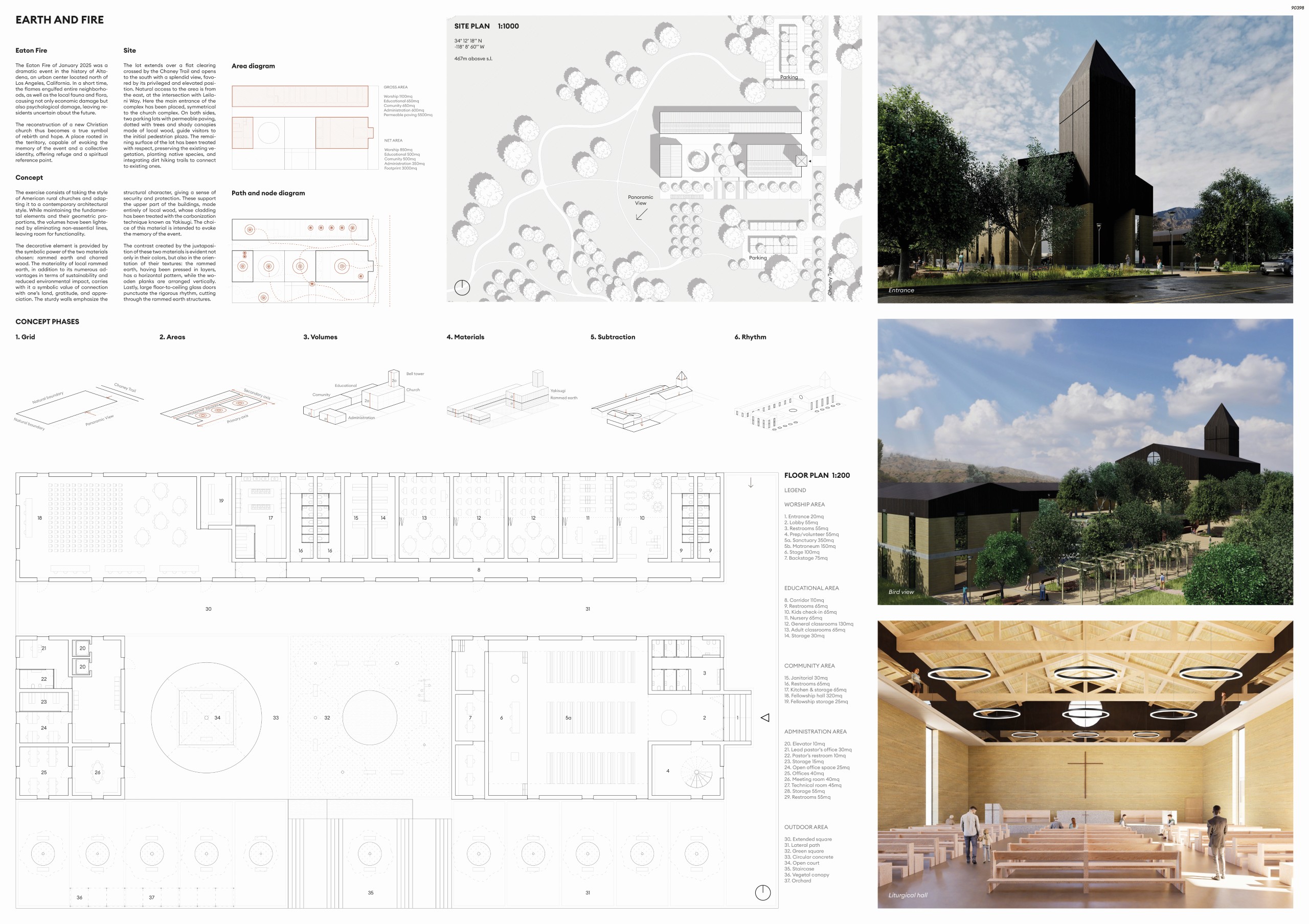
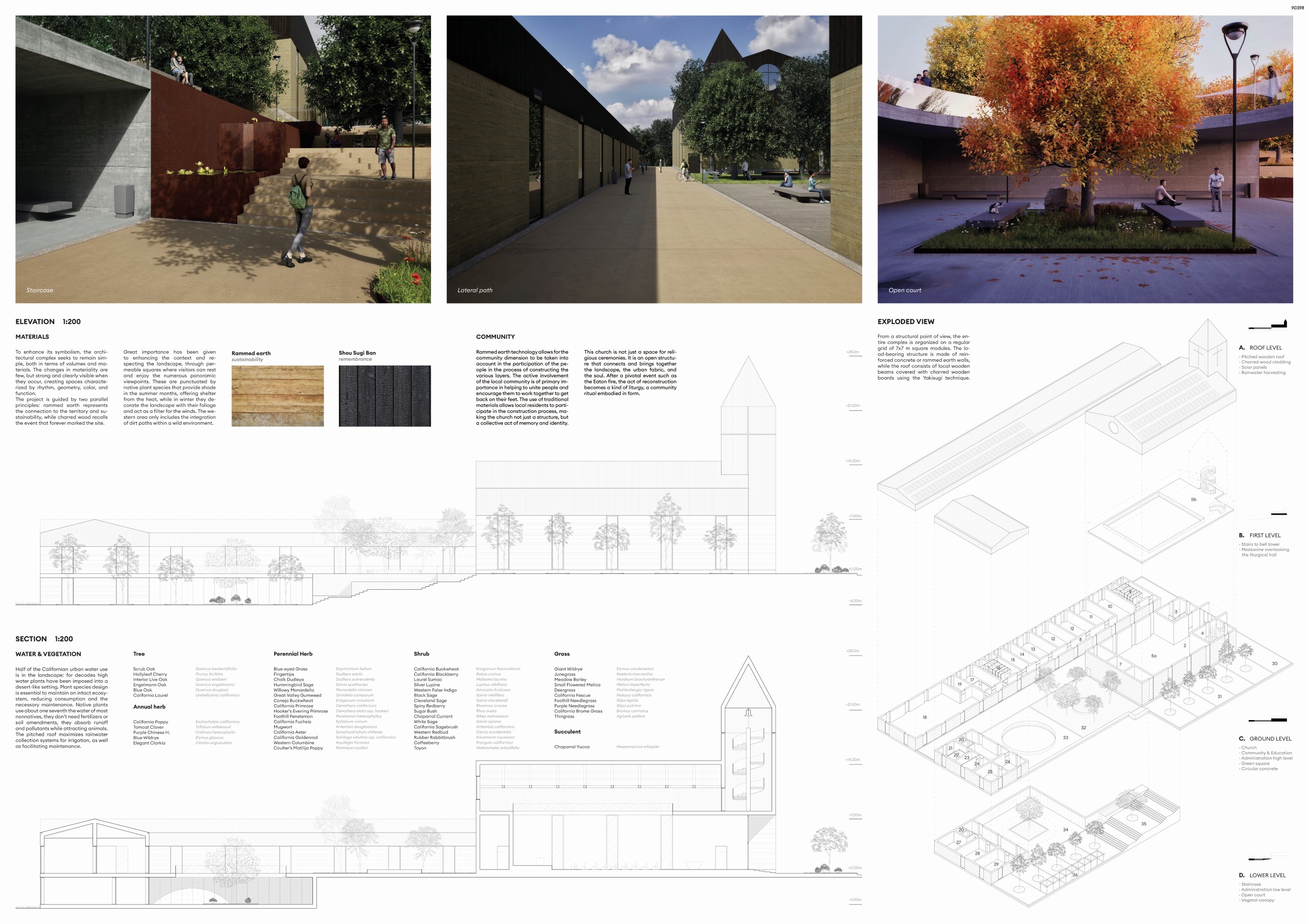
EARTH AND FIRE
Gianmarco Bambini [Italy]
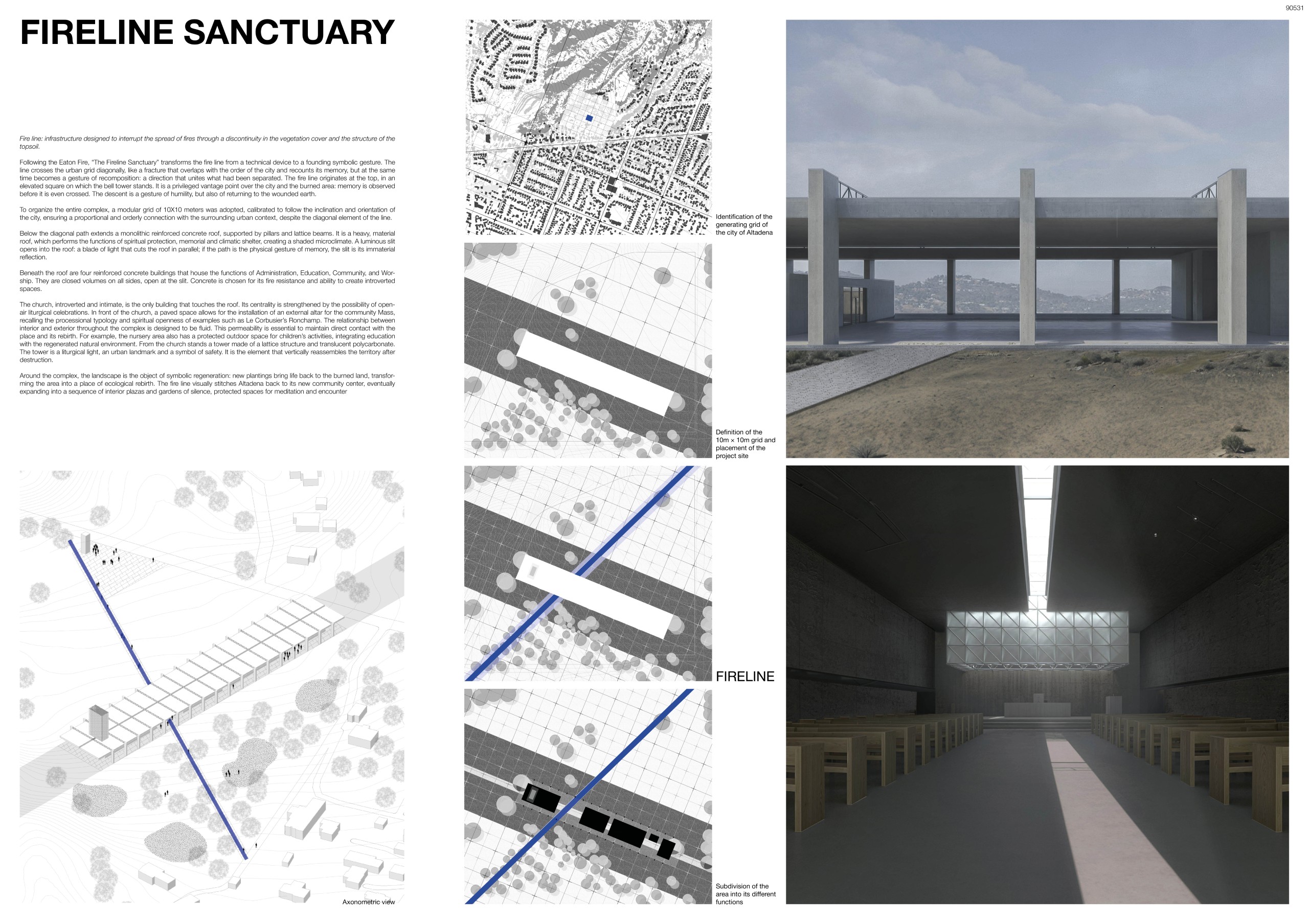
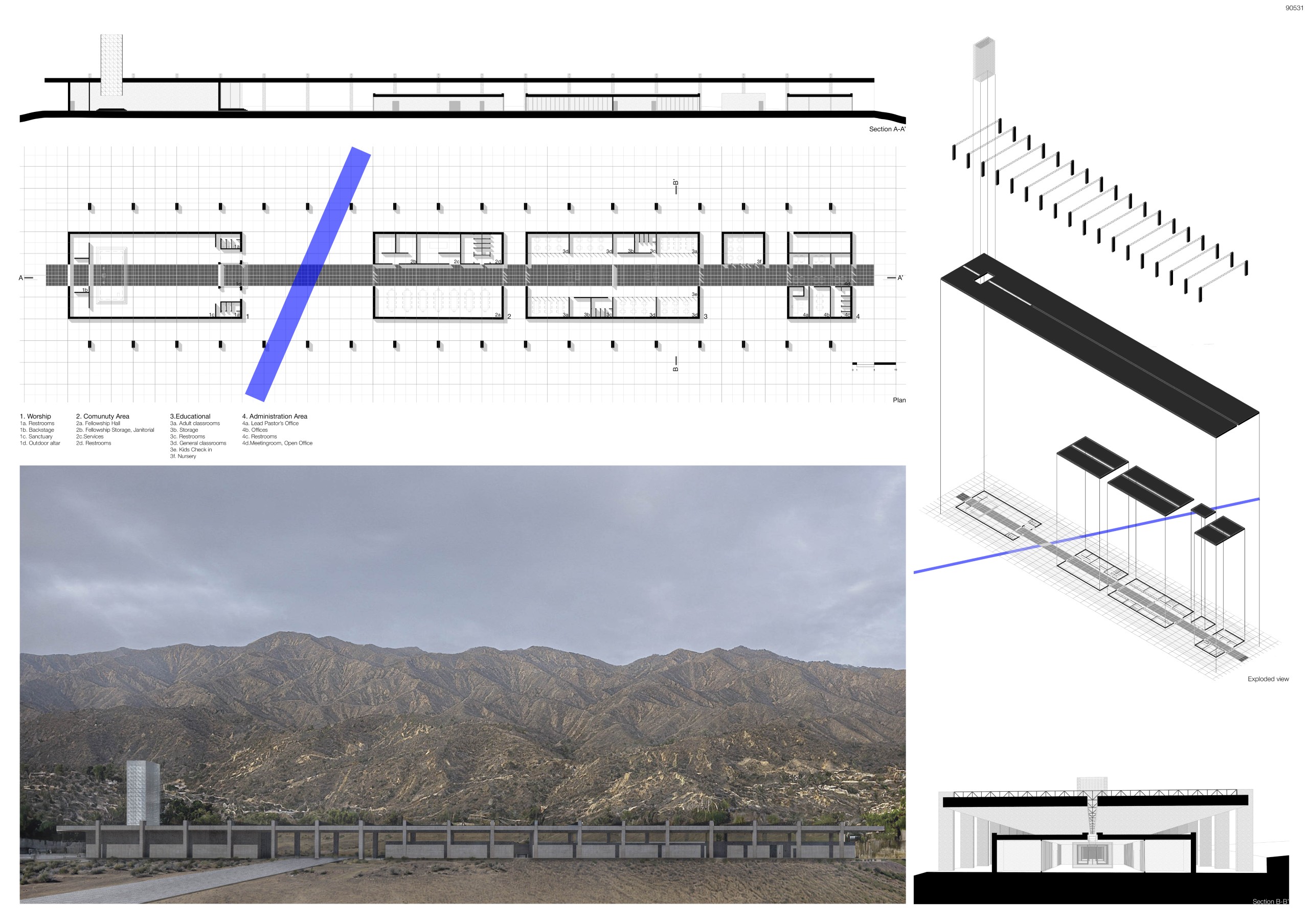
Fireline Sanctuary
Alice Parlato, Carlotta Rigosi, Luisa Sarri [Italy]
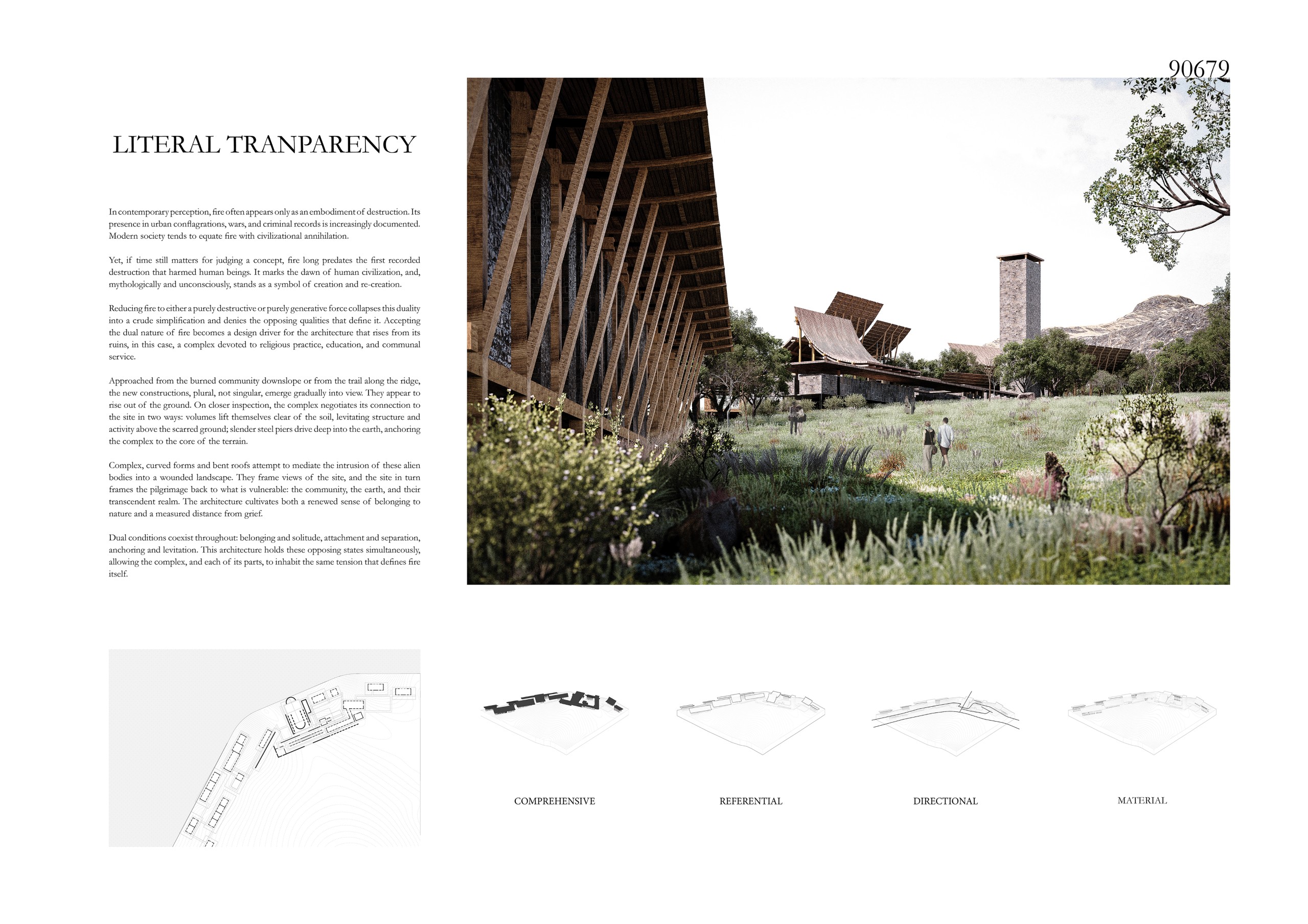
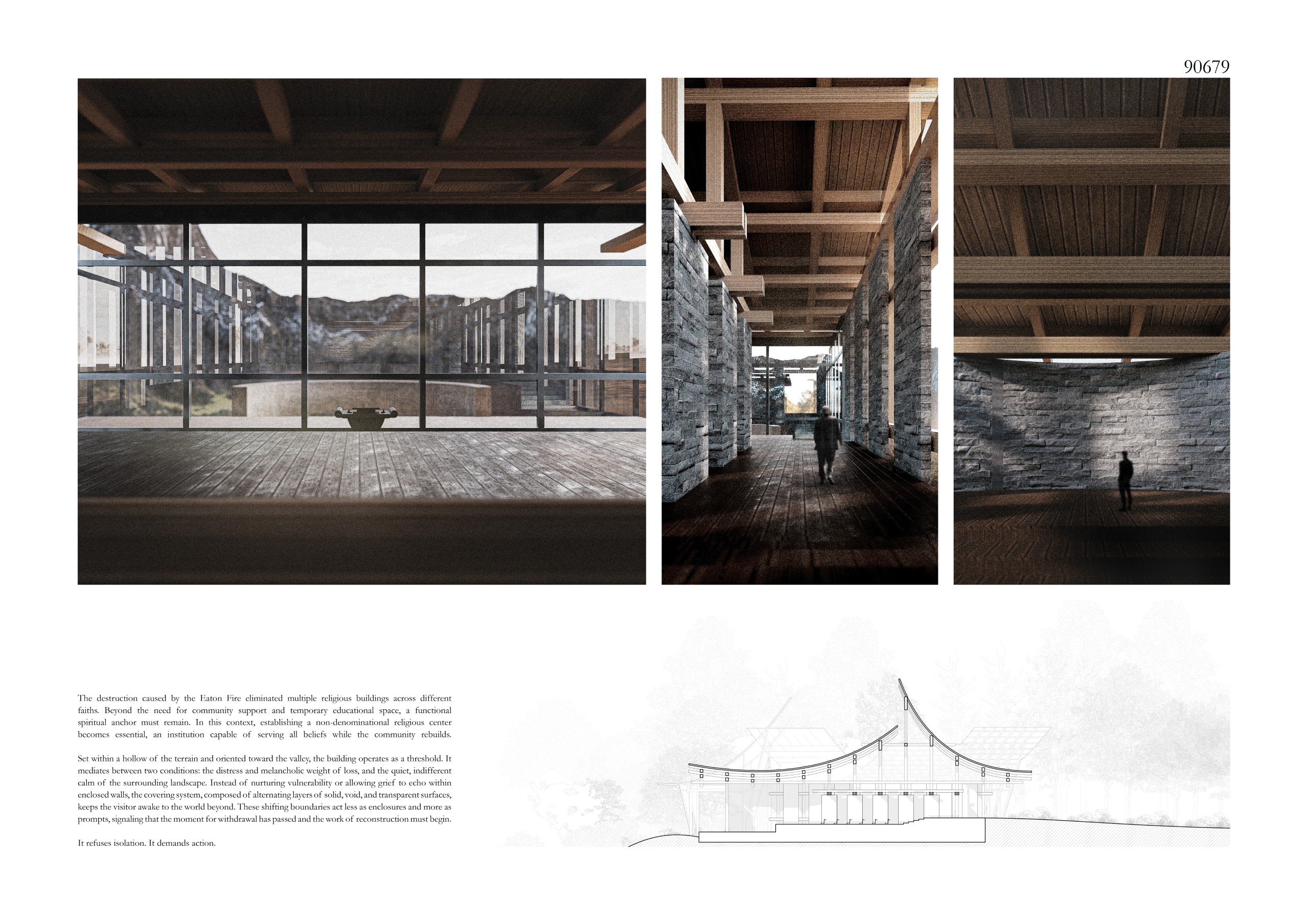
Literal Transparency
Tuan Nguyen, Minh Nguyen [Vietnam]
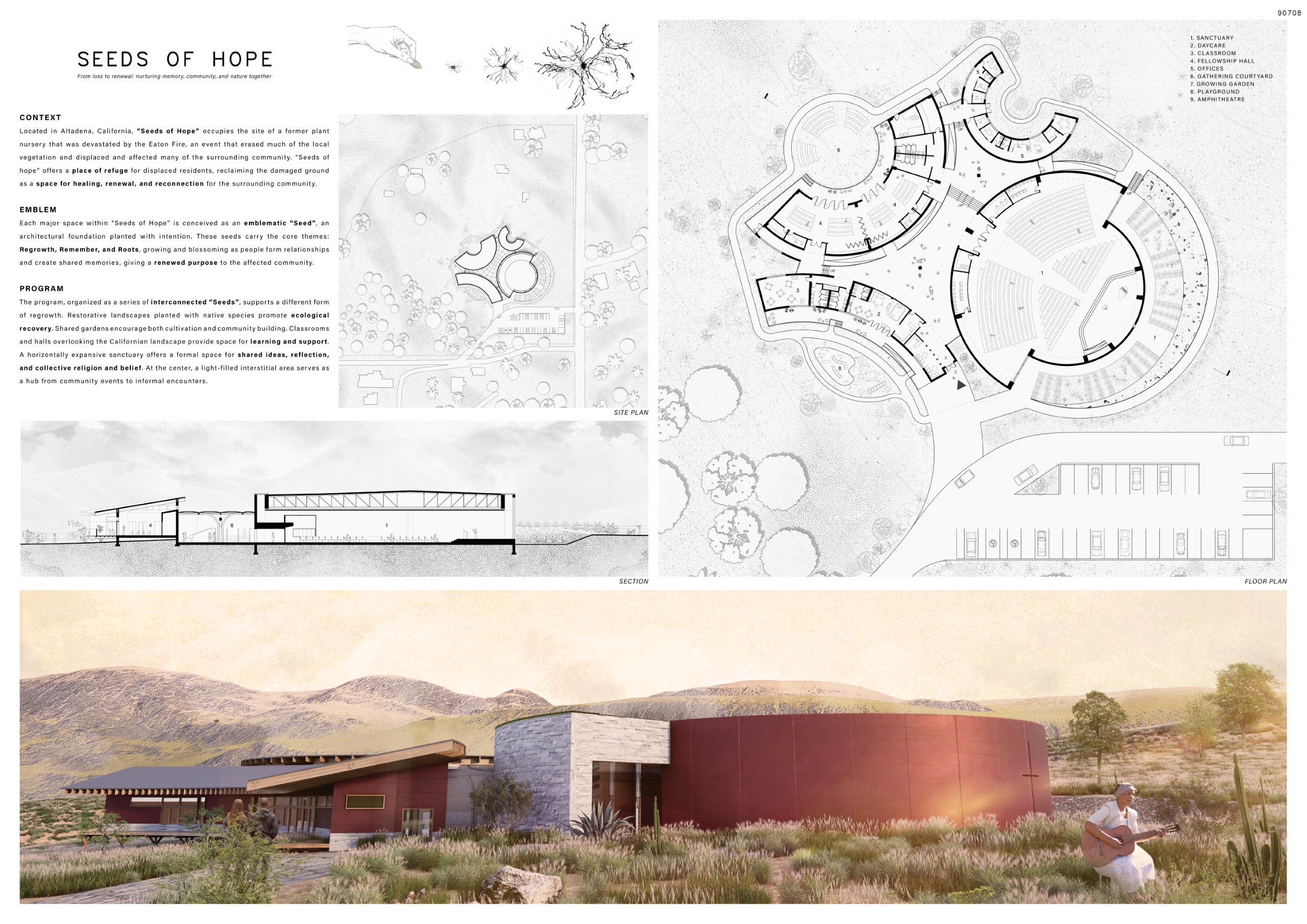
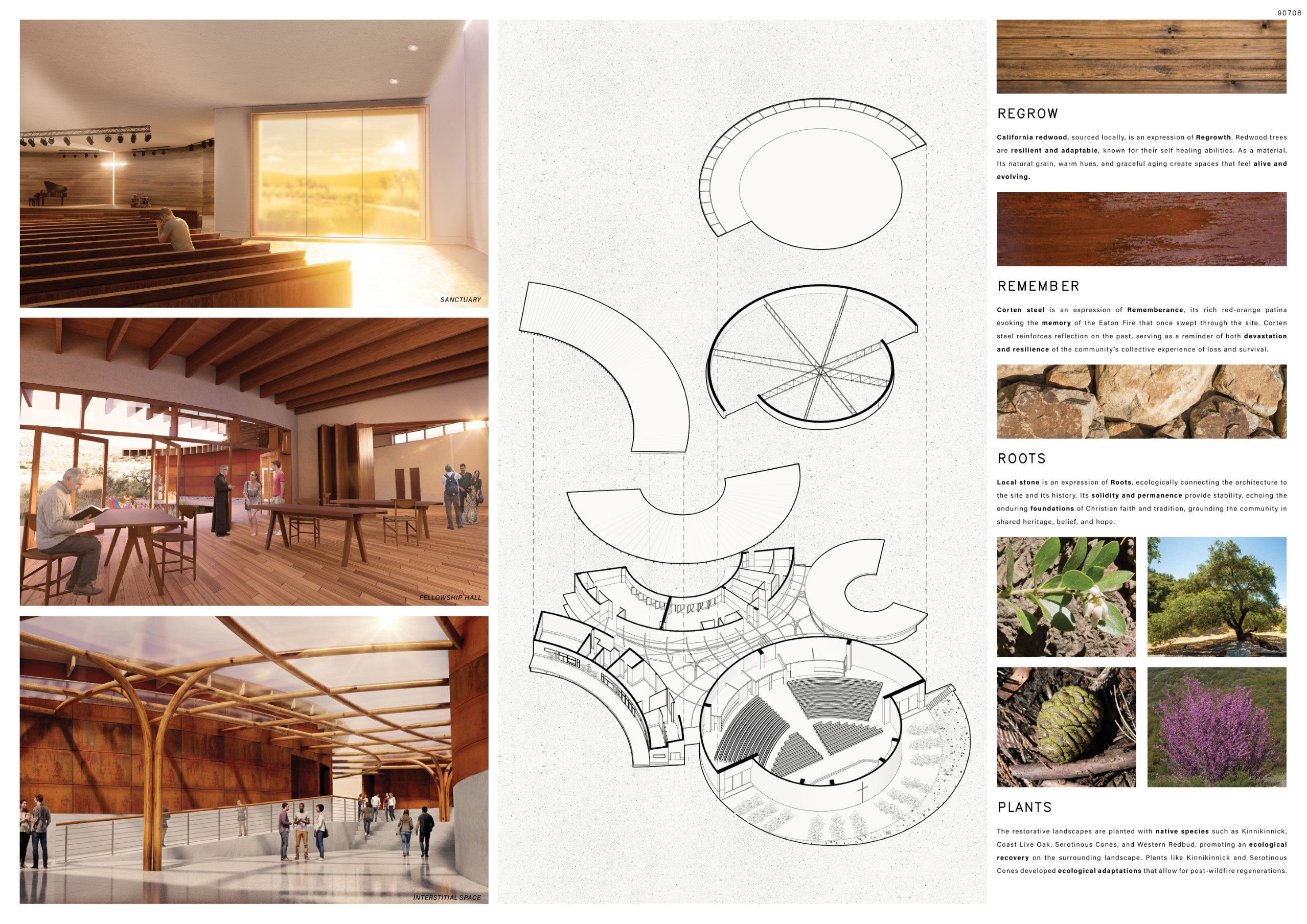
Seeds Of Hope
Tiffany Chui, Kyle Wong, Lincoln Uy, Gavyn Cheung, Jeff Man [Canada]
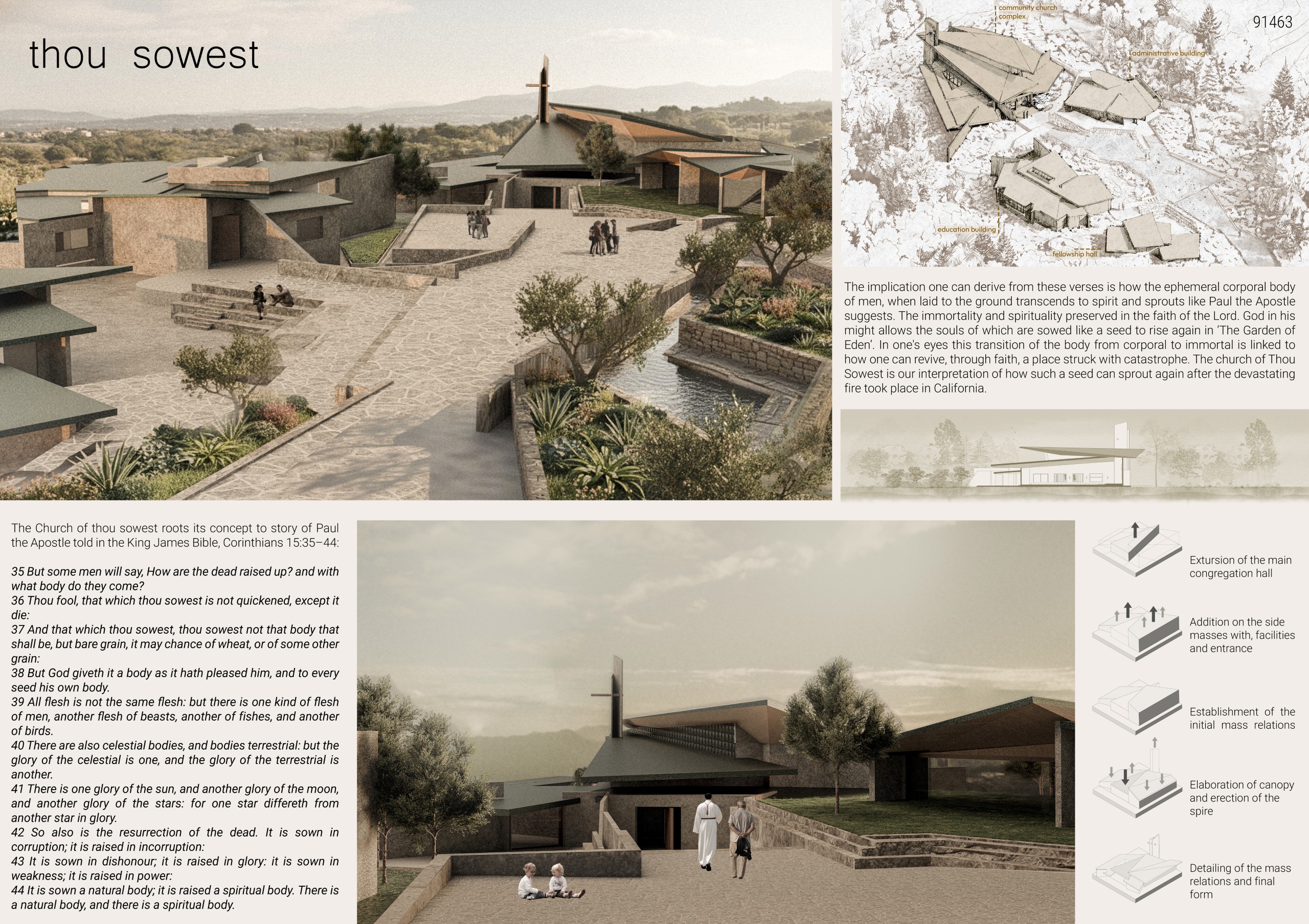
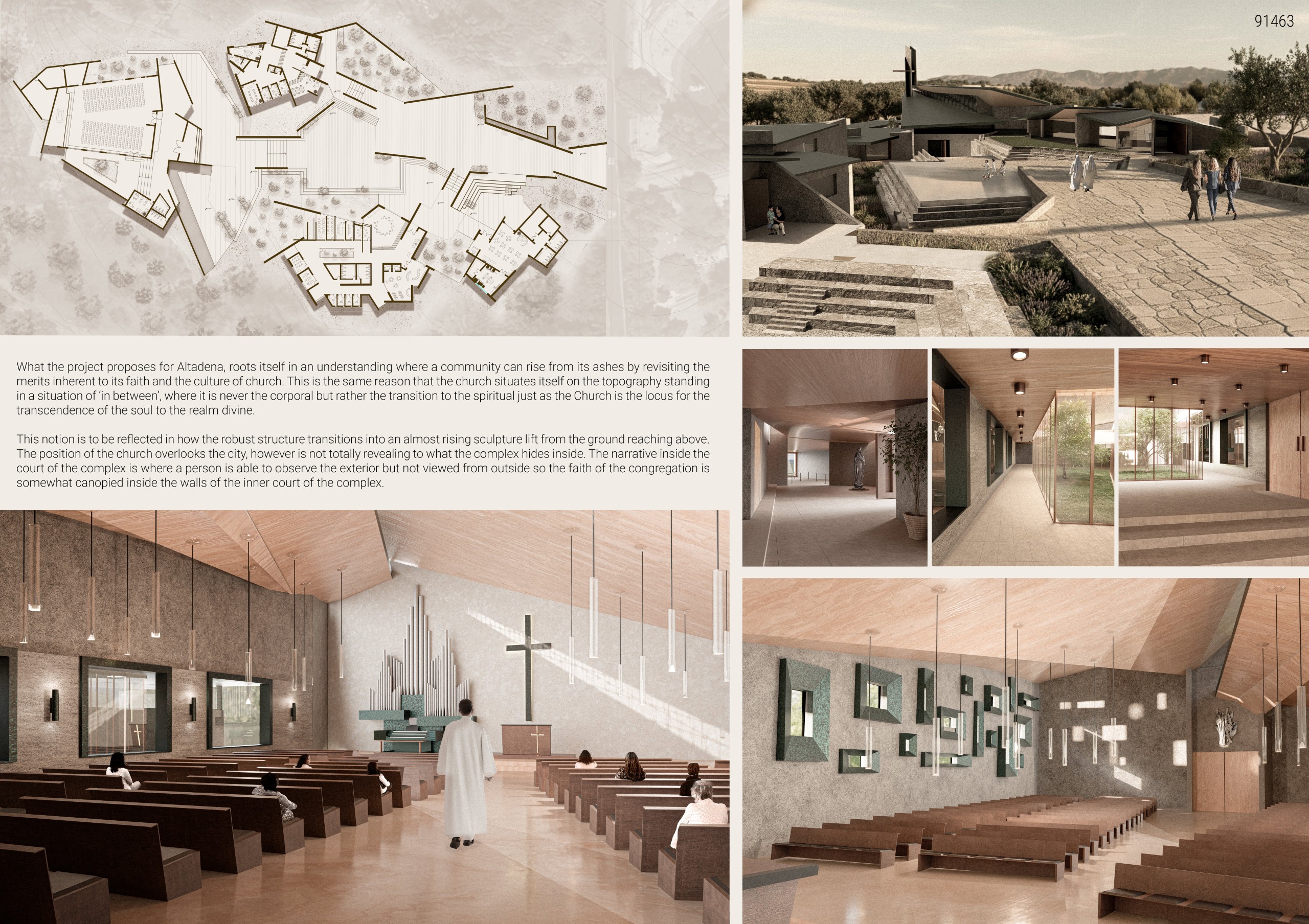
Thou Sowest
Osman İmamoğlu, Buse İrem Polat, Teoman Gönenç, Aynur Melis Alçı [Turkey]
fiRe_
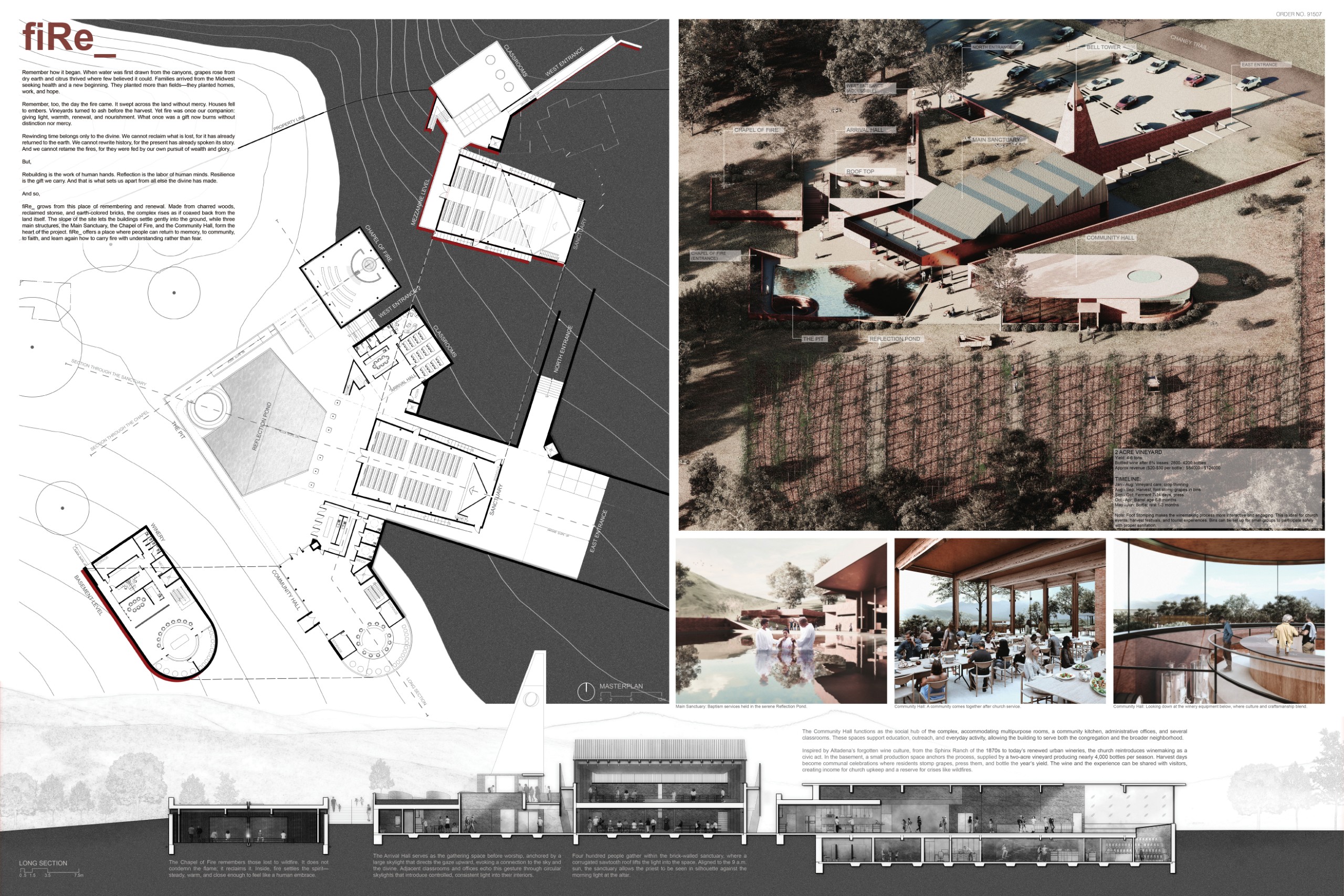
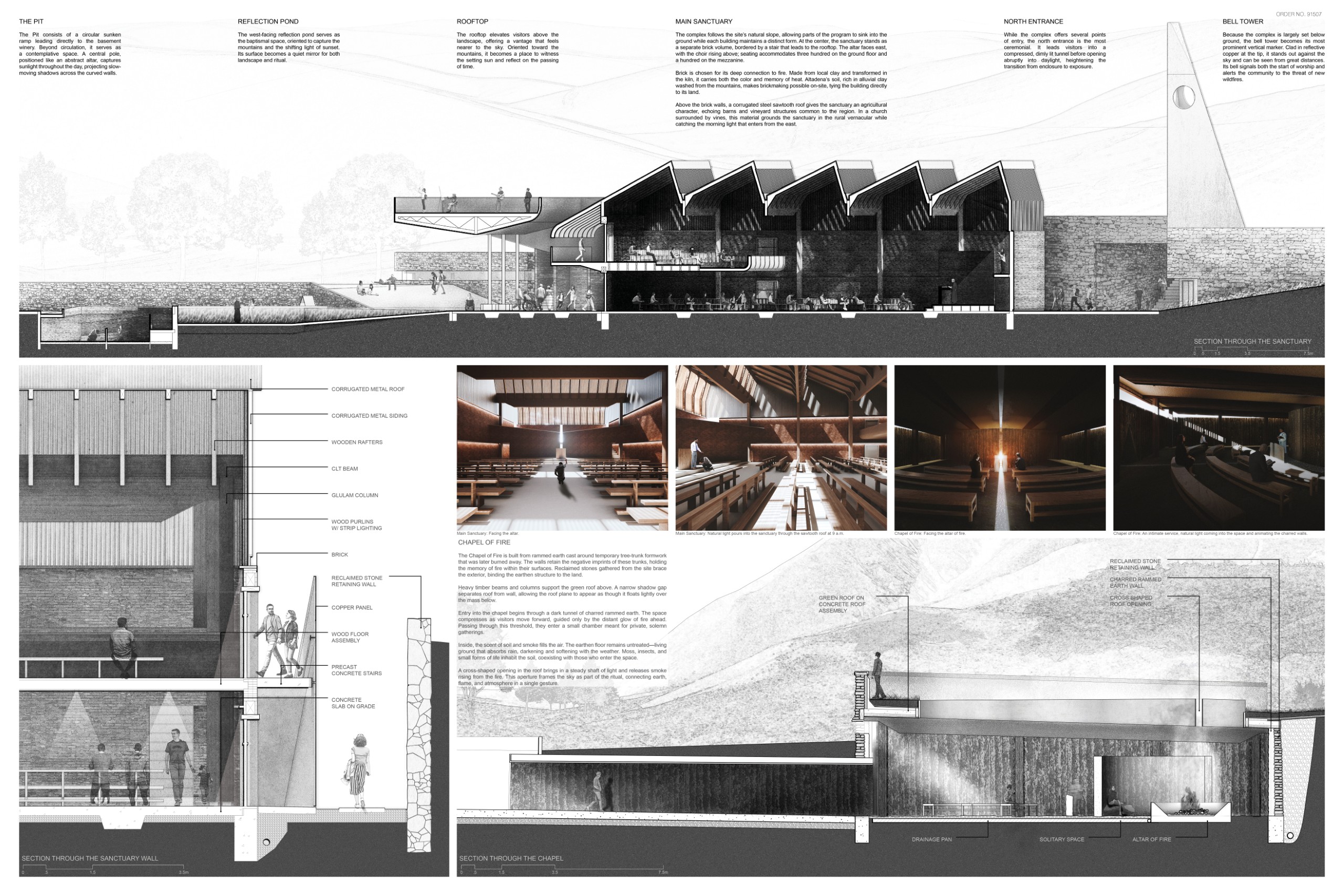
Natalie Cole Bajet, Nikki ElimNg, Mu Qu Jennifer Liu [Canada]
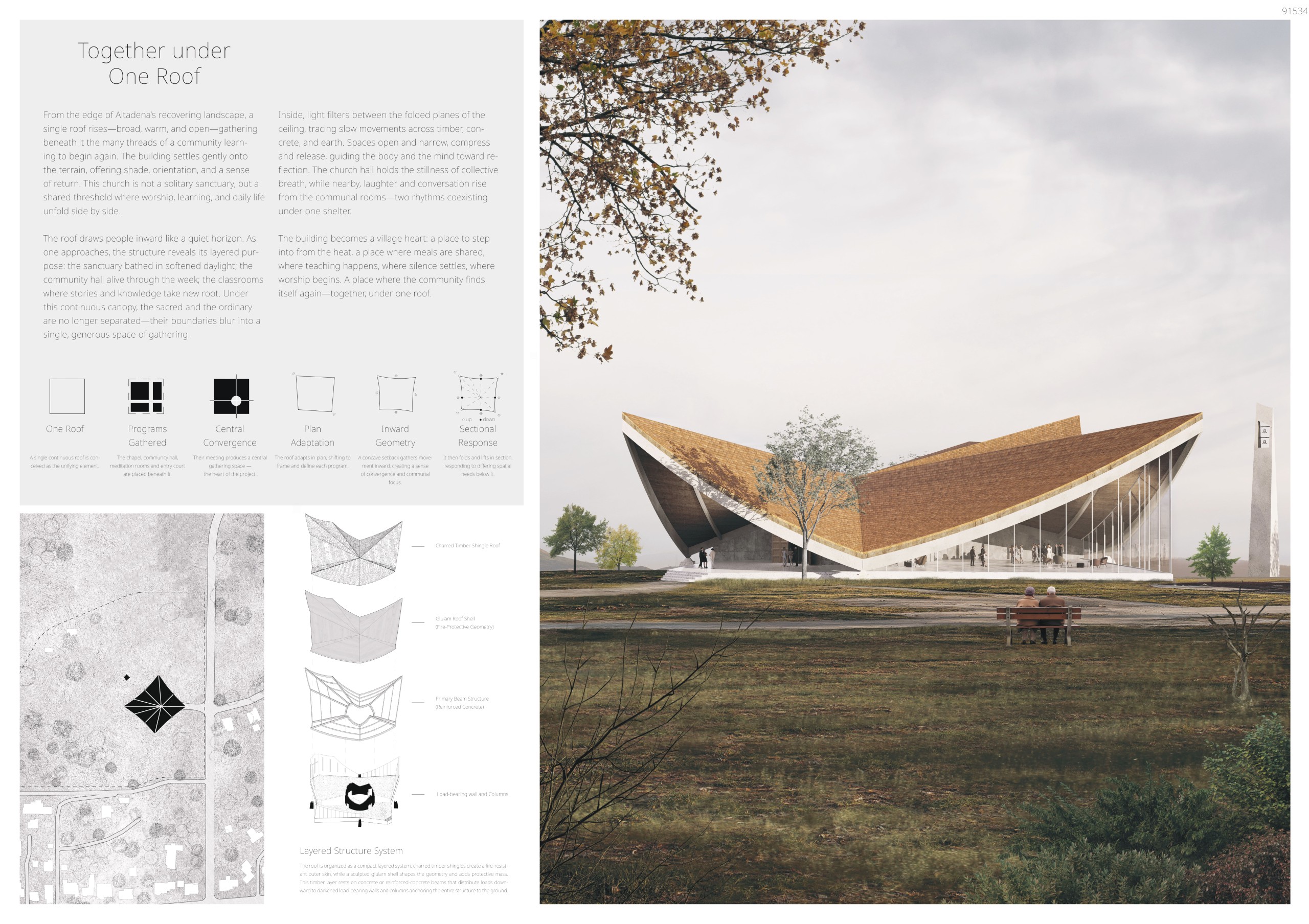
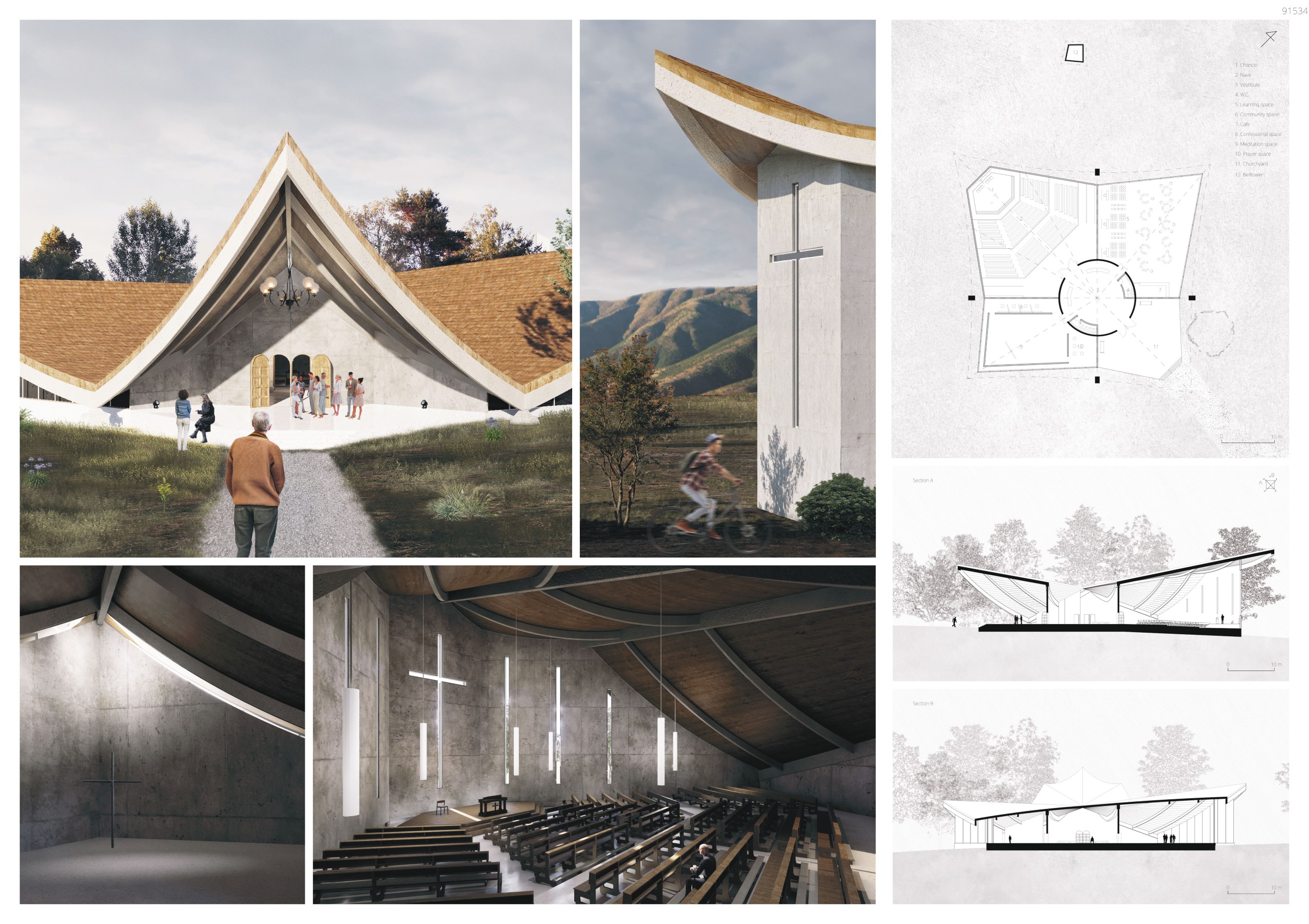
Together under one roof
Taehun Ryu, Hanbin Yang [South Korea]
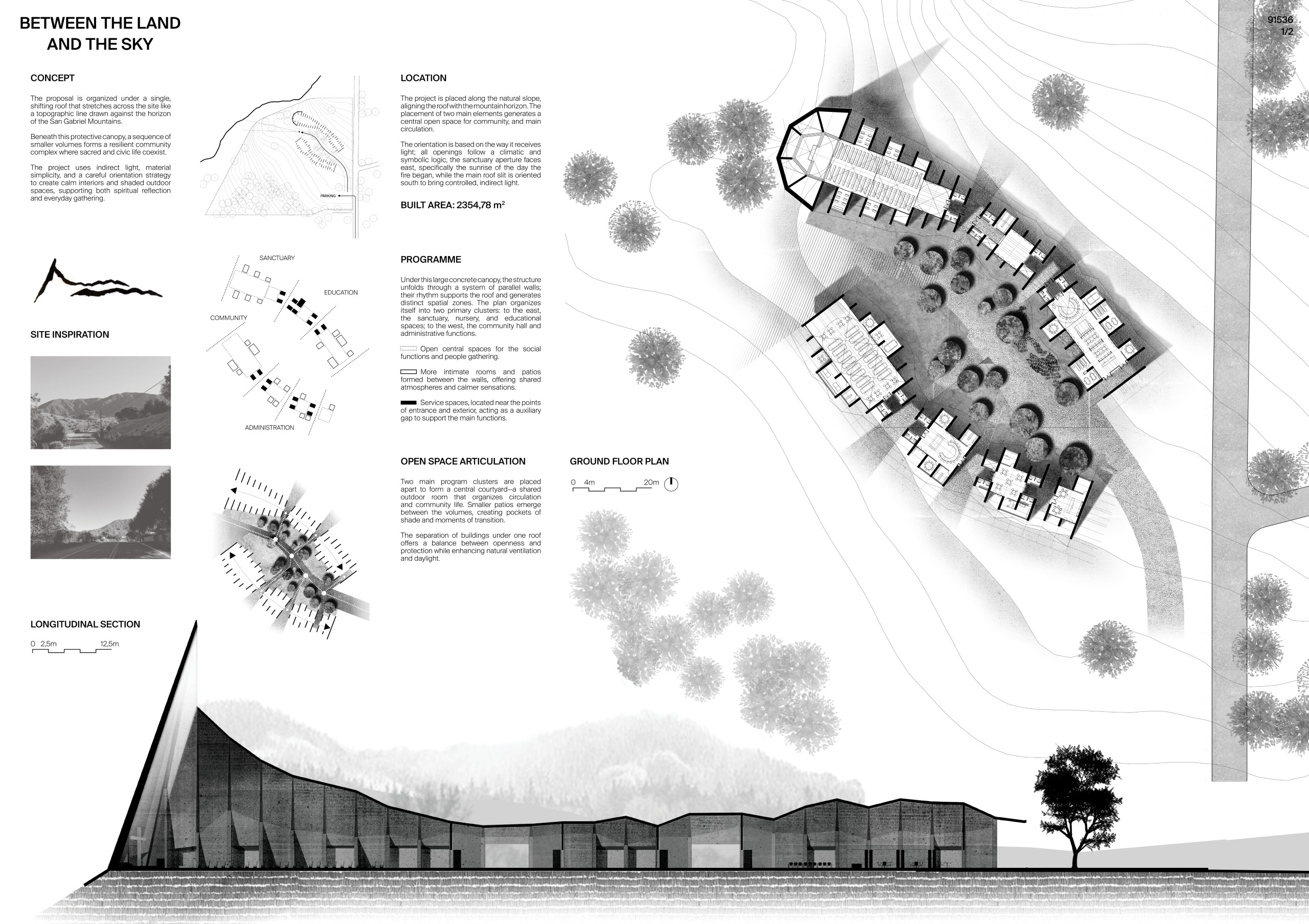
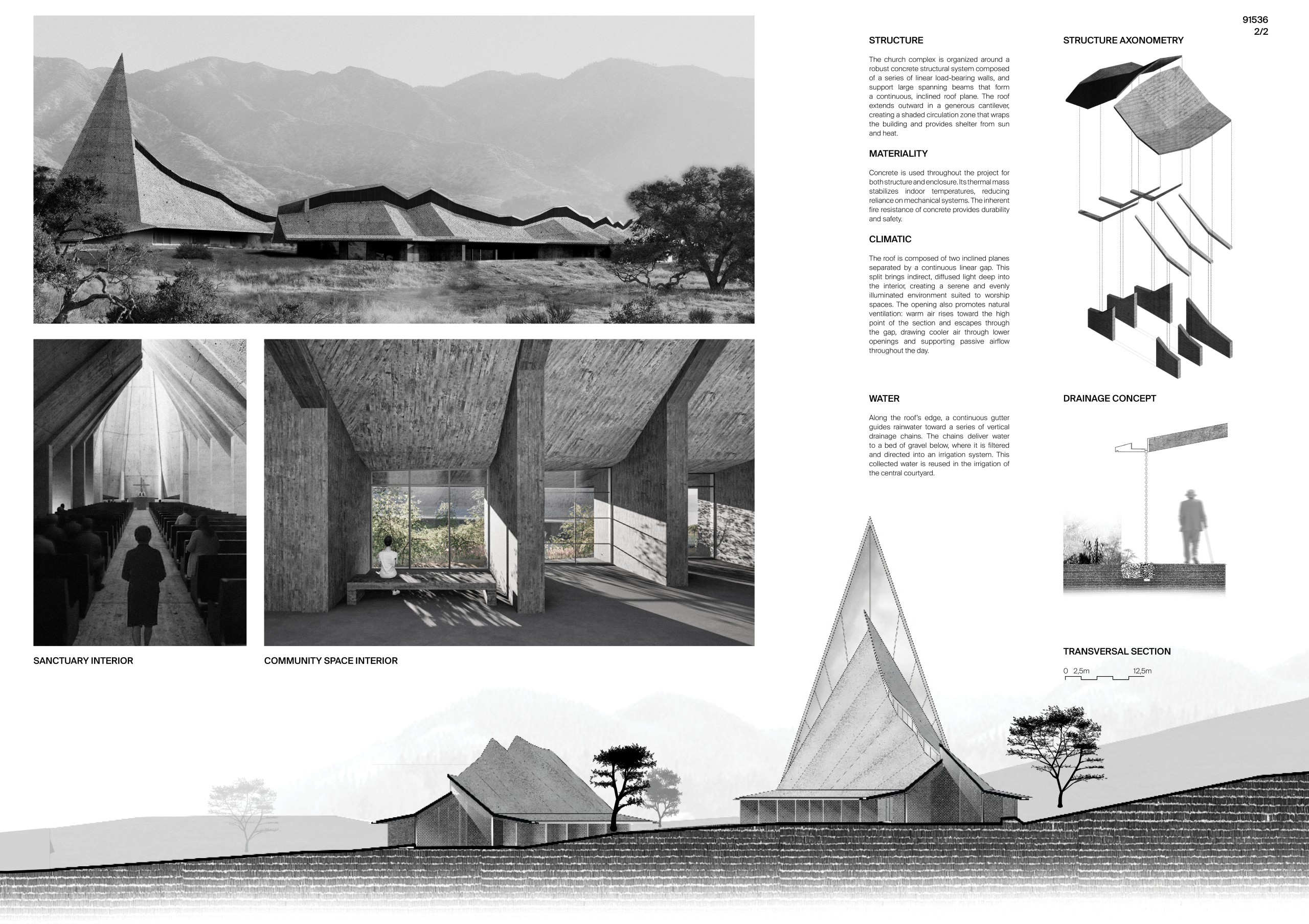
Between the land and the sky
Roshan Krell, Asli Feyza Yetiskin, Dali Salamova [Italy – Turkey – Ukraine]
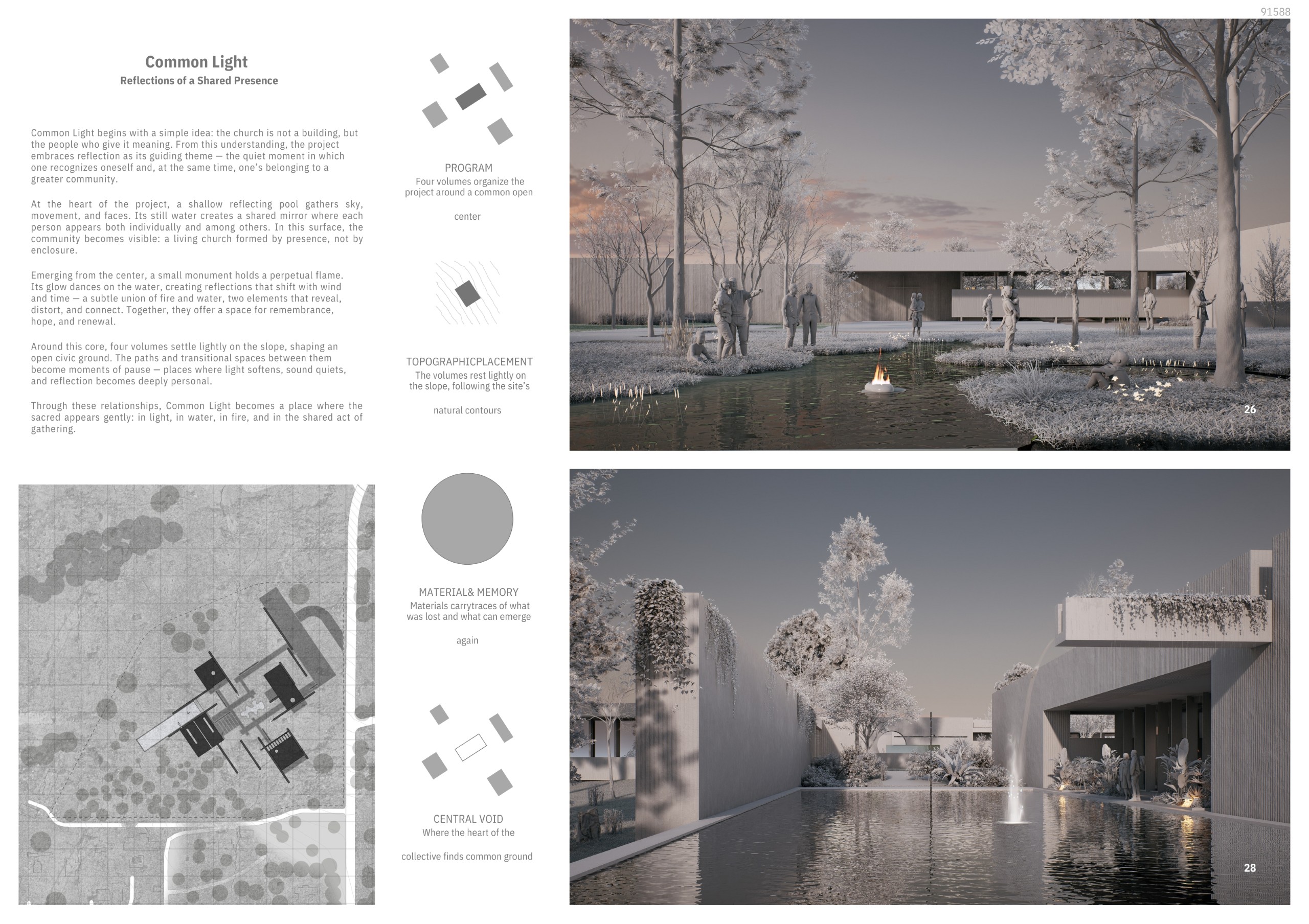
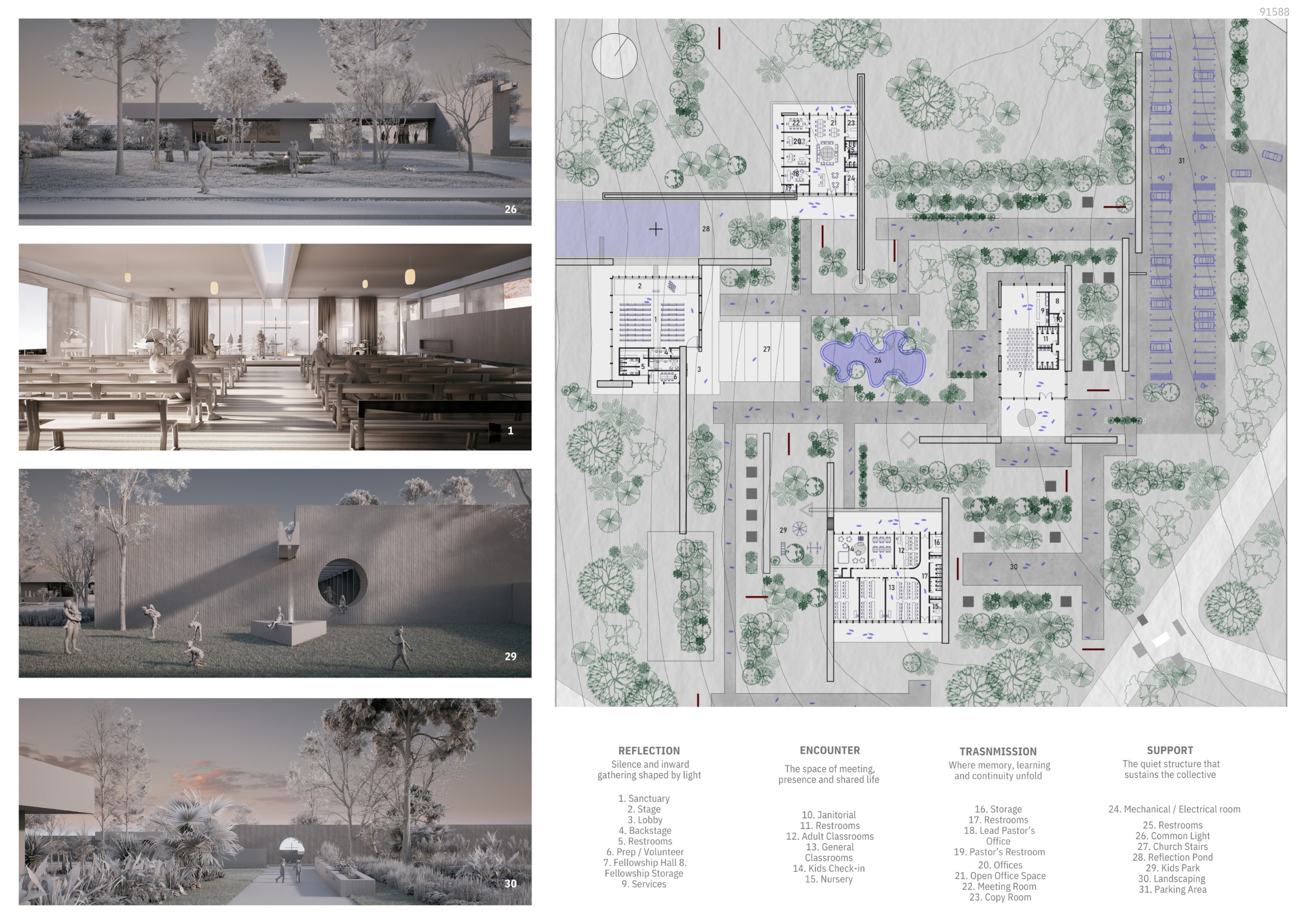
Common Light
Laura Camelo, Franklin Arias, Camilo Reyes, Juan Pablo Forero [Colombia]
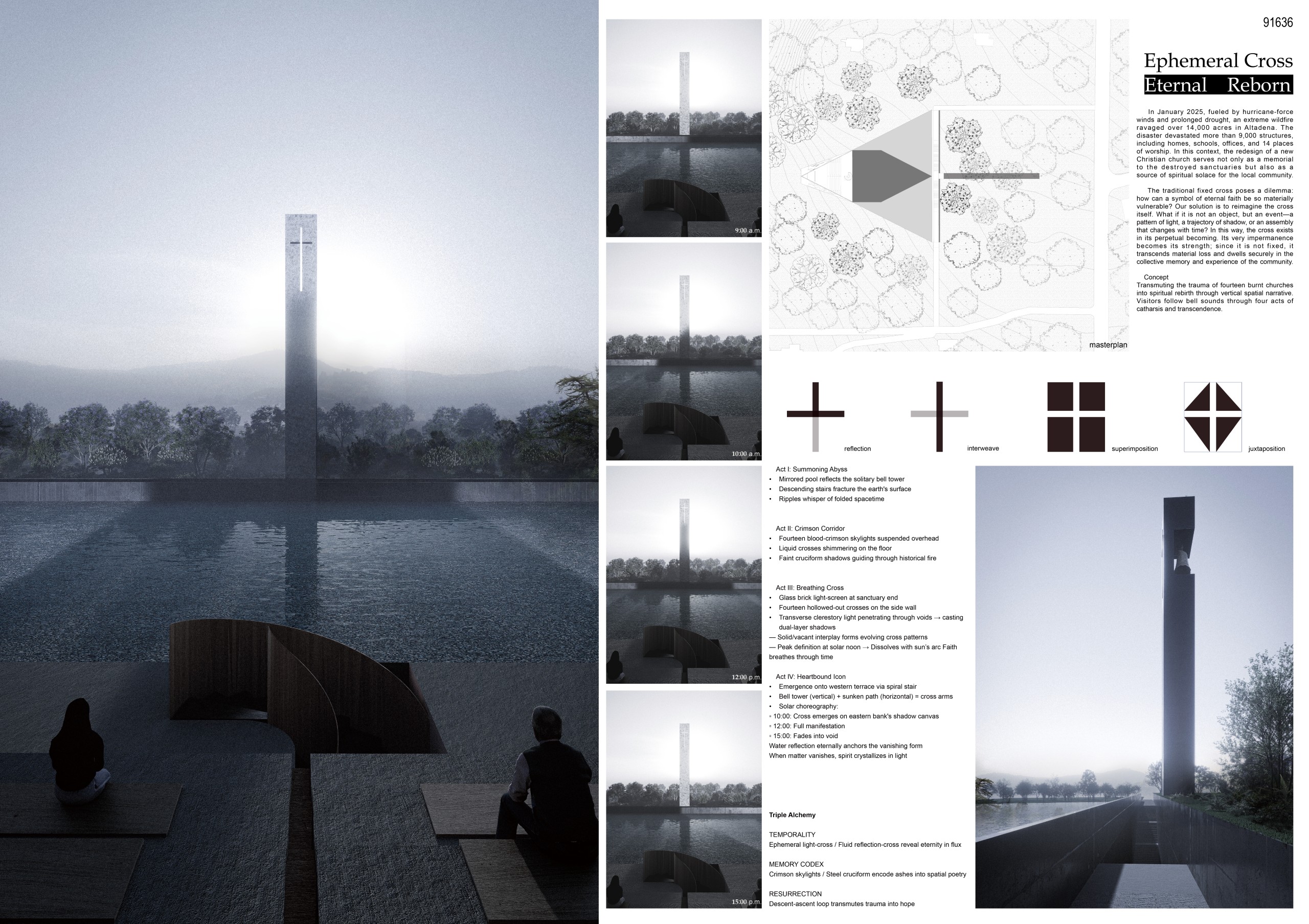
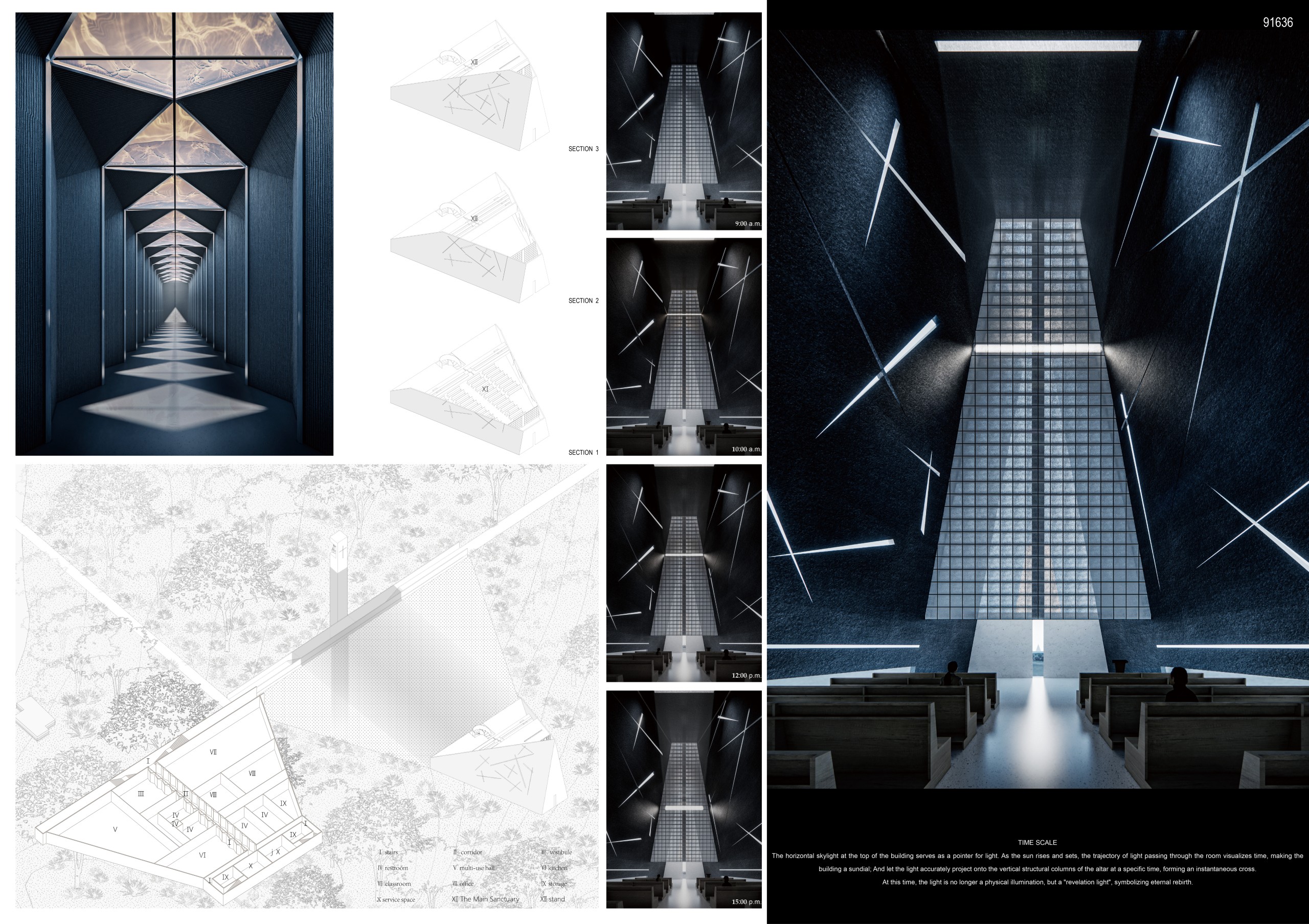
Ephemeral Cross, Eternal Reborn
Tong Le, Rumeng Zhao [China]
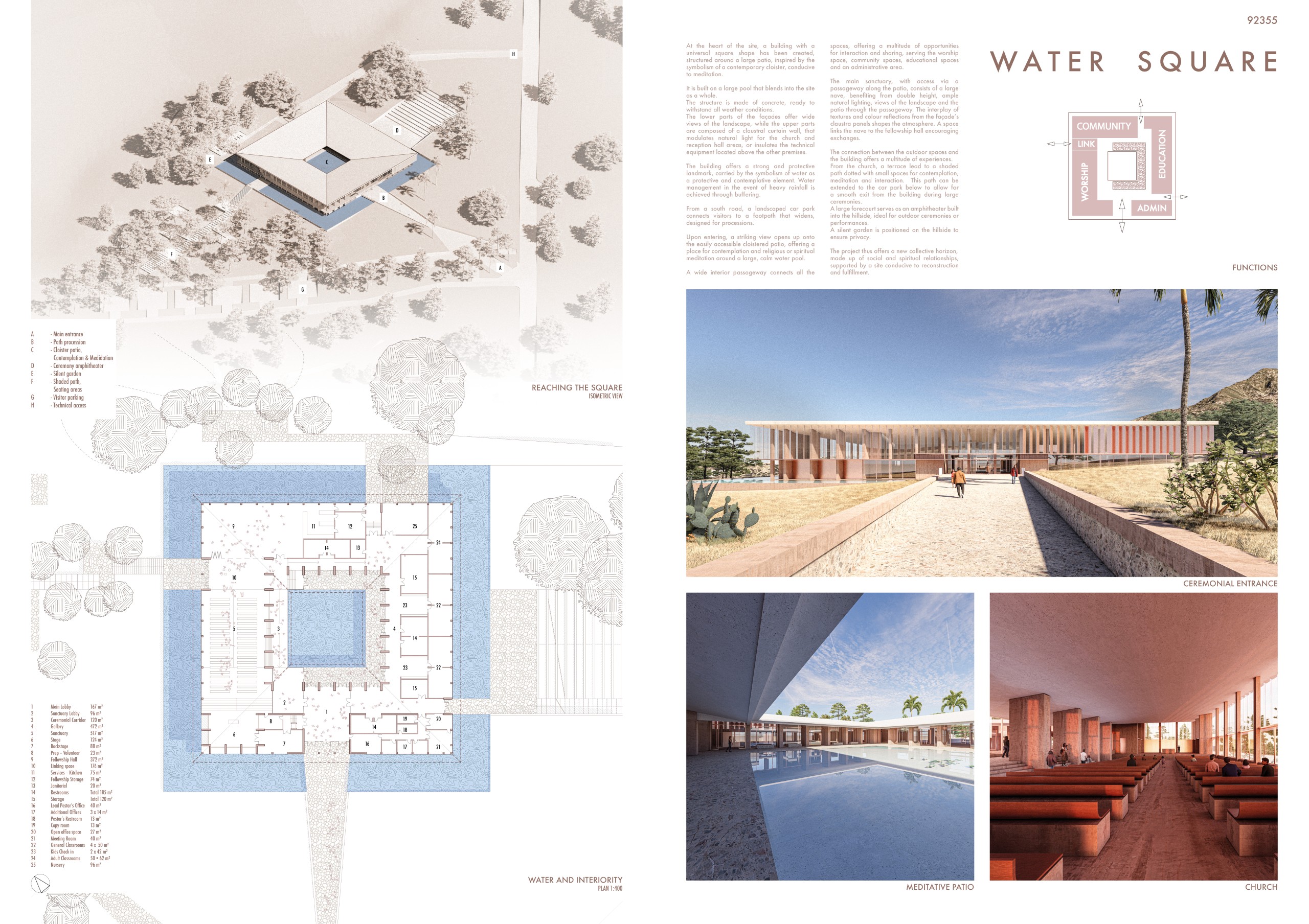
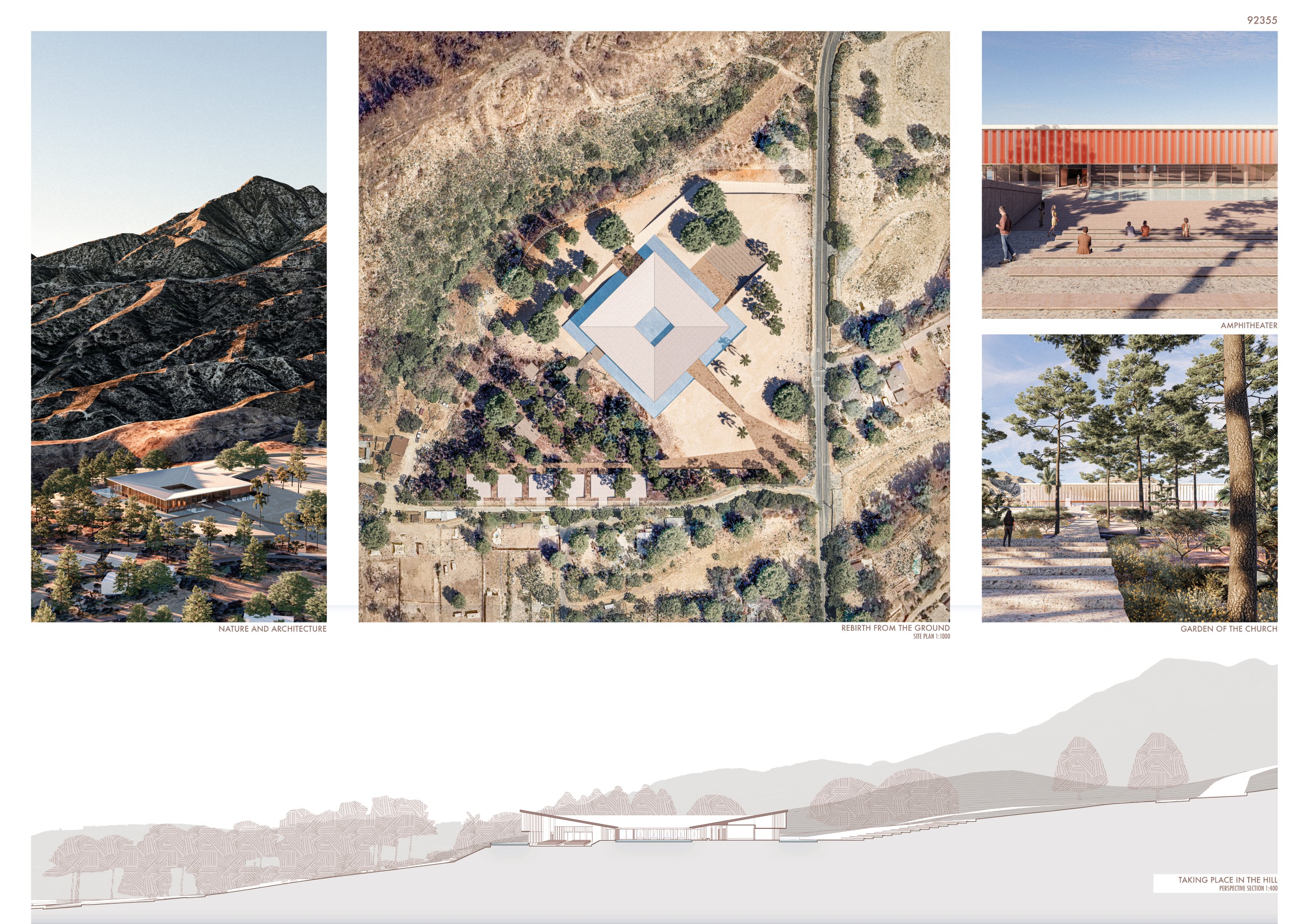
WATER SQUARE
Yves Wozniak [France]
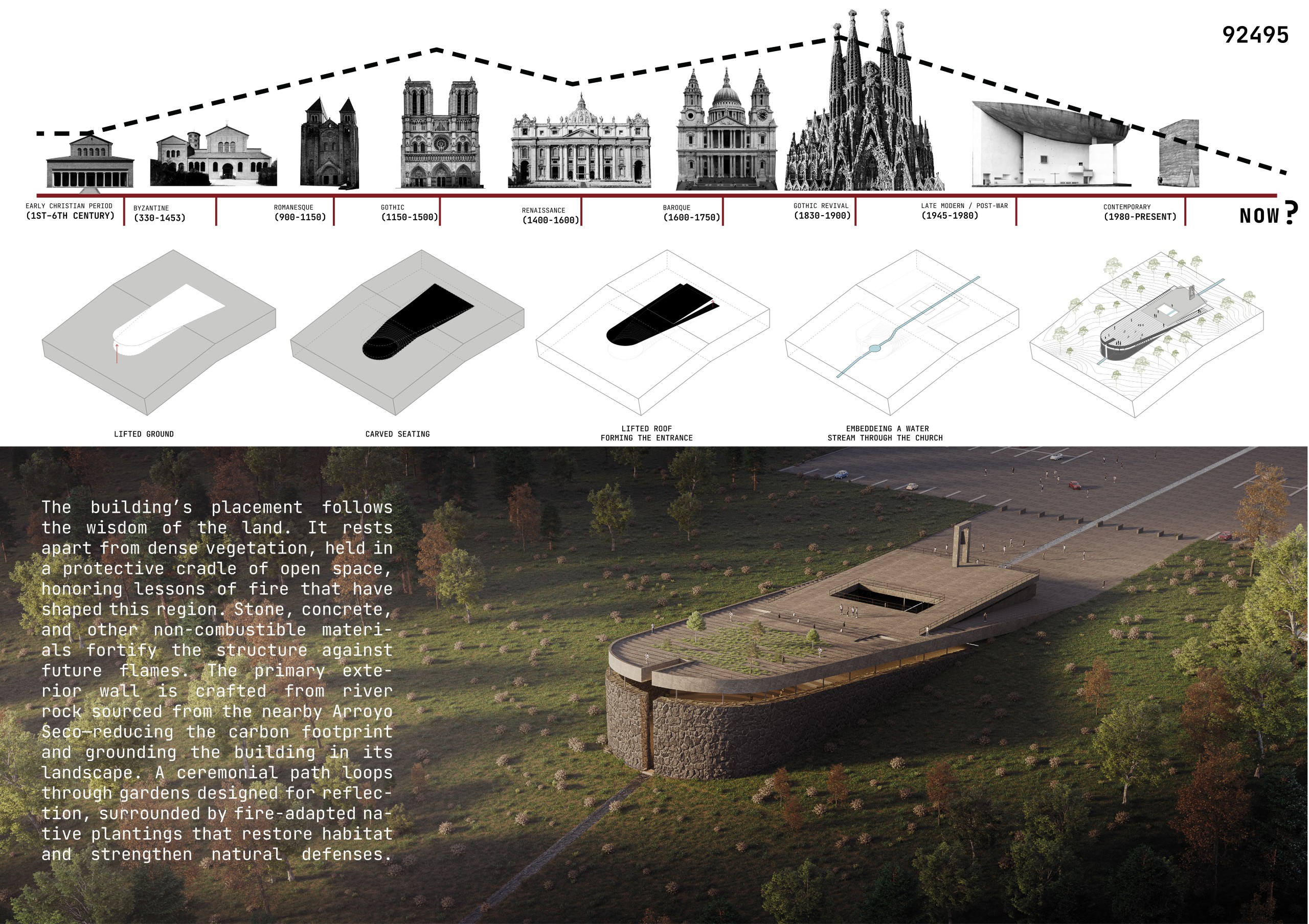
Hope Center
Mazyar Kahali, Ehsan Karimi, Poone Nasri, Kiana Kassai, Nahal Memari, Helia Bahmani [United States] www.moment-studio.ir
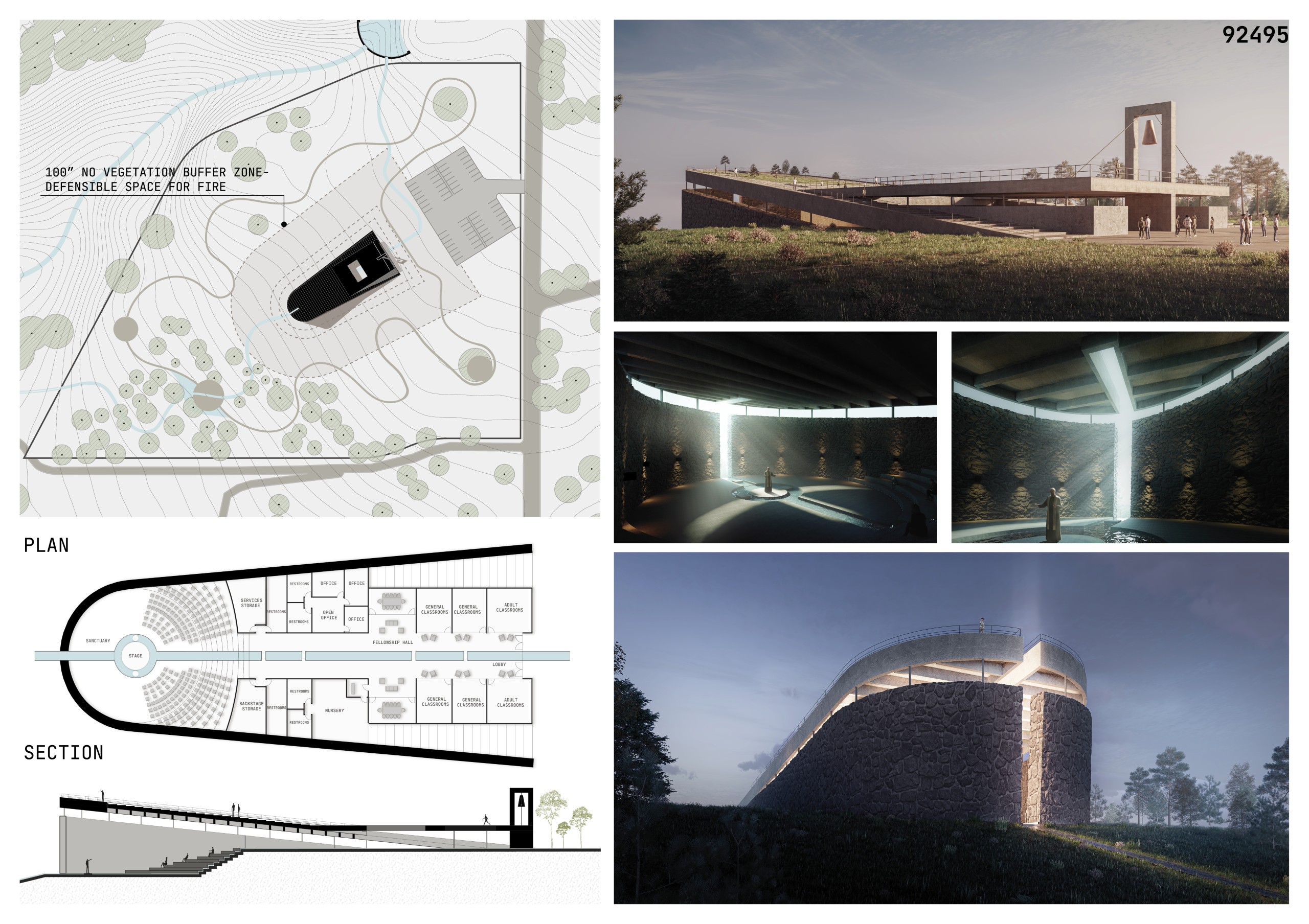
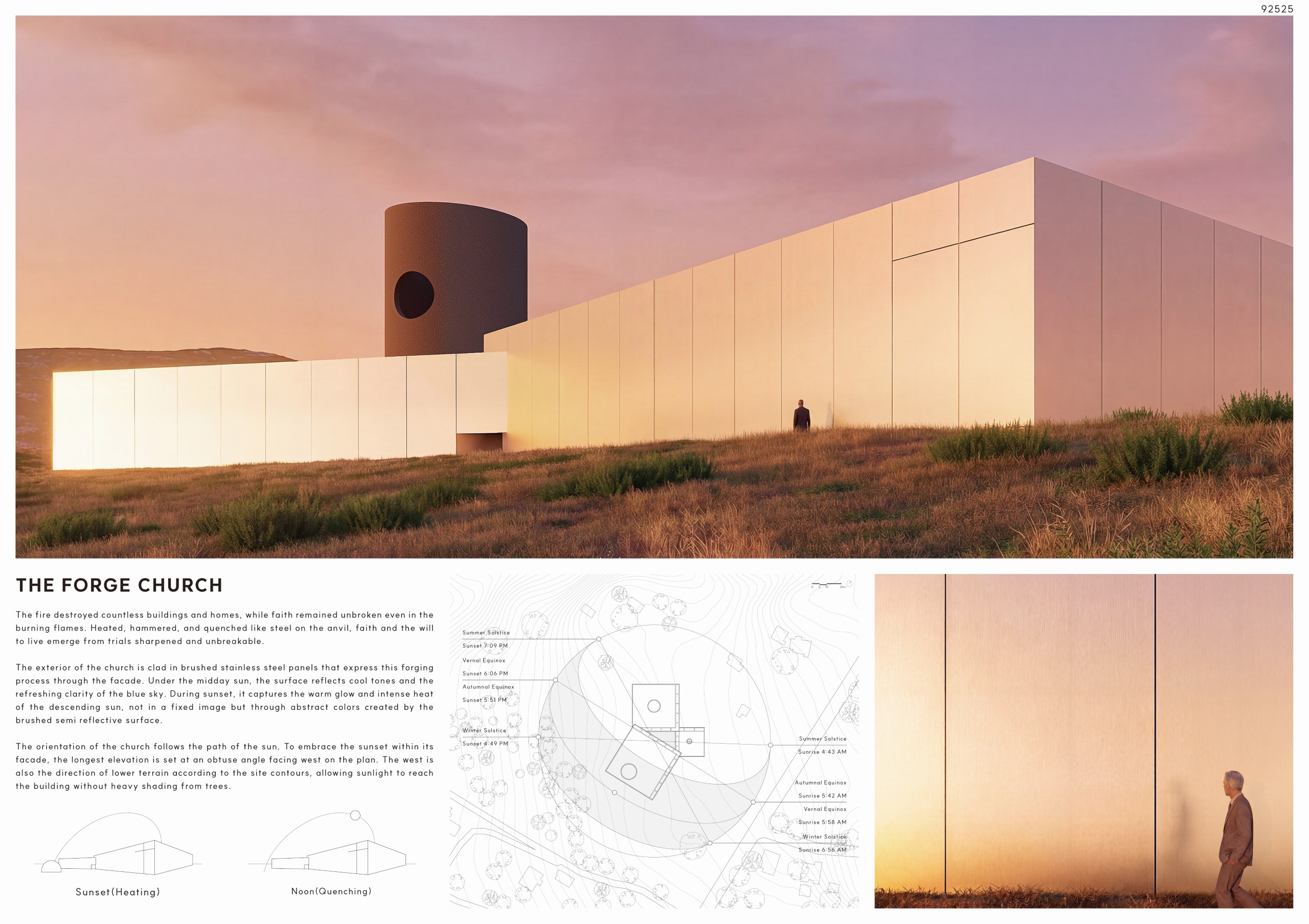
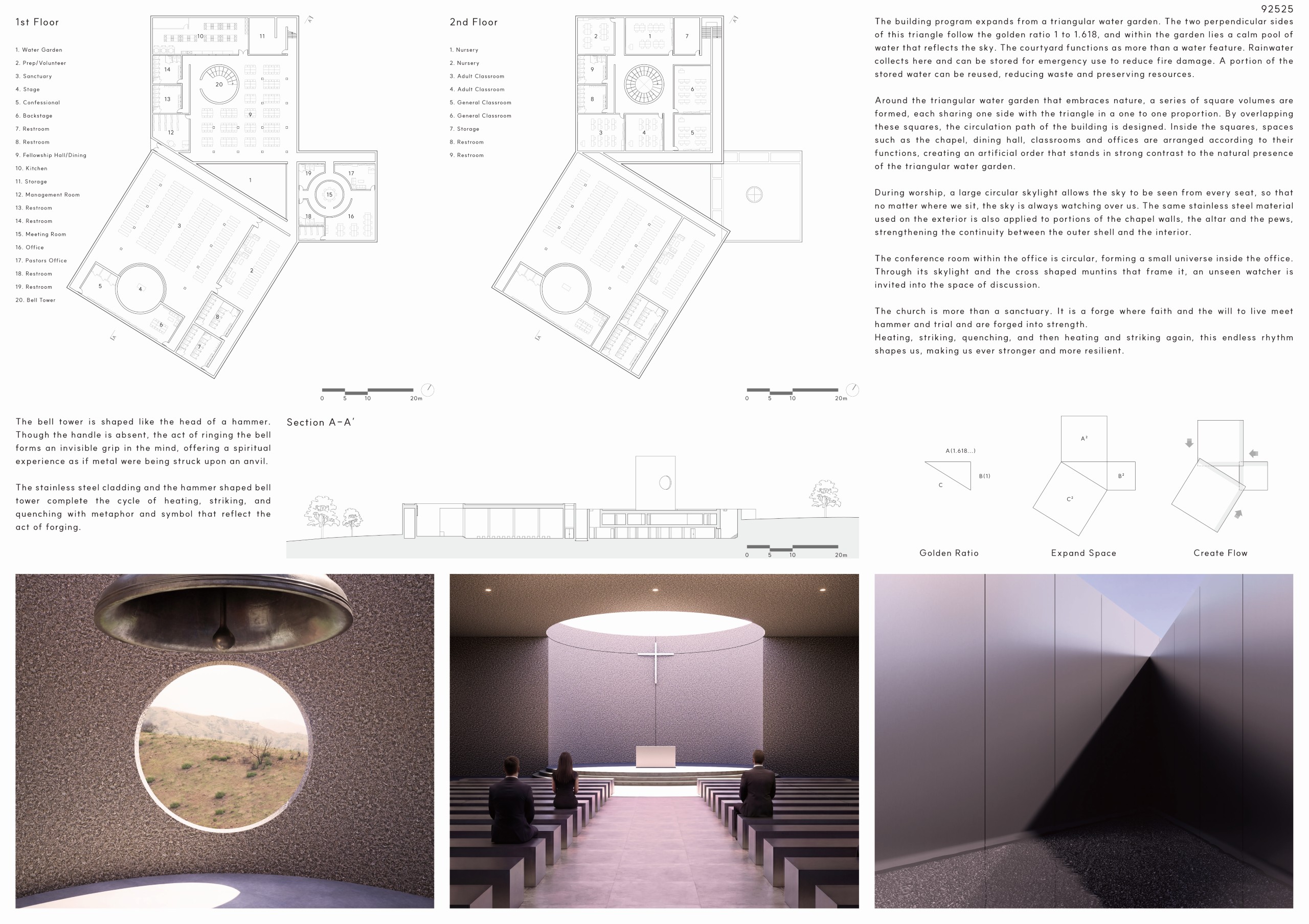
The forge church
Sungjo Park [South Korea]
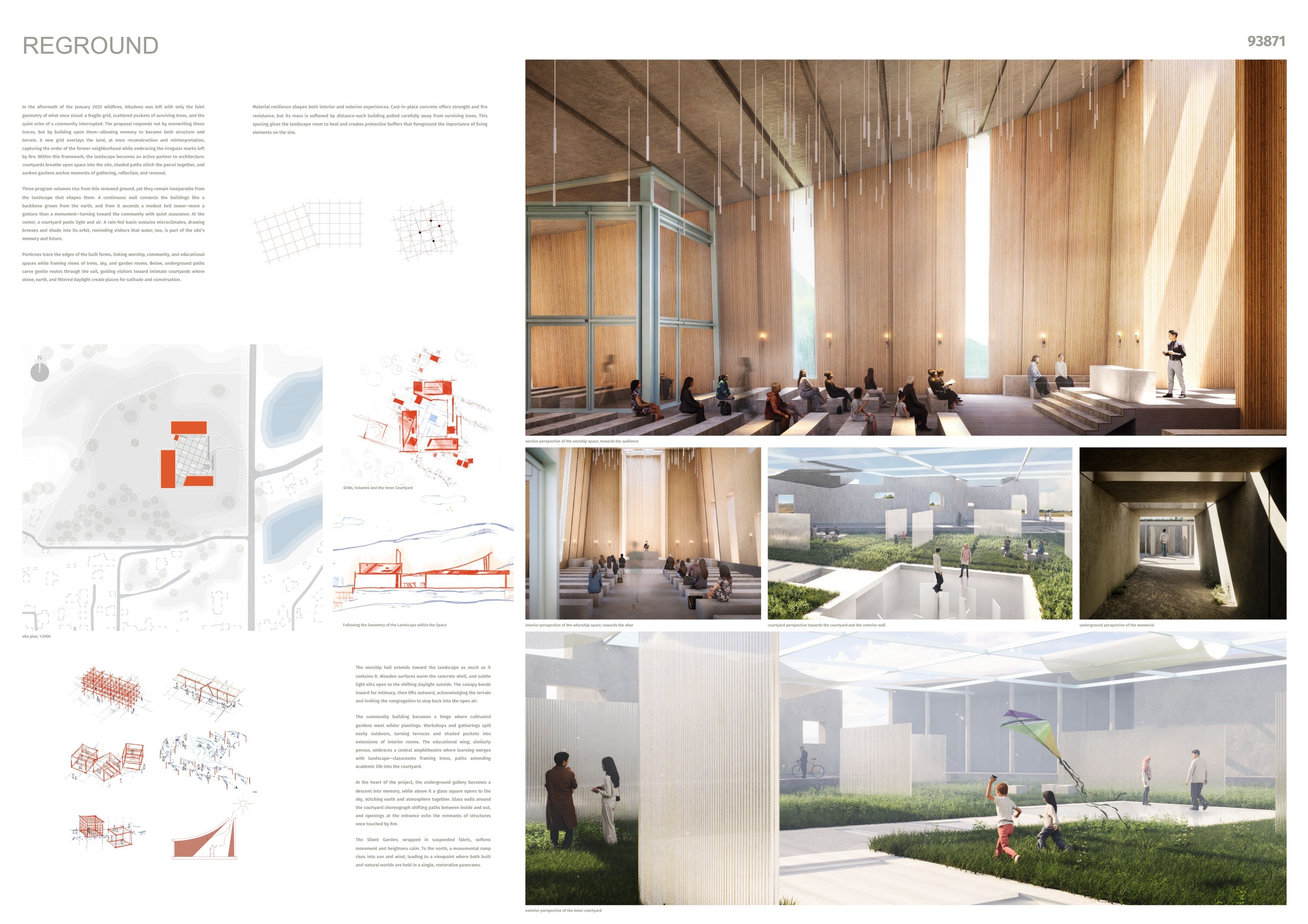
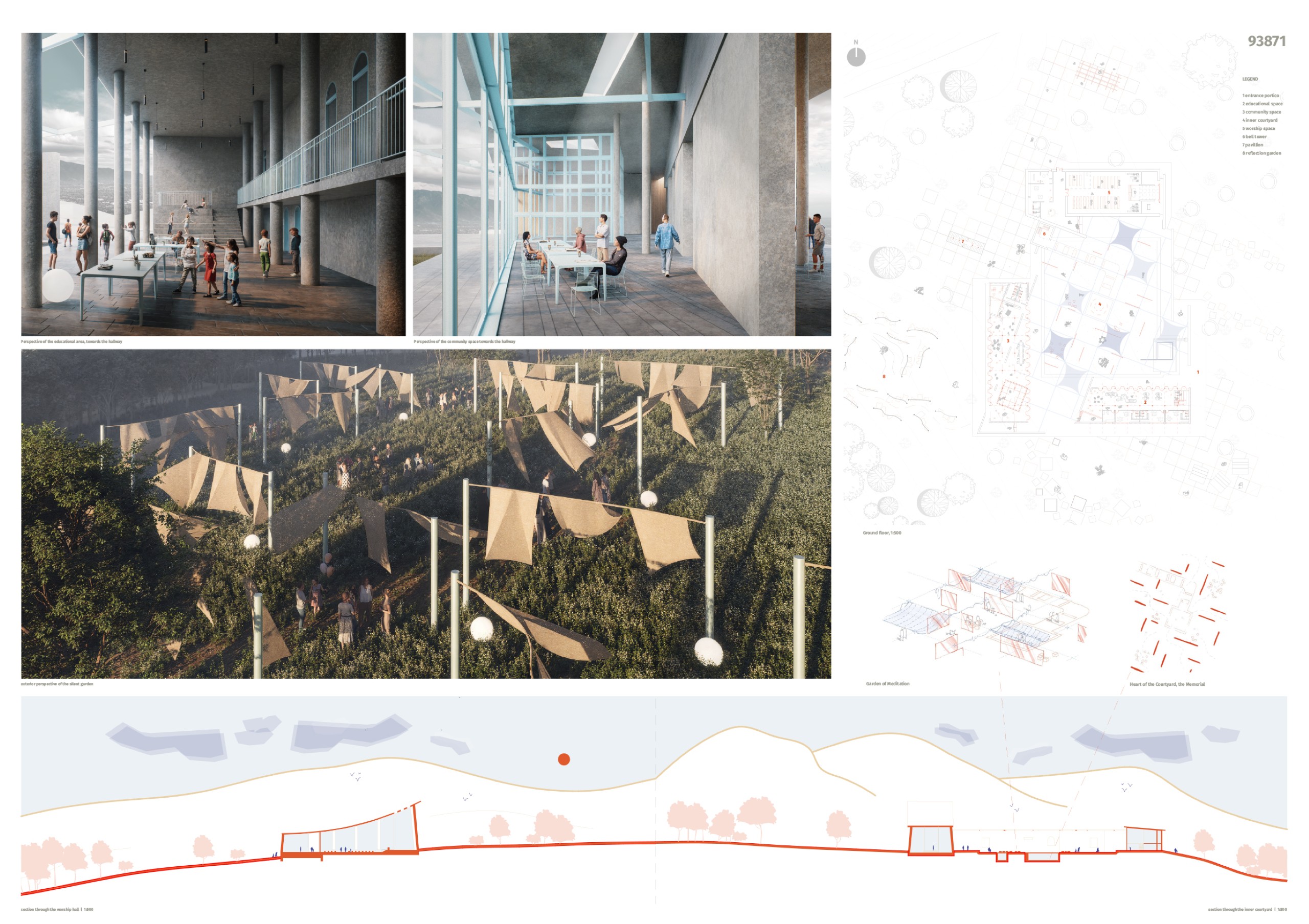
REGROUND
Sabrina-Ioana Dâscă, Bianca Stoichiță, Mara-Maria Ghițescu, Andreea-Bianca Cărăușu [Romania]
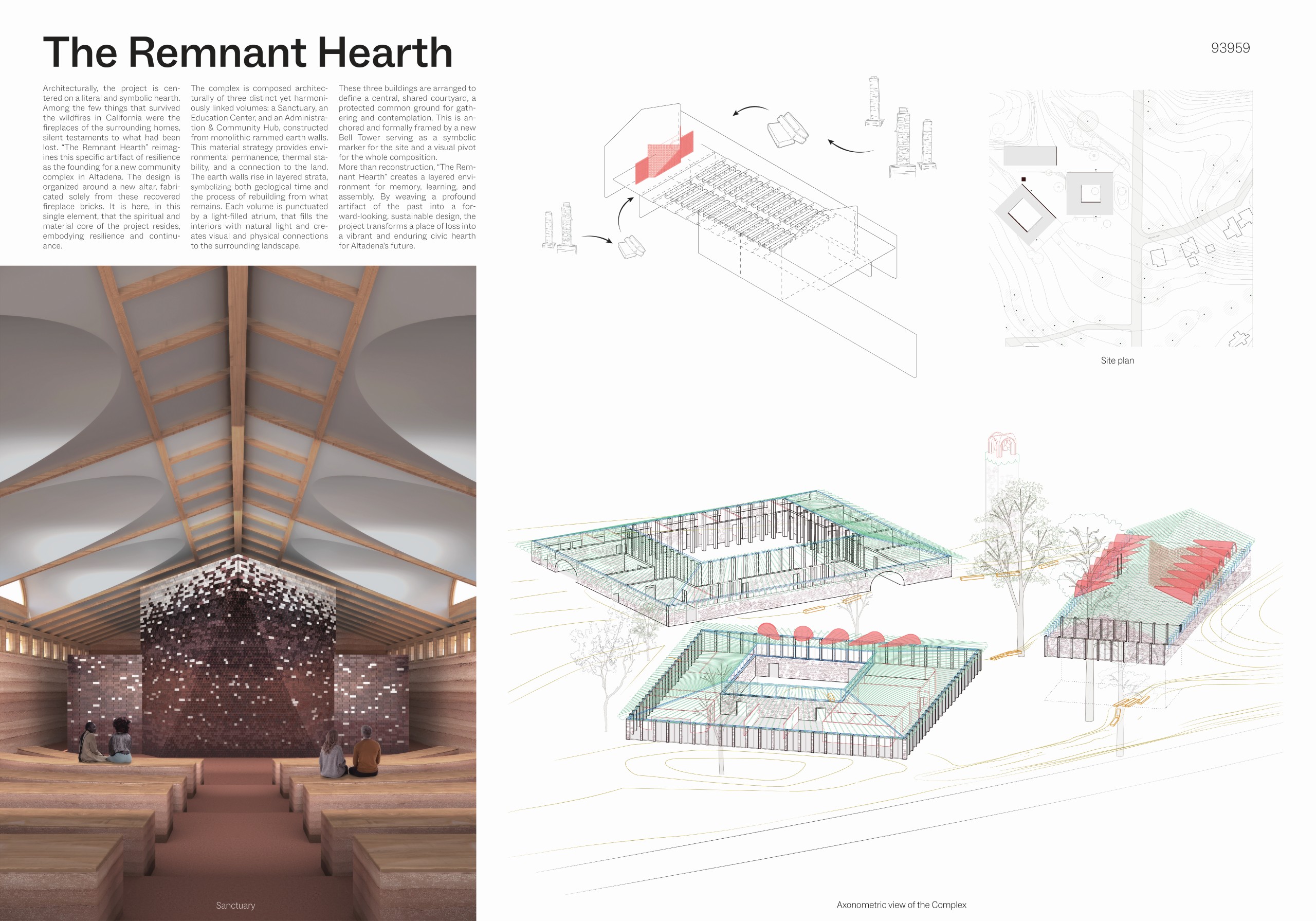
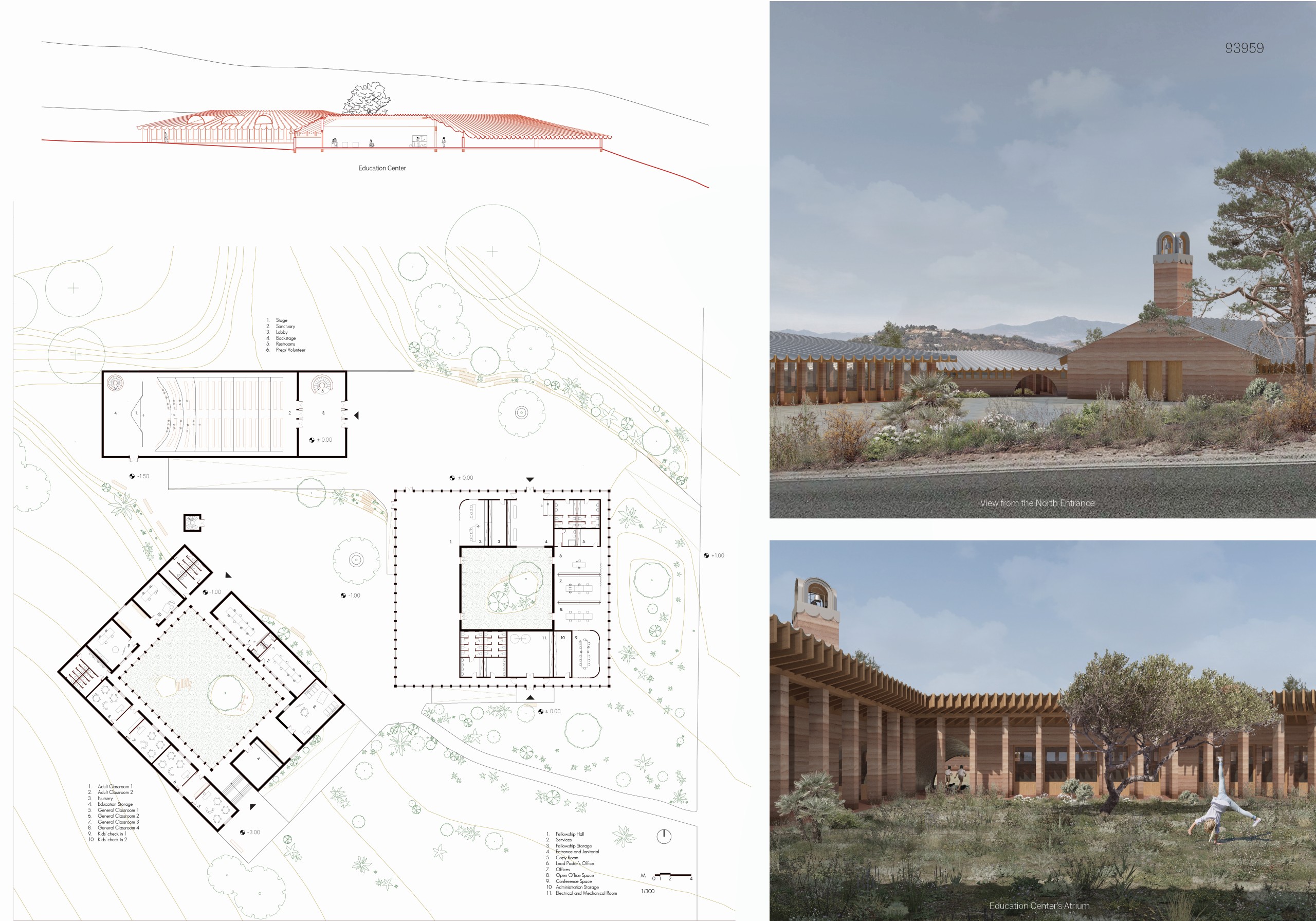
The Remnant Hearth
Mostafa Yosef, Kyriaki Deligiannidou, Aikaterini Sideri [Syria – Greece]
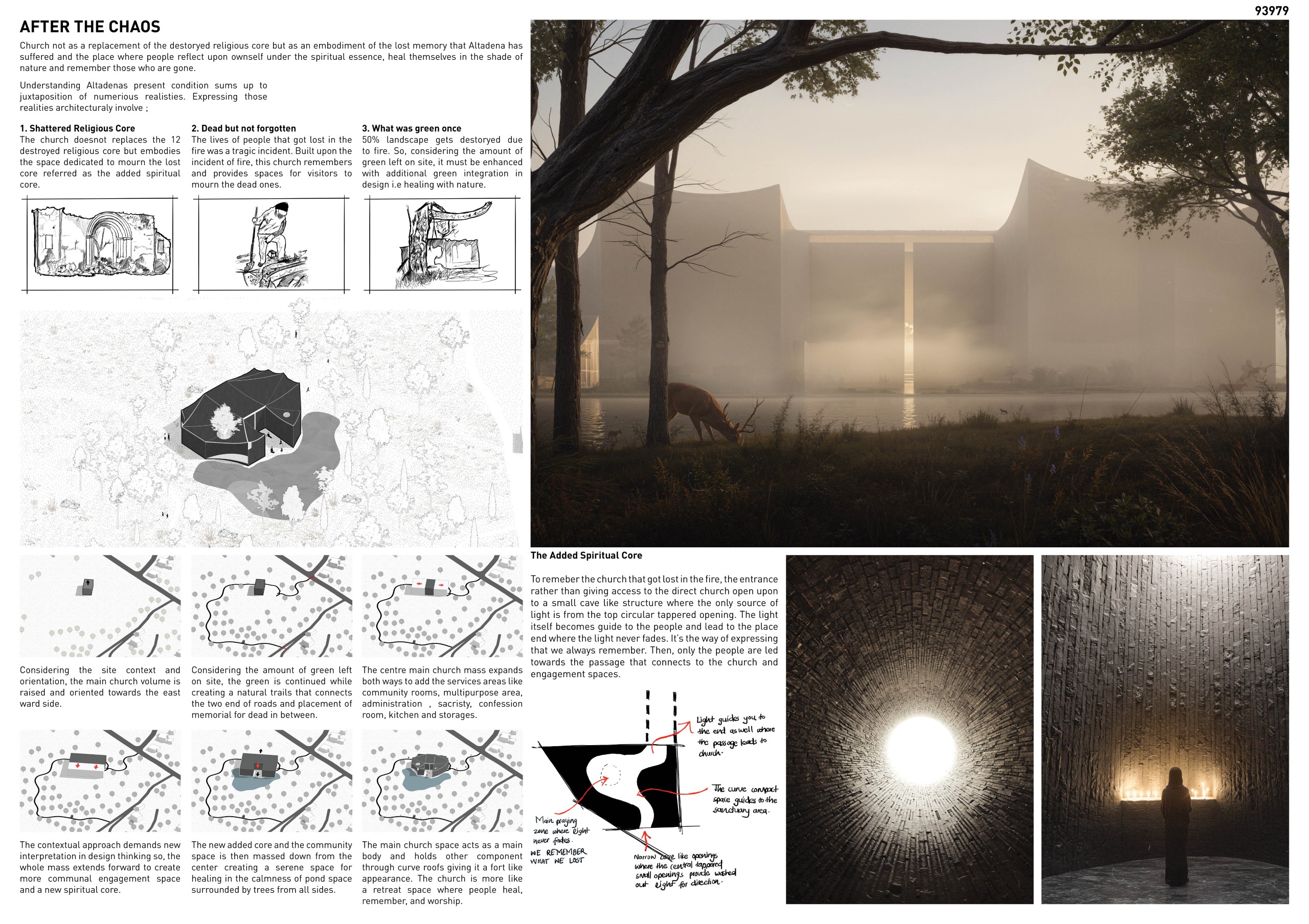
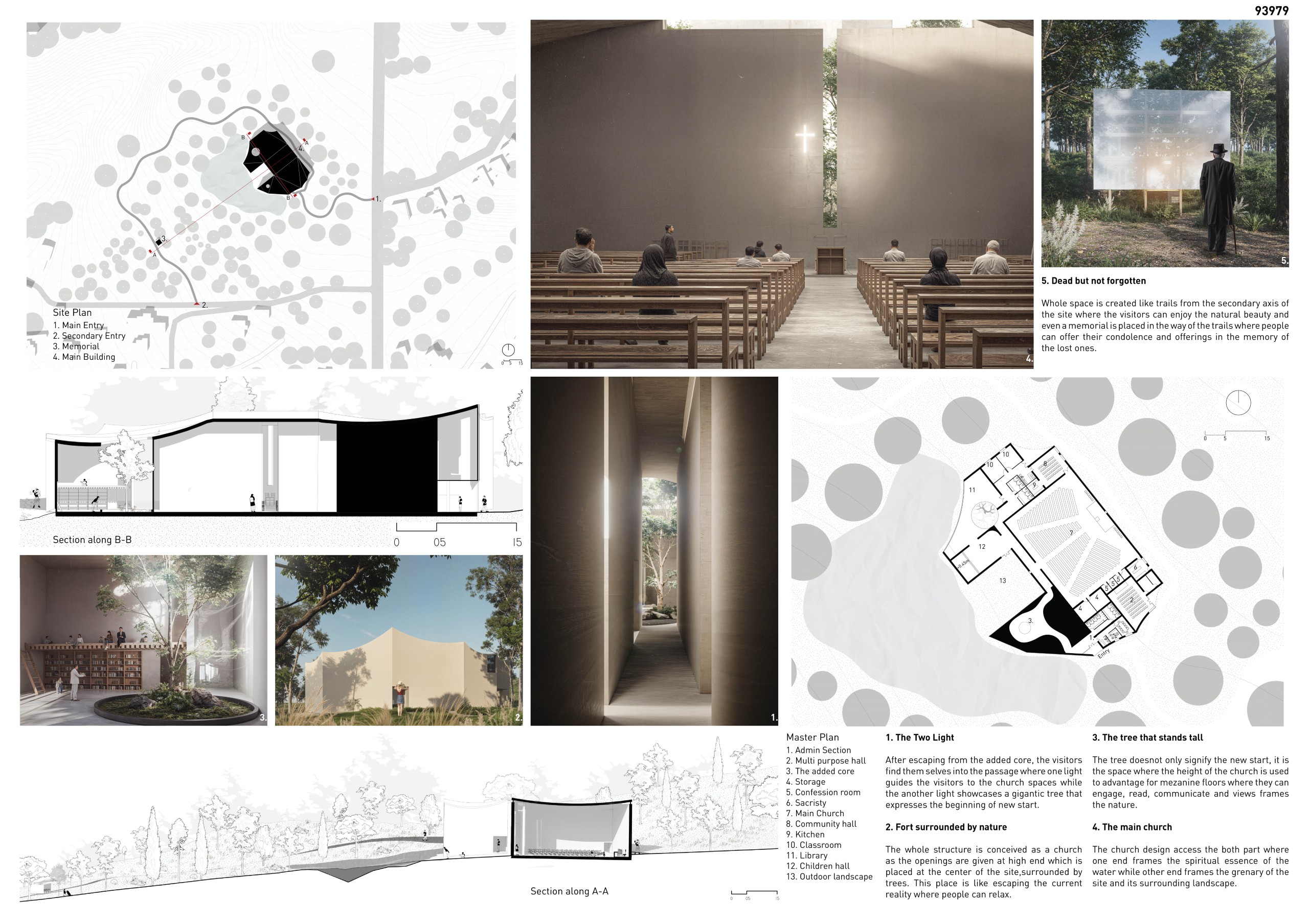
After the Chaos
Brijesh Ghale [Nepal]
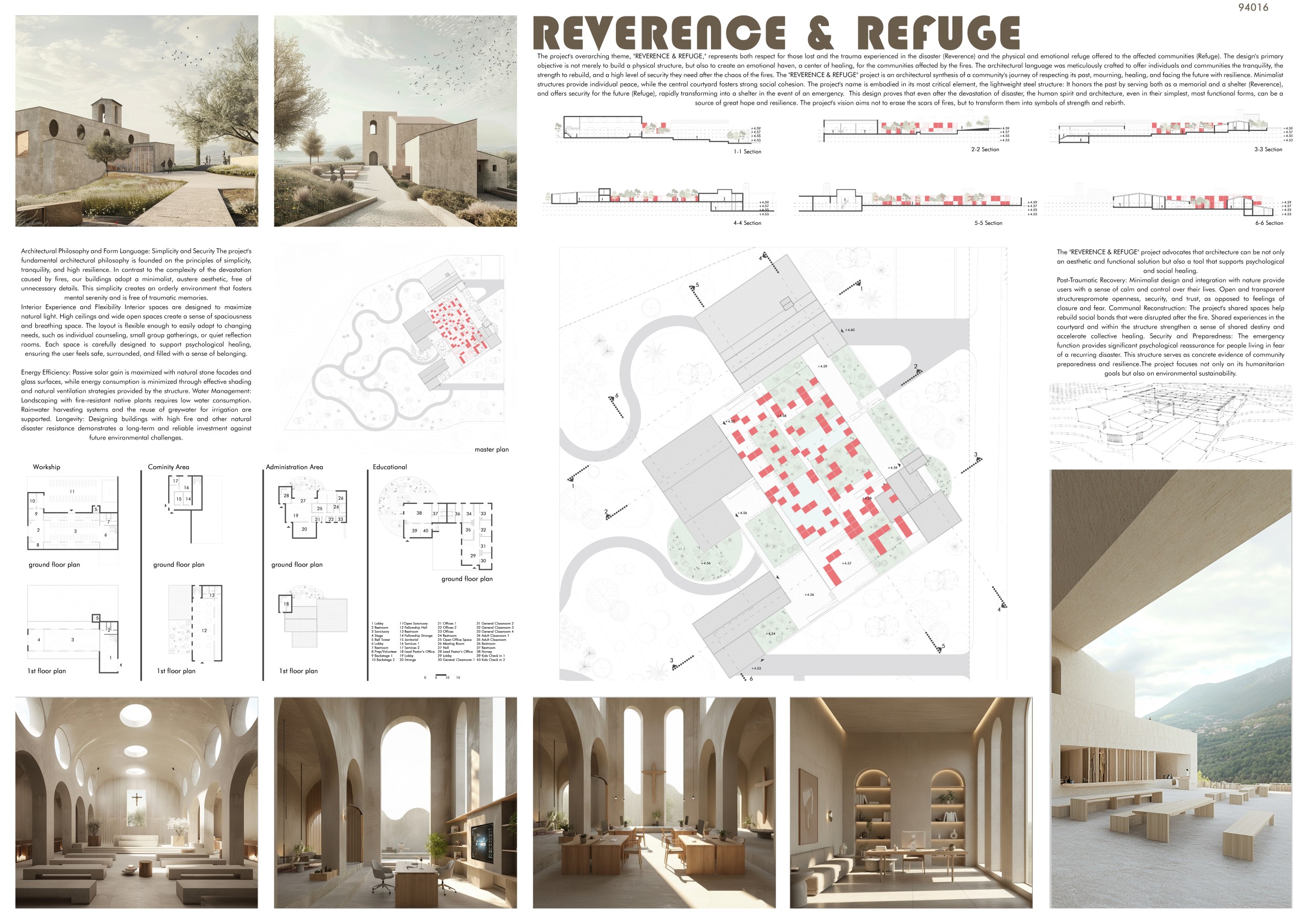
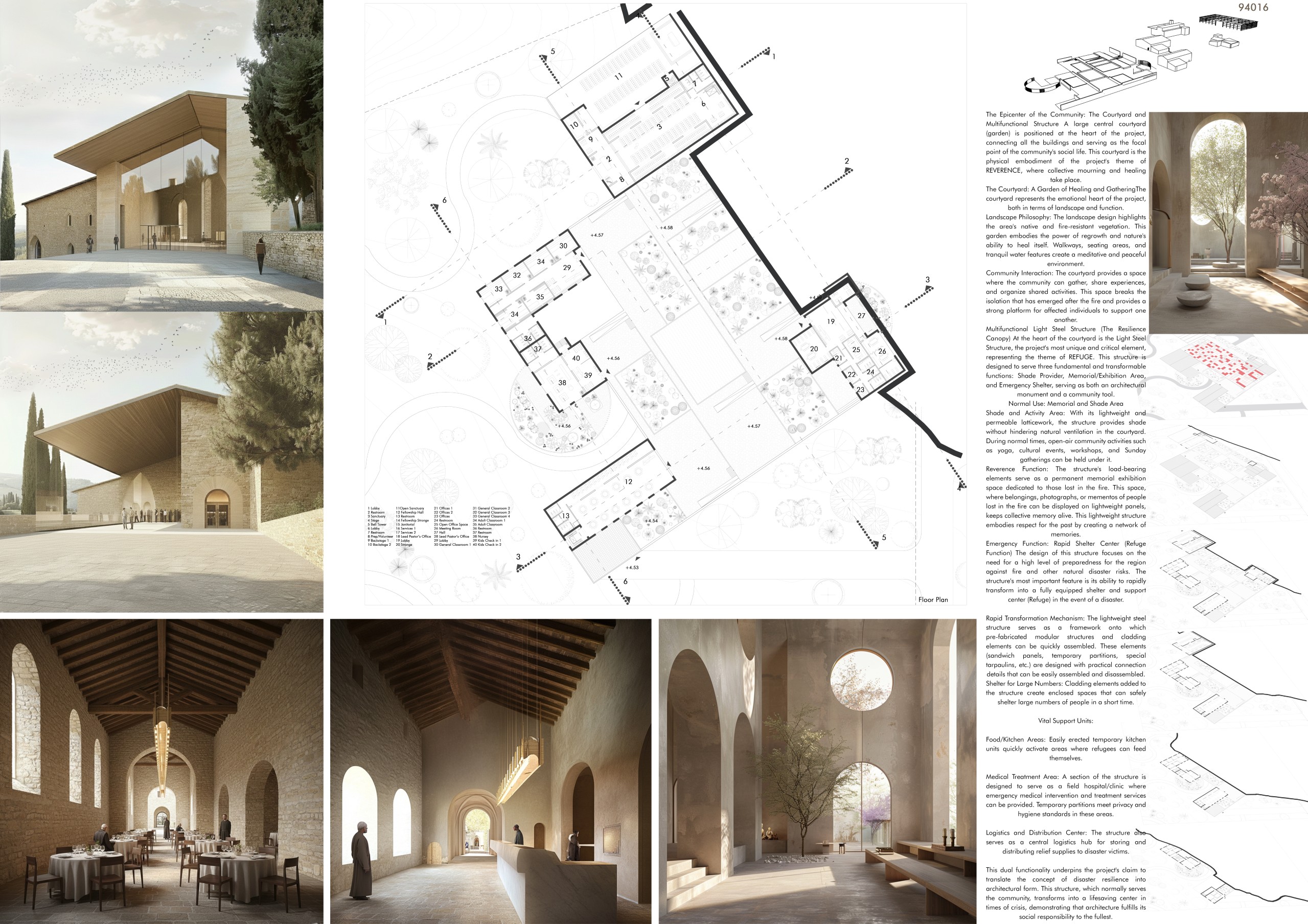
REVERENCE & REFUGE
inci Shoainia, Emil Shoainia [Turkey]
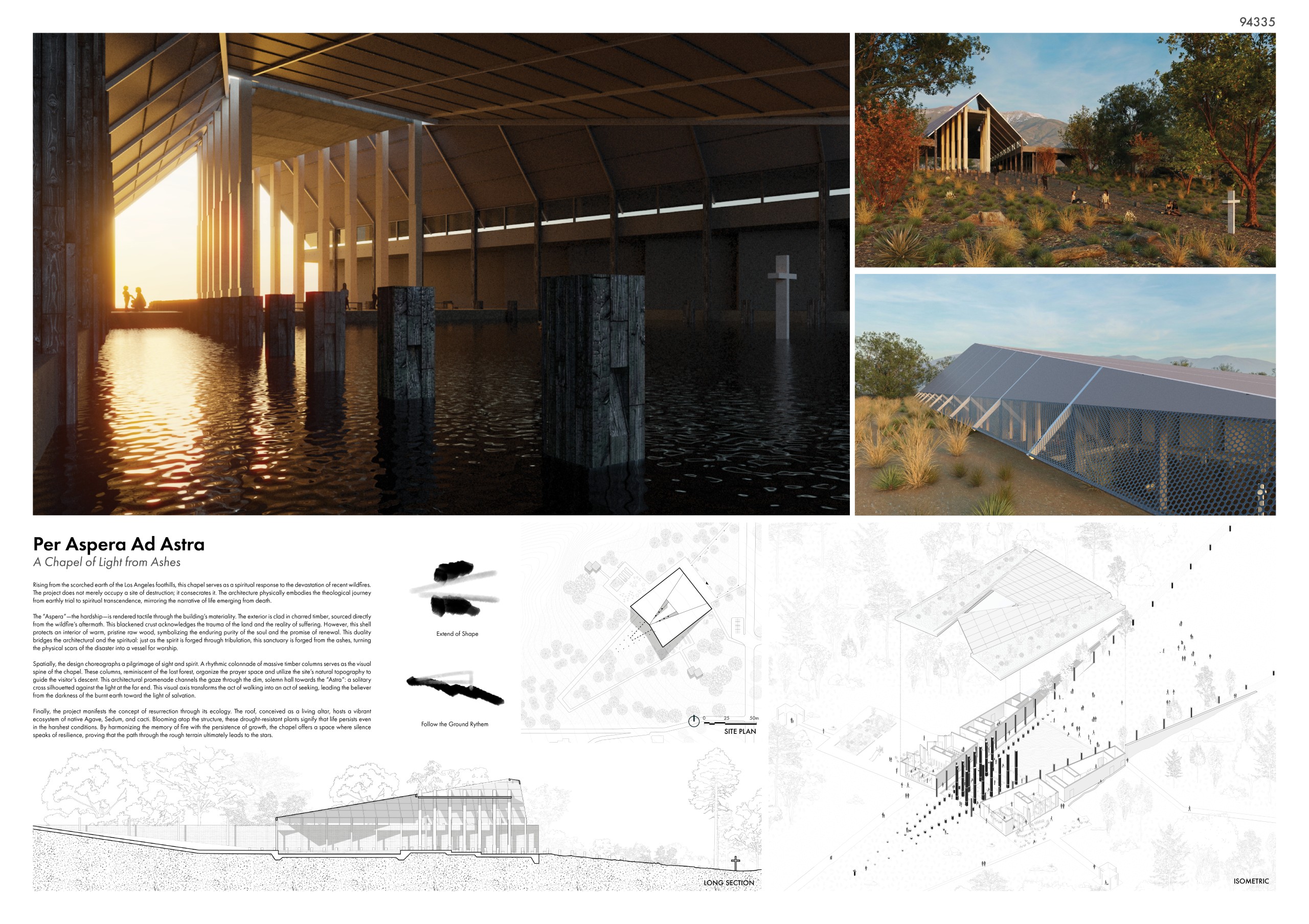
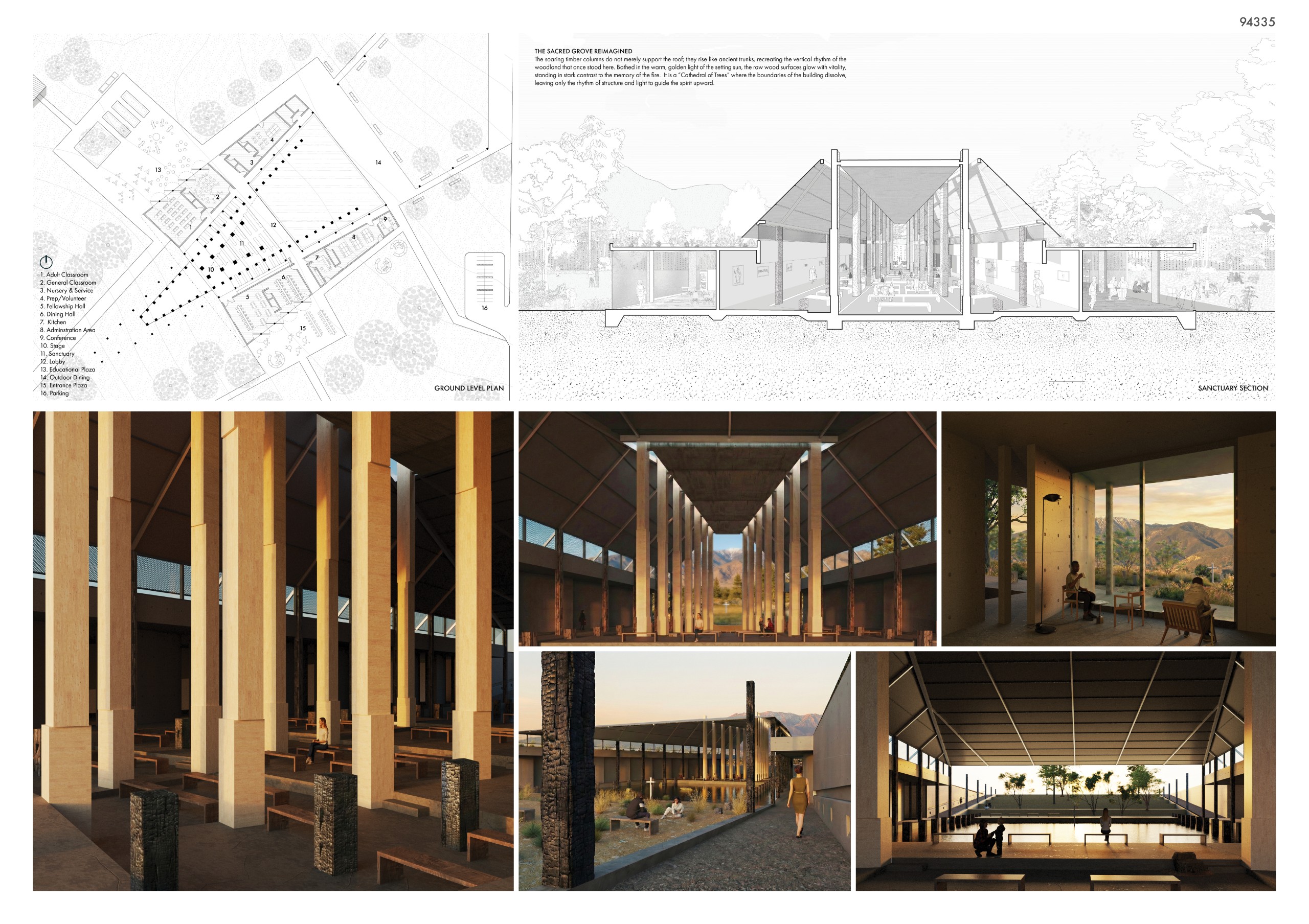
Per Aspera Ad Astra
Jiageng Chen, Jiahui Qiu, Yishu Yu [United States]
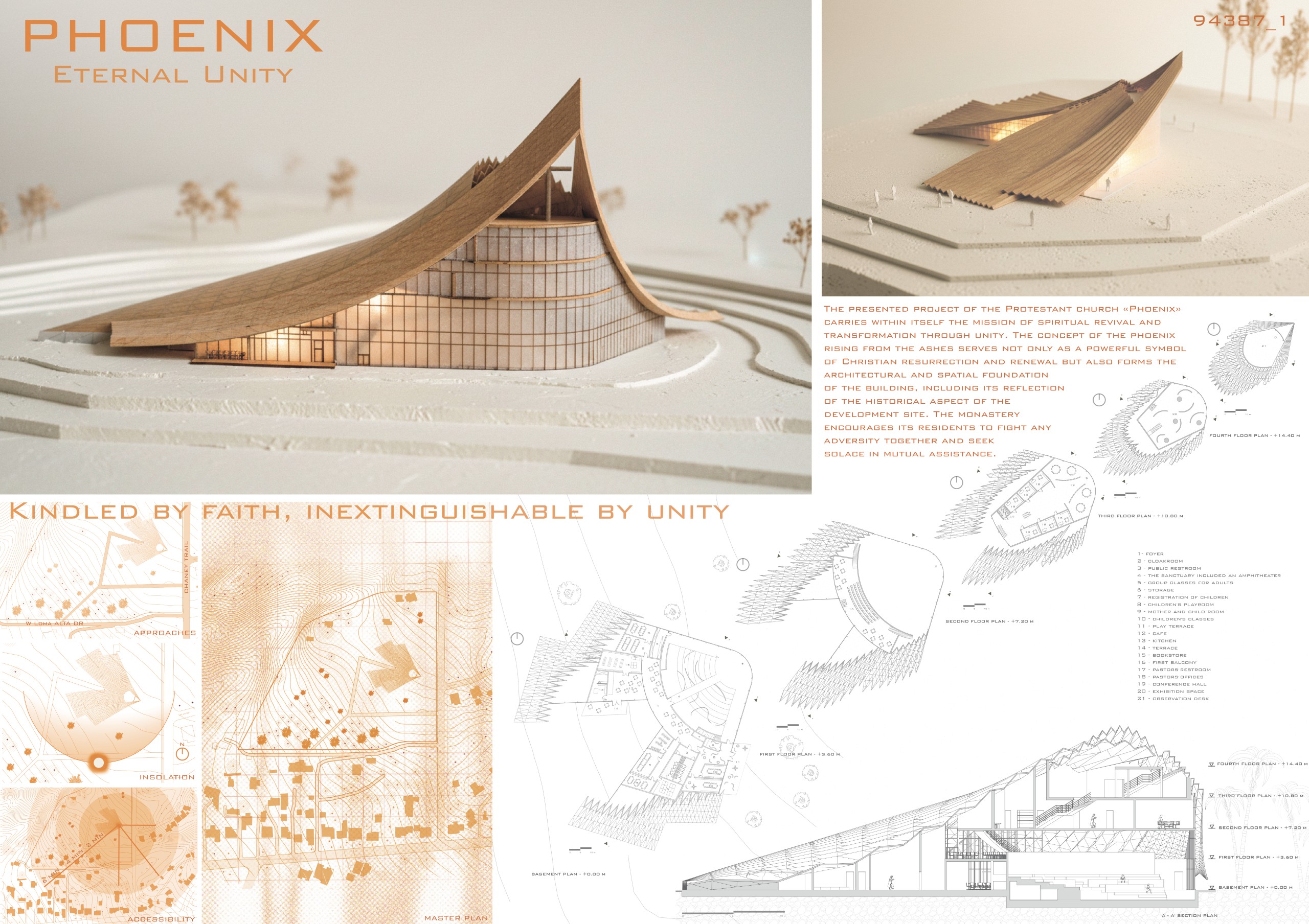
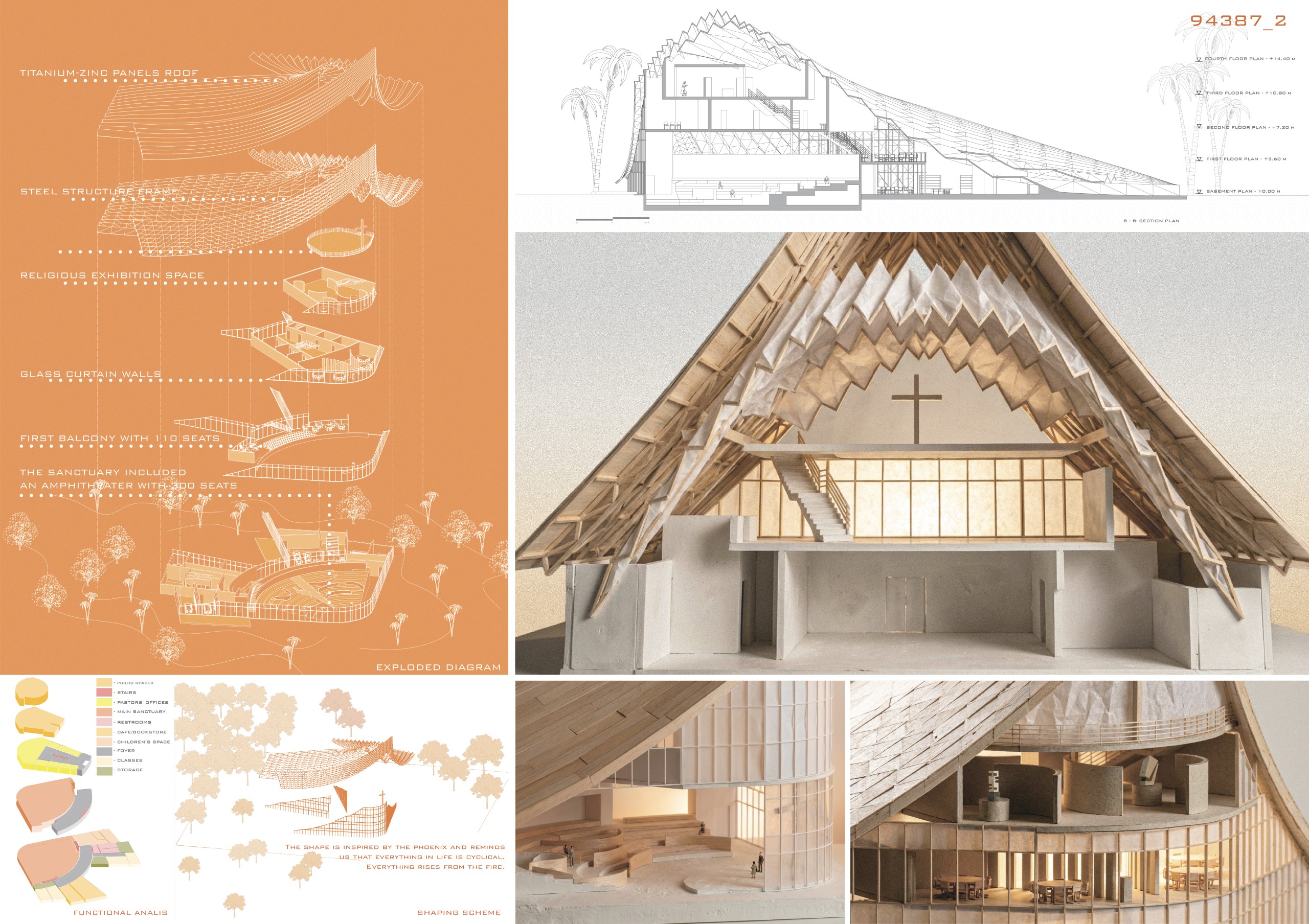
PHOENIX. Eternal Unity
Sofia Zhdanova, Ivan Iliukhin [Russia]
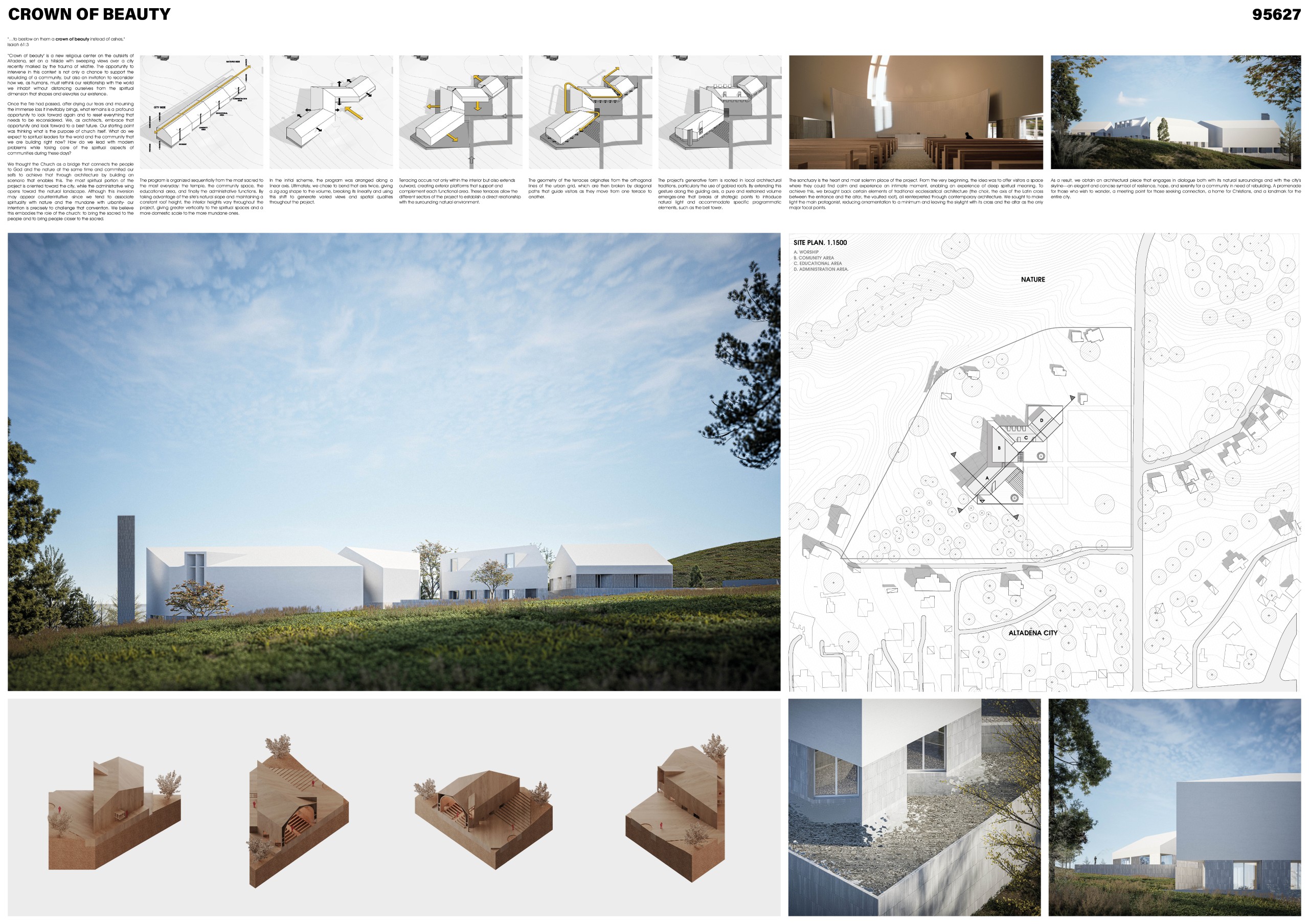
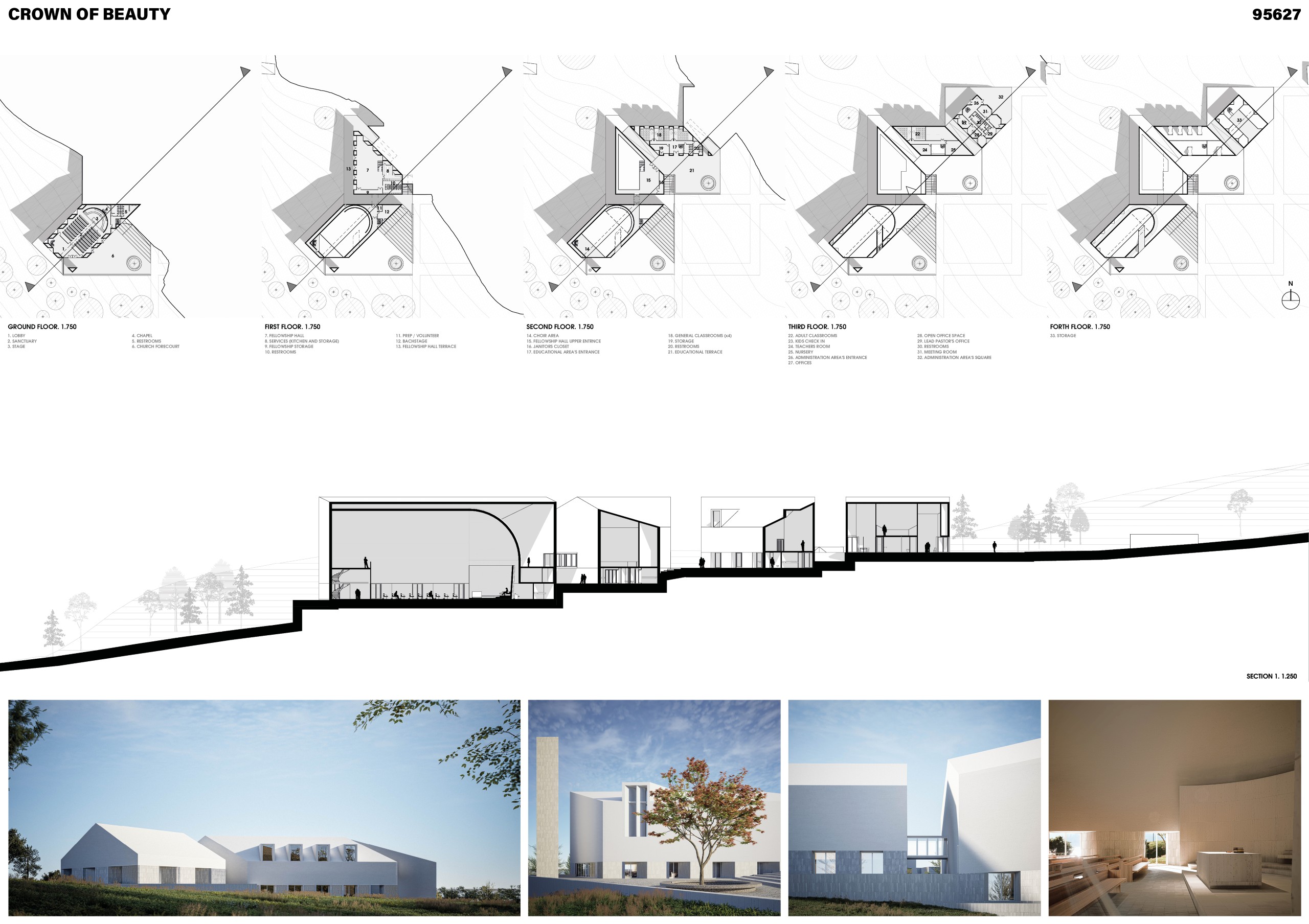
Crown of beauty
Marcos Herrera, Marcos Gonzalez Mazza [Argentina]
Featured Projects
(ordered by request date)
While not all projects make it to the final stage, we believe many still deserve to be featured! That’s why we decided to create this special section to promote the most innovative designs and emerging talents from our global community.
Submit the request to publish your project on our website and Instagram accounts
Team Name(s) [Country]

PROJECT DESCRIPTION
META CITY
Anna Mos [Italy] – @__anna_mos_
PROJECT DESCRIPTION
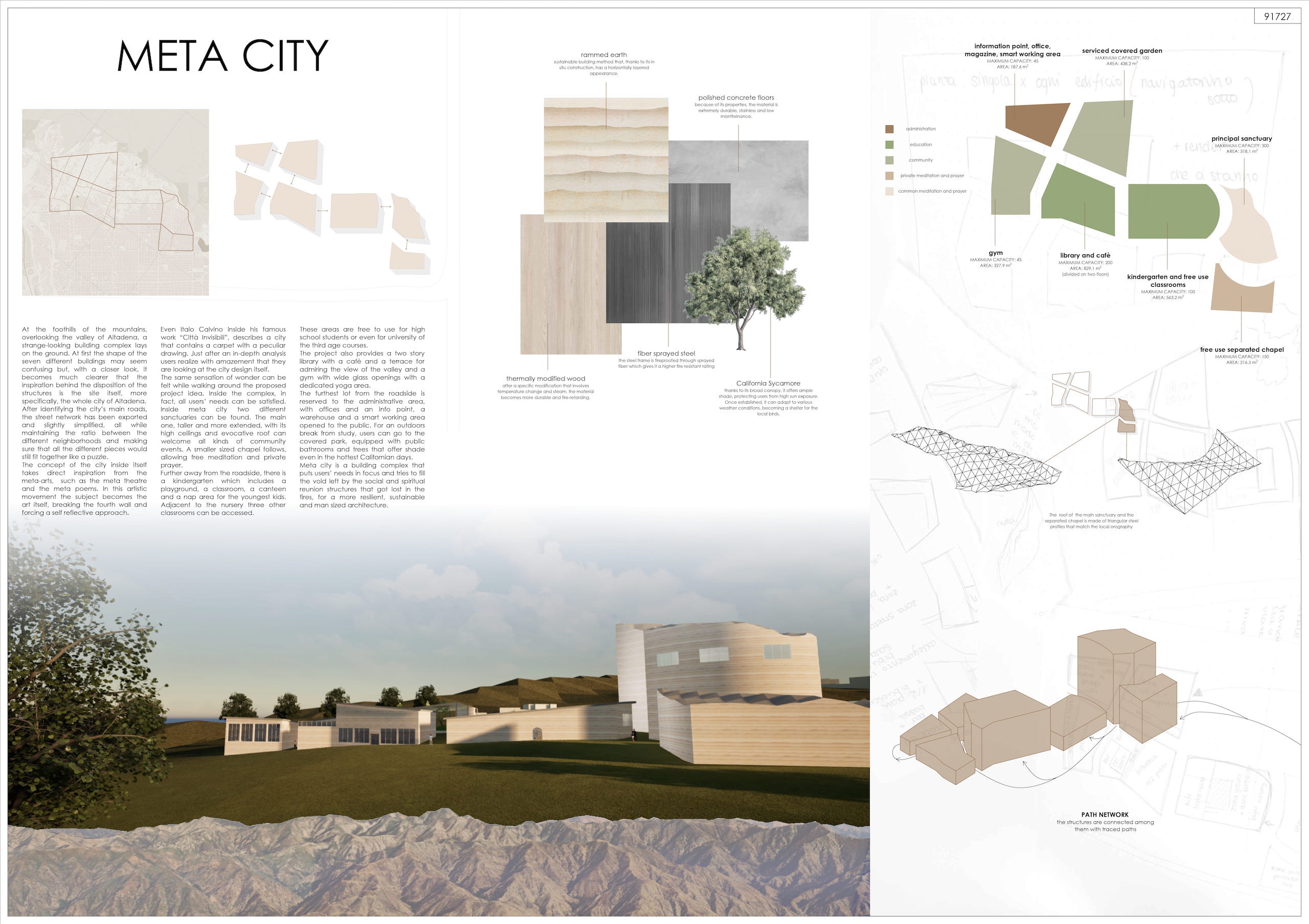
As in the meta-arts, such as the metatheatre which is often described as the theatre inside itself, the project of the “Meta City” takes a self reflecting approach towards architecture. The shape of the complex is in fact inspired from the building site, Altadena.
After the identification of the city’s main roads, the abstraction of the street network has been used to obtain the shape of every building, consolidating solidly the new construction to its location. Through this process an actual “city inside the city” is created, a concept that has already been explored by the Italian writer Italo Calvino in one of his major works, “Le città invisibili”.
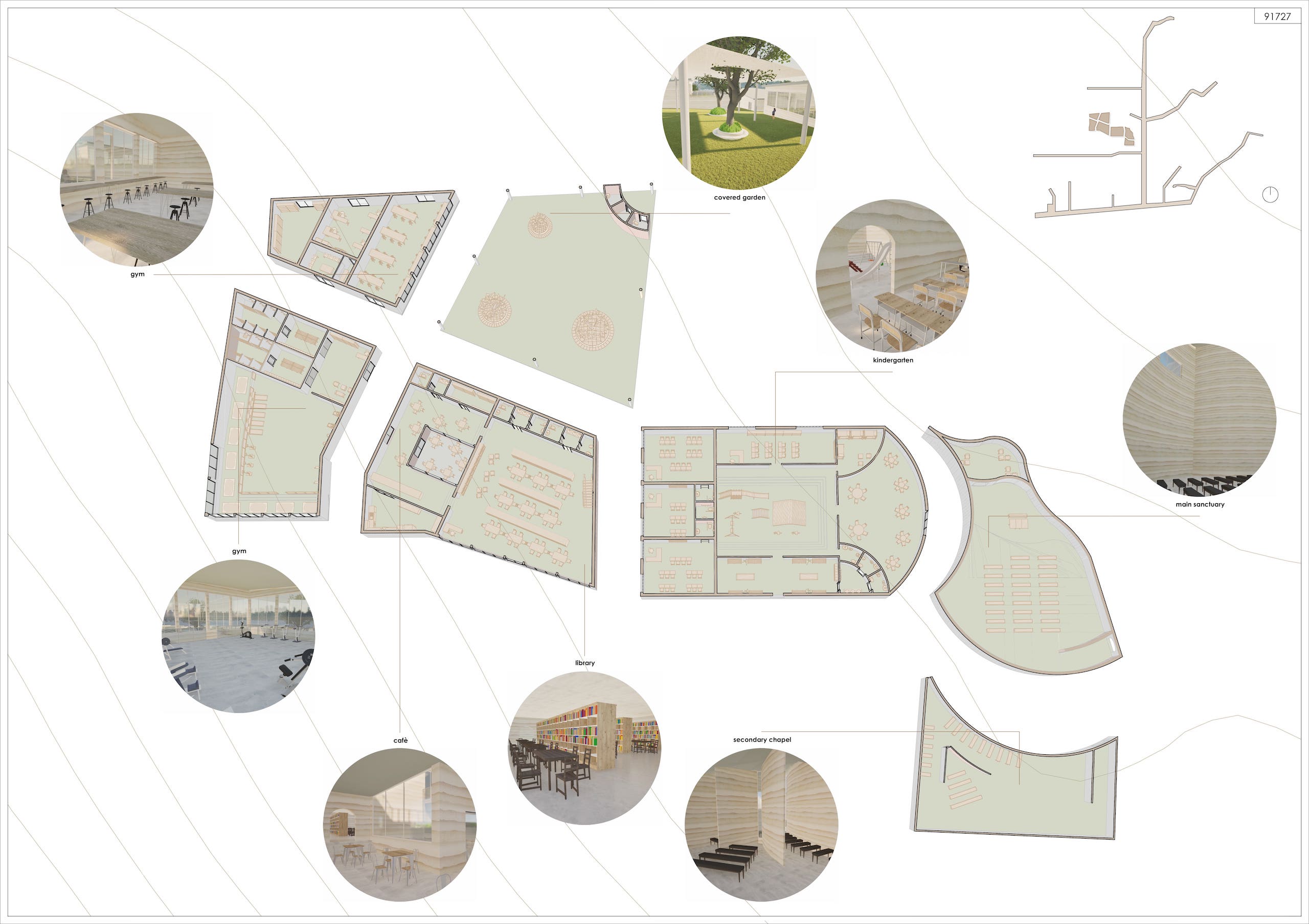
The district is composed of seven buildings, organized in different areas based on the function. The zone dedicated to worship, both private and communal, can be found in parallel with Chaney Trail, making it easily accessible for everyone. The two buildings melt into the landscape, thanks to their peculiar roofs, shaped as the surrounding mountains.
Through the perpendicular road, instead, the other buildings can be accessed by.
In this area a two story library with a cafè, a gym, a kindergarten and several classrooms are located. Finally, in the back of the site you can find administrative spaces and a covered serviced garden.
Meta city is designed to welcome people of every age and to embrace everyone’s needs, starting from a place to study or to read, to a place to meditate or relax, making architecture a prolonging of the community.
The materials used, through their eccentric texture, create a warm and inviting atmosphere. The walls are made of rammed earth, one of the most heat resistant building methods with ancient roots. This material is obtained from compacted local natural raw aggregates, cutting down the construction process costs and carbon emissions. Thanks to its exposed surface, made of clay and pores which allows the overall envelope to breathe more compared to conventional buildings, the humidity control of the interior spaces is more than effective.
Inclined roofs are fabricated in fiber sprayed steel, a fireproof class A metal.
Both of these materials are tied together by carved out windows, creating evocative light effects and offering from the buildings unique views of the valley, making the local territory even more a core part of the miniaturized city.
The aim of the project is not only to create new sacred structures, but to redefine the role of architecture as a tool to create not only shapes, but spaces thought for embracing a resilient community and all of its necessities in a place that feels like home, because it actually is.
Guthrie
Luke Guthrie [USA] – @_lukeguthrie
PROJECT DESCRIPTION
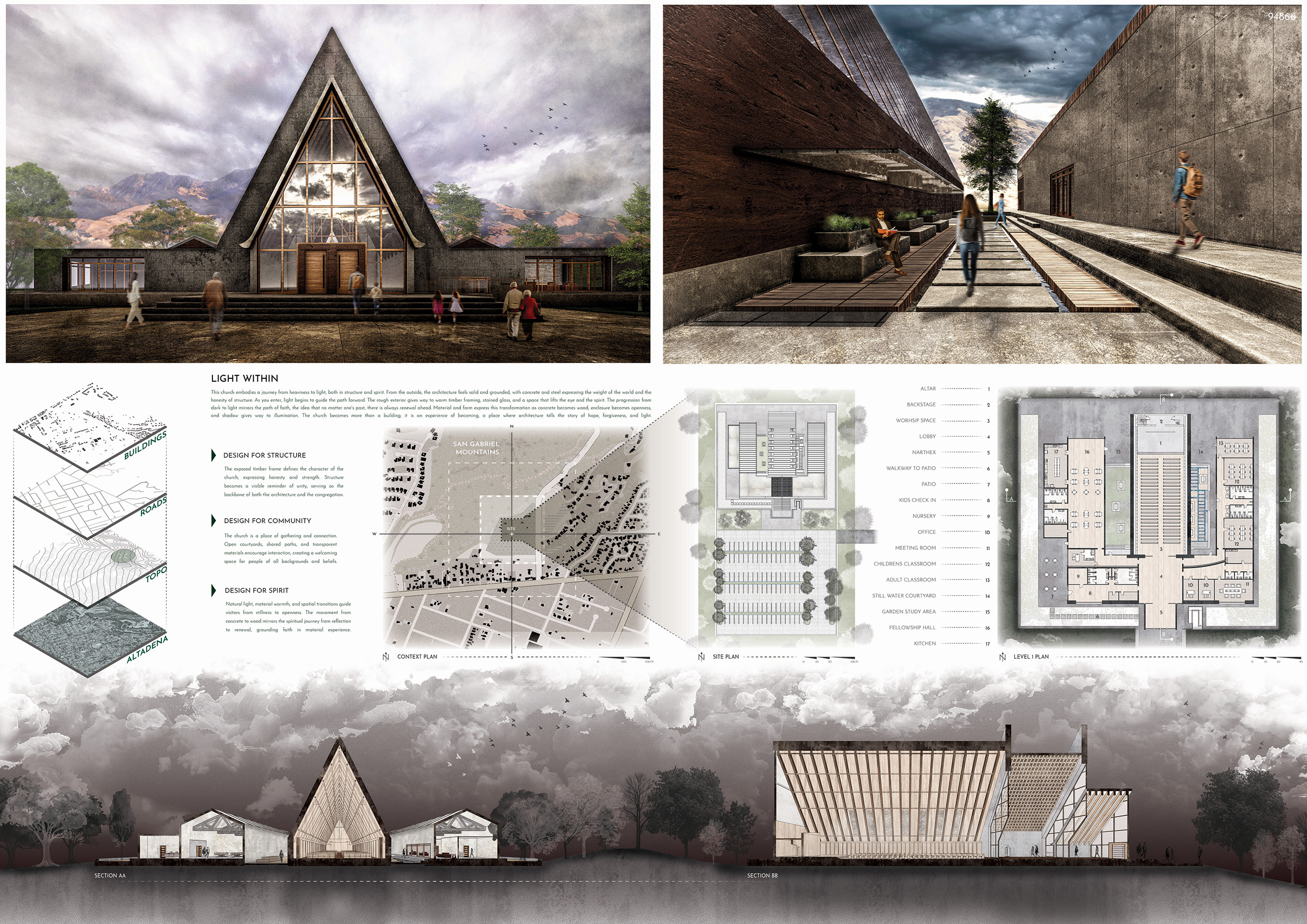
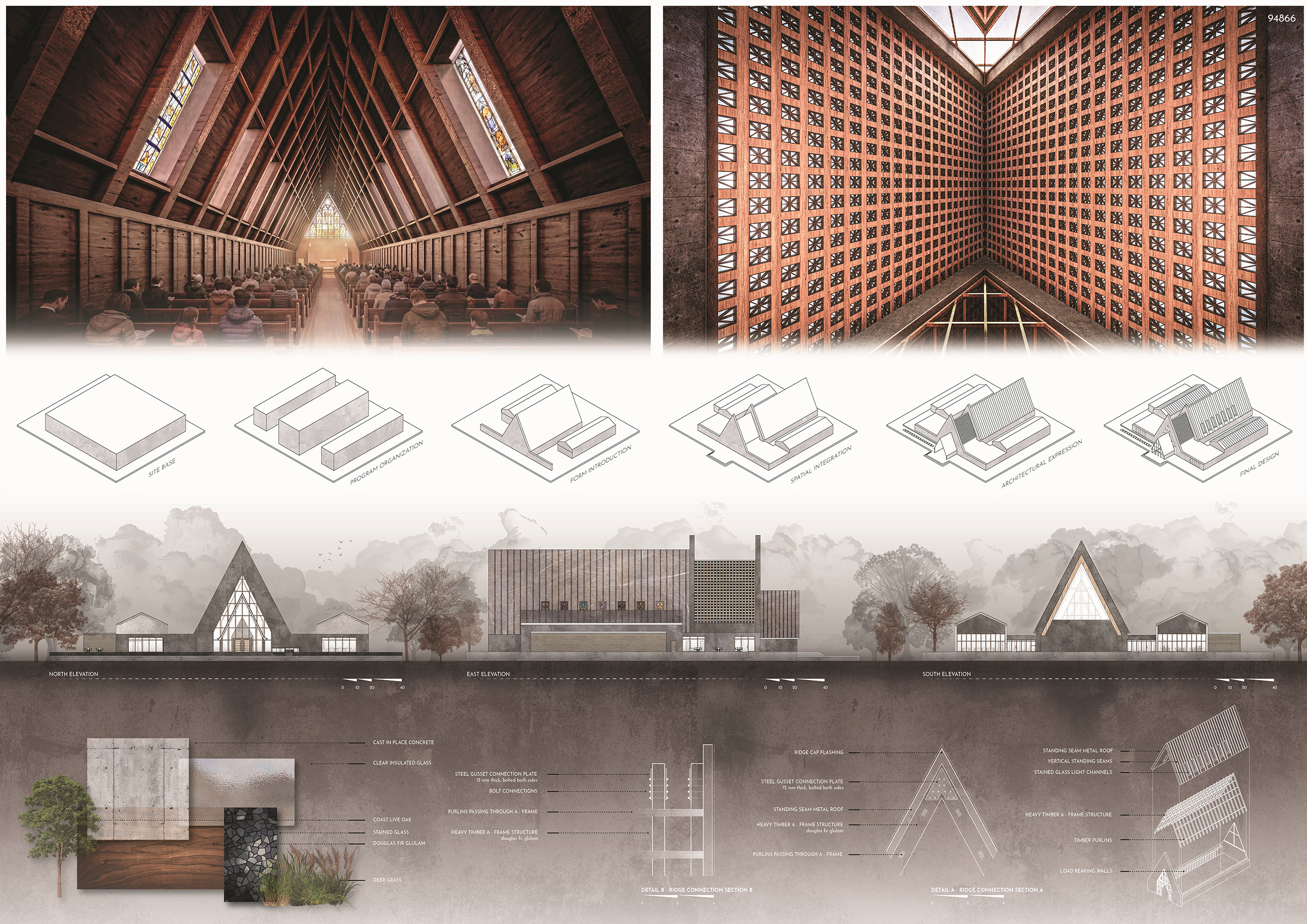
This church embodies a journey from heaviness to light, both in structure and spirit. From the outside, the architecture feels solid and grounded, with concrete and steel expressing the weight of the world and the honesty of structure. As you enter, light begins to guide the path forward. The rough exterior gives way to warm timber framing, stained glass, and a space that lifts the eye and the spirit. The progression from dark to light mirrors the path of faith, the idea that no matterone’s past, there is always renewal ahead. Material and form express this transformation as concrete becomes wood, enclosure becomes openness, and shadow gives way to illumination. The church becomes more than a building; it is an experience of becoming, a place where architecture tells the story of hope, forgiveness, and light.
Altadena Community Hub
Francesco Benfante [Italy] – architettobenfante.altervista.org
PROJECT DESCRIPTION
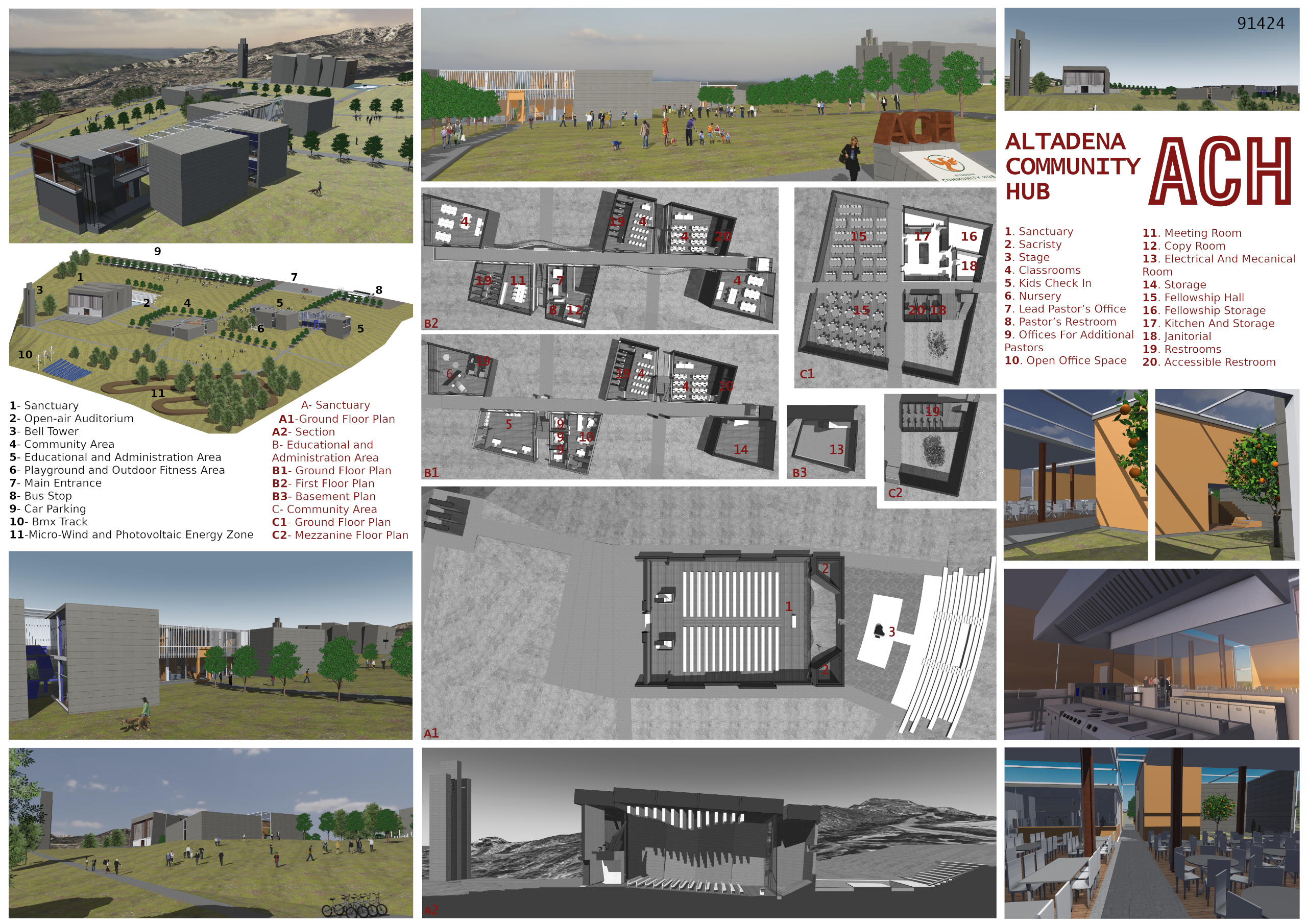
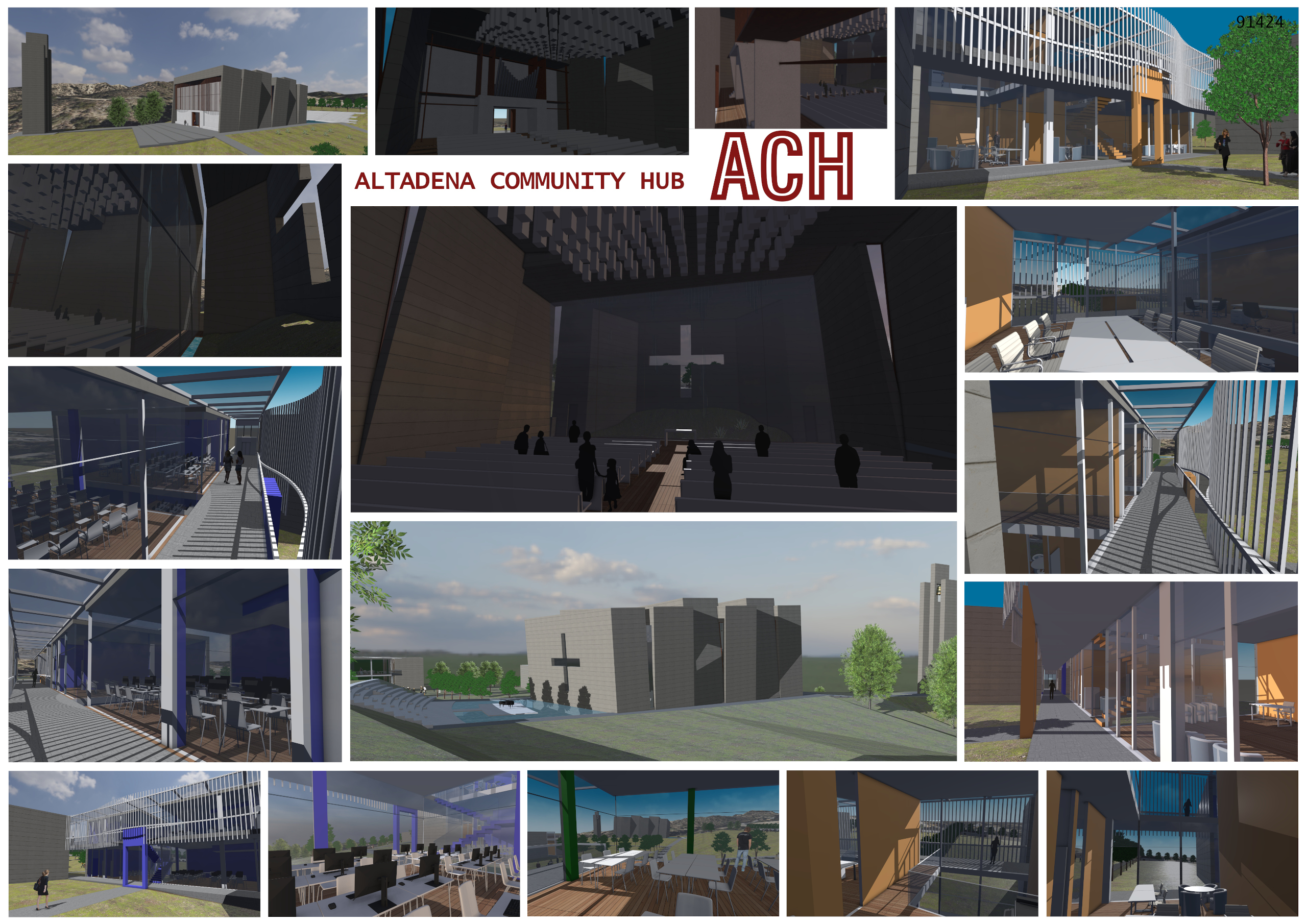
L’Altadena Community Hub nasce come risposta al bisogno della comunità di ritrovare uno spazio condiviso, in cui spiritualità, socialità e natura possano intrecciarsi in modo armonico. Il progetto favorisce inoltre lo sviluppo di un forte senso di appartenenza, offrendo luoghi capaci di accogliere identità diverse e di consolidare legami sociali attraverso rituali, attività, incontri quotidiani, tempo libero. Il sito, sospeso tra città e montagne, offre un punto panoramico unico che diventa matrice compositiva dell’intero progetto. La proposta interpreta il tema “Rising from Ashes” come occasione di rinascita sociale, culturale, architettonica e paesaggistica.
Il complesso si sviluppa prevalentemente secondo una direttrice nord-sud, articolandosi in una sequenza di percorsi pedonali, spazi verdi calpestabili e funzioni distribuite in corpi edilizi distinti. L’accesso principale, dalla viabilità est, accoglie i visitatori provenienti dal trasporto pubblico e dal parcheggio, guidandoli verso una rete di padiglioni diversificati per colori e volumi.
L’area amministrativa e gli spazi educativi si snodano lungo un sistema connettivo orizzontale e verticale che tiene insieme sei padiglioni destinati a didattica, uffici, servizi tecnici e depositi. Geometrie elementari chiuse che, decostruendosi, manifestano il loro interno accogliente e funzionale.
Geometrie analoghe, in un altro plesso, attraversate dalla rete dei percorsi pedonali, ospitano la grande cucina comunitaria e la sala polifunzionale affacciata su un giardino d’inverno.
Il Santuario con il teatro all’aperto e il campanile è posto nella parte più alta a Nord. Composto da geometrie elementari che in parte si adagiano ed in parte penetrano il terreno, geometrie disarticolate che infrangono la certezza di riferimenti orizzontali e verticali assoluti, evocando una condizione sospesa e meditativa: fenditure di luce definiscono lo spazio interno, orientato verso la zona del presbiterio, dove una parete di vetro divide l’aula dall’abside, questa è separata dal corpo principale da un taglio netto, come una frattura nella roccia lascia che l’acqua e la luce scorrano al suo interno.
I materiali — cemento faccia vista, intonaco di canapa, acciaio Corten, vetro — costruiscono un dialogo continuo tra luce-ombra ed esperienze visivo-tattili diverse; restituiscono inoltre la percezione di stabilita e durabilità.
Lungo i percorsi emergono aree ludiche, playground, zona fitness, spazi meditativi e una pista per BMX. Un’area appena fuori vista è utilizzata per la produzione di energia con sistema ibrido microeolico e fotovoltaico.